

Aircraft overview
The Agusta A109 is a light twin-engine helicopter with a four-bladed main rotor and retractable tricycle landing gear. The E-model cabin accommodates up to seven passengers with one pilot.
The A109E, marketed as the Power, received Italian approval on 31 May 1996. It introduced a revised cockpit with an Integrated Display System and FADEC-controlled engines. The PW206C-powered version is described in the specifications.
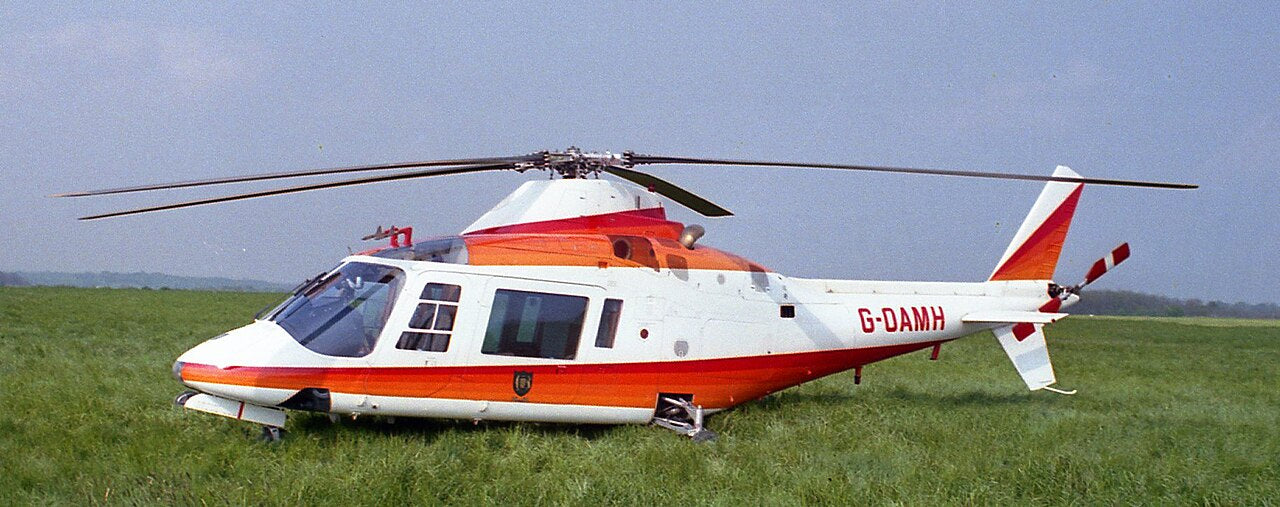
Photograph: Steve Knight · 19 May 1984 · Photo source: G-OAMH Agusta A-109A Biggin Air Fair 1984 (51875624225) · CC BY 2.0

At a glance
A109E Power · PW206C engines, wheeled landing gear
- Engines
- Two Pratt & Whitney Canada PW206C turboshaftsFADEC-controlled PW206C installation; the later Arrius-powered version is described below.
- Installed normal power
- 450 shp per engineAll-engines-operating take-off and maximum continuous rating.
- Main / tail rotor
- Four / two blades11.00 m / 2.00 m diameters.
- Fuselage length / width / height
- 11.45 m / 2.88 m / 3.50 mWheeled configuration.
- Maximum mass
- 2,850 kg3,000 kg requires the specified PW206C weight-increase kit.
- Cabin
- One pilot + up to seven passengersCrew and mission-equipment arrangements affect available seating.
- Usable fuel
- 595 litresBase installation; auxiliary tanks are separate.
In Air Defender
Role guidance · v0.8.16.0
Air Defender v0.8.16.0 lists the A109 as a light twin helicopter, with corporate transport, air-ambulance and law-enforcement examples. Its general label does not identify every aircraft’s equipment or occupants.
Compare the single-engine AS350 and the twin-engine AS355. Aircraft Data explains the game’s information display.
Game catalogue values · v0.8.16.0
In-game specifications
These figures come from the game’s general aircraft reference. A matching civilian register entry can supply different fields in Aircraft Data. How to read the two layouts →
- Role
- Light Twin Helicopter
- Category
- Light Helicopter
- Service ceiling
- 20,000 ftA reference upper height. Read Flight Info for the contact’s present height.
- Maximum speed
- 165 knotsA reference maximum, not the speed the aircraft is flying now.
- Cruise speed
- 143 knotsA typical speed for the main part of a flight, not a guaranteed commanded speed.
- Stall speed
- Not specified as a stall-speed valueA zero in the game catalogue means no usable stall-speed figure is supplied; it does not mean the rotor blades cannot stall. FAA helicopter handbook: rotor-blade stall →
- Typical crew
- 1
- Powerplant
- Twin turboshaft engines (Pratt & Whitney Canada PW206C) Compare engine types →
- Manufacturer
- Agusta/Leonardo (Italy)
Use the right procedure
In depth
The A109E development
The A109 family uses a four-bladed articulated main rotor. The E model developed from the A109K2 with new engine installations, electronic engine control and a revised cockpit display system.
The E received approval in May 1996, with the 2,850 kg weight increase approved in July 1997. The later 3,000 kg configuration requires a specific kit and PW206C engines.
Rotor, structure and undercarriage
The four composite main-rotor blades connect through an articulated head with elastomeric bearings. The two-bladed tail rotor uses a teetering arrangement.
The wheeled E has retractable tricycle landing gear. Its 11.45 m fuselage length and 3.50 m height are separate from the space occupied by the 11 m main rotor.
FADEC and power ratings
FADEC means full-authority digital engine control. Its computer monitors engine operation and adjusts the controls within the approved limits. The original A109E installation uses two PW206C engines; the alternative Arrius 2K1 installation has an approved flight manual dated 29 July 2003.
For the PW206C configuration, normal take-off and continuous power are 450 shaft horsepower per engine. The 640 shp emergency figure applies for 2½ minutes with one engine inoperative; it is not a normal two-engine rating.
Cabin and equipment
The maximum passenger arrangement is seven, with the minimum pilot seated on the right. Corporate, medical and utility fits use that space differently and alter empty weight and useful load.
An approved IFR equipment installation permits instrument flying with one or two pilots under the applicable manual. The cockpit’s Integrated Display System also supplies outside-air-temperature information from an external probe.
Fuel and loading
The basic usable-fuel capacity is 595 litres. Auxiliary fuel installations have their own quantities and loading conditions.
The 2,850 kg maximum applies to the reference configuration. The 3,000 kg increase is conditional on the specified modification; the number of available seats does not remove that loading restriction.
Variants
A109E Power
FADEC-equipped twin with an Integrated Display System.
A119
Single-engine A109E derivative with skid landing gear, approved on 30 December 1999.
A109S / AW109SP
Later family models approved in 2005 and 2009 respectively, with revised airframes, engines or cockpit equipment.
After 1998
1999–2009 · later family branches
The single-engine A119 was approved in December 1999. The Arrius 2K1-powered A109E has an approved flight manual dated July 2003. The A109S followed with approval in June 2005, and the AW109SP in May 2009. These are separate developments from the original PW206C-powered A109E.
2020 · New Zealand acceptance of the A109S Trekker configuration
New Zealand accepted the A109S Trekker configuration on 19 May 2020. It combines fixed skid landing gear, a Genesys avionics suite and an automatic flight-control system. This is a later A109S configuration, separate from the wheeled 1996 A109E.