

Aircraft overview
The Antonov An-124 Ruslan is a strategic transport built for very large loads. Its wide cargo hold, nose and rear doors, and adjustable landing gear allow equipment to be loaded through the aircraft. Four D-18T turbofan engines power the type.
The An-124 first flew on 24 December 1982. It began as a military transport and developed a major commercial role carrying outsized industrial cargo. The standard An-124-100 and later 150-tonne conversions share the Ruslan name but have different approved payload limits.
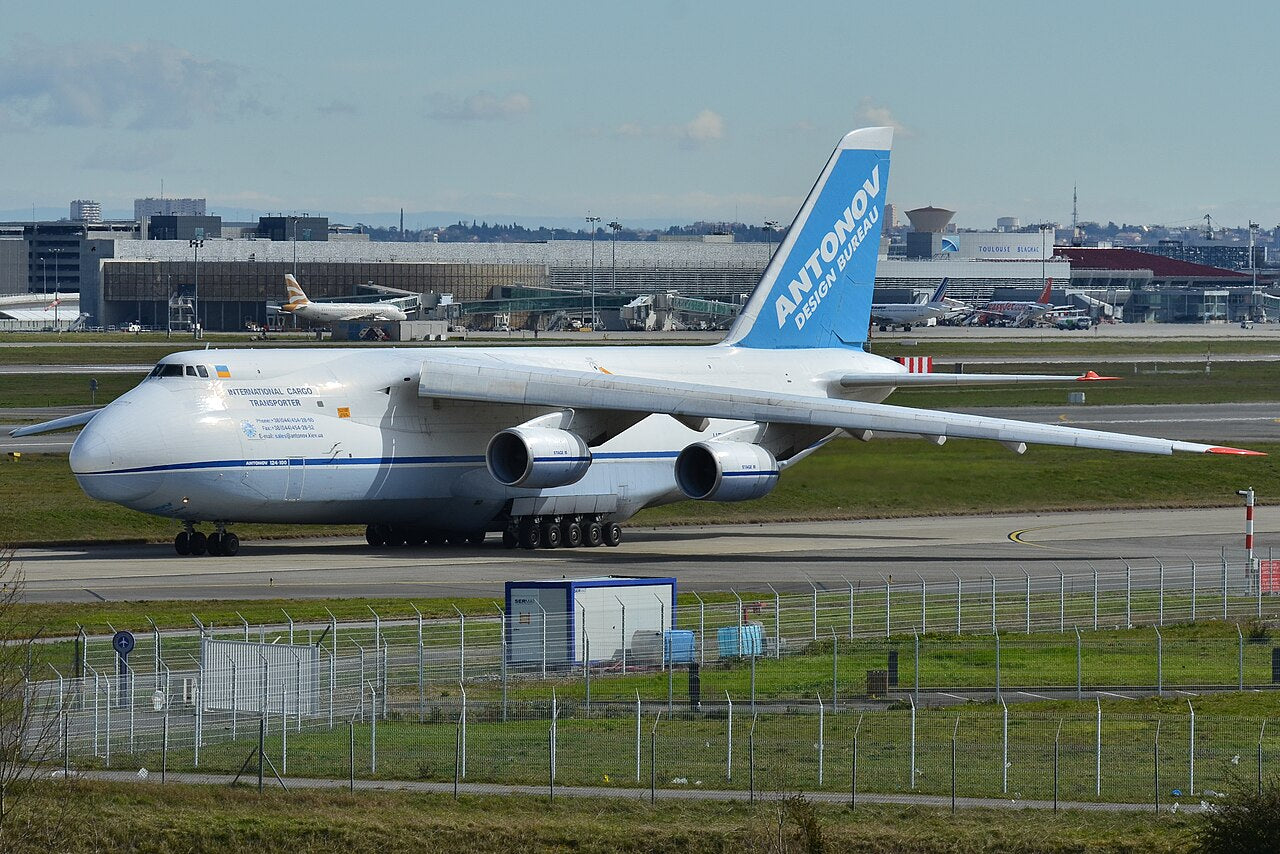
Photograph: Laurent ERRERA · 7 March 2013 · Photo source: Antonov Airlines Antonov An-124 UR-82029 (10299293483) · CC BY-SA 2.0

At a glance
An-124-100 commercial reference · standard 120-tonne version; later 150-tonne conversions are separate
- Role
- Heavy and outsized cargo transportMilitary airlift and commercial freight roles across the family.
- Engines
- Four D-18T turbofansAn-124-100 reference.
- Length / wingspan
- 69.10 m / 73.30 mAn-124 dimensions.
- Standard maximum payload
- 120 tonnesAn-124-100; not the later 150-tonne conversion.
- Cargo cabin
- 36.5 × 6.4 × 4.4 mLength, width and height excluding the extended ramp area.
- Cargo loading
- Nose and rear doors · kneeling landing gearThe landing gear adjusts the aircraft’s ground angle for loading.
In Air Defender
Role guidance · v0.8.16.0
Air Defender’s v0.8.16.0 catalogue lists the An-124 Ruslan as a strategic transport. The game’s performance figures are shown separately below.
Use Aircraft Data and Flight Info for the selected contact and the identification guide when investigating it. The catalogue describes the type; it does not establish that the player can launch or task it.
Game catalogue values · v0.8.16.0
In-game specifications
These figures come from the game’s general aircraft reference. A matching civilian register entry can supply different fields in Aircraft Data. How to read the two layouts →
- Role
- Strategic Transport
- Category
- Military Transport
- Service ceiling
- 35,000 ftA reference upper height. Read Flight Info for the contact’s present height.
- Maximum speed
- 460 knotsA reference maximum, not the speed the aircraft is flying now.
- Cruise speed
- 432 knotsA typical speed for the main part of a flight, not a guaranteed commanded speed.
- Stall speed
- 130 knotsA reference for specified conditions. Stalling means the wing loses lift, not that an engine stops.
- Typical crew
- 6
- Powerplant
- Four turbofan engines (Progress D-18T) Compare engine types →
- Manufacturer
- Antonov (Ukraine/Russia)
Use the right procedure
In depth
Development for strategic airlift
The Soviet requirement behind the Ruslan called for a major increase in military airlift capacity. Design studies examined many configurations before development settled on the An-124. Its first flight in December 1982 was followed by production at Kyiv and Ulyanovsk.
The wing uses a supercritical cross-section, or aerofoil, combining a relatively thick structural section with low aerodynamic drag. Drag is the resistance of the air to the aircraft’s movement. Deep structure is important when carrying heavy loads; large structural panels and new materials formed part of the development programme.
Airframe, decks and engines
The double-deck fuselage separates the flight crew and accompanying personnel from the main cargo space. The decks have separate pressurisation arrangements. Four D-18T turbofan engines are carried beneath the wings.
Two cargo doors allow a through-loading route for vehicles. The kneeling landing gear changes the aircraft’s angle on the ground to assist loading through the nose. These features are part of the aircraft’s cargo-handling design, rather than equipment borrowed from a passenger airliner.
Cargo space and loading equipment
The An-124-100 cabin measures 36.5 m long, 6.4 m wide and 4.4 m high, with a published cargo volume of 1,040 m³. The upper deck contains flight-crew and cargo-attendant accommodation.
Overhead cranes provide up to 30 tonnes of combined lifting capacity. Heavier pieces require a different loading arrangement. Cargo mass, dimensions and the loading method all matter; a load that fits through the door is not automatically within every limit.
From military transport to commercial freight
A Ruslan commercial air-transport division was established within Antonov in 1989. Construction of the first production An-124-100 was completed in December 1990. The commercial type brought very large cargo movements into airline operations.
The An-124-100 also became useful to military customers using chartered airlift. Under the SALIS arrangement described in 2011, participating nations secured access to commercial An-124-100 aircraft instead of each owning a fleet of these heavy transports.
Variants
An-124 Ruslan
The original military strategic transport, first flown in 1982.
An-124-100
Commercial cargo version with a standard maximum payload of 120 tonnes.
An-124-100M-150
Modernised version with a 150-tonne maximum payload, strengthened loading structure and other equipment changes.
After 1998
By 2011 · higher-payload upgrades
By 2011, a modernised 150-tonne variant had been developed, with changes including strengthened cargo-handling structure. The standard An-124-100 has a 120-tonne maximum payload.