

Aircraft overview
The AS355 Twin Squirrel is a light twin-engine utility helicopter. It has a three-bladed main rotor, a two-bladed tail rotor and skid landing gear, with power supplied by two turboshaft engines.
The F2 was approved on 10 December 1985 and uses two Rolls-Royce/Allison 250-C20F turboshafts. The later N and NP models use Arrius engines and have different approved configurations.
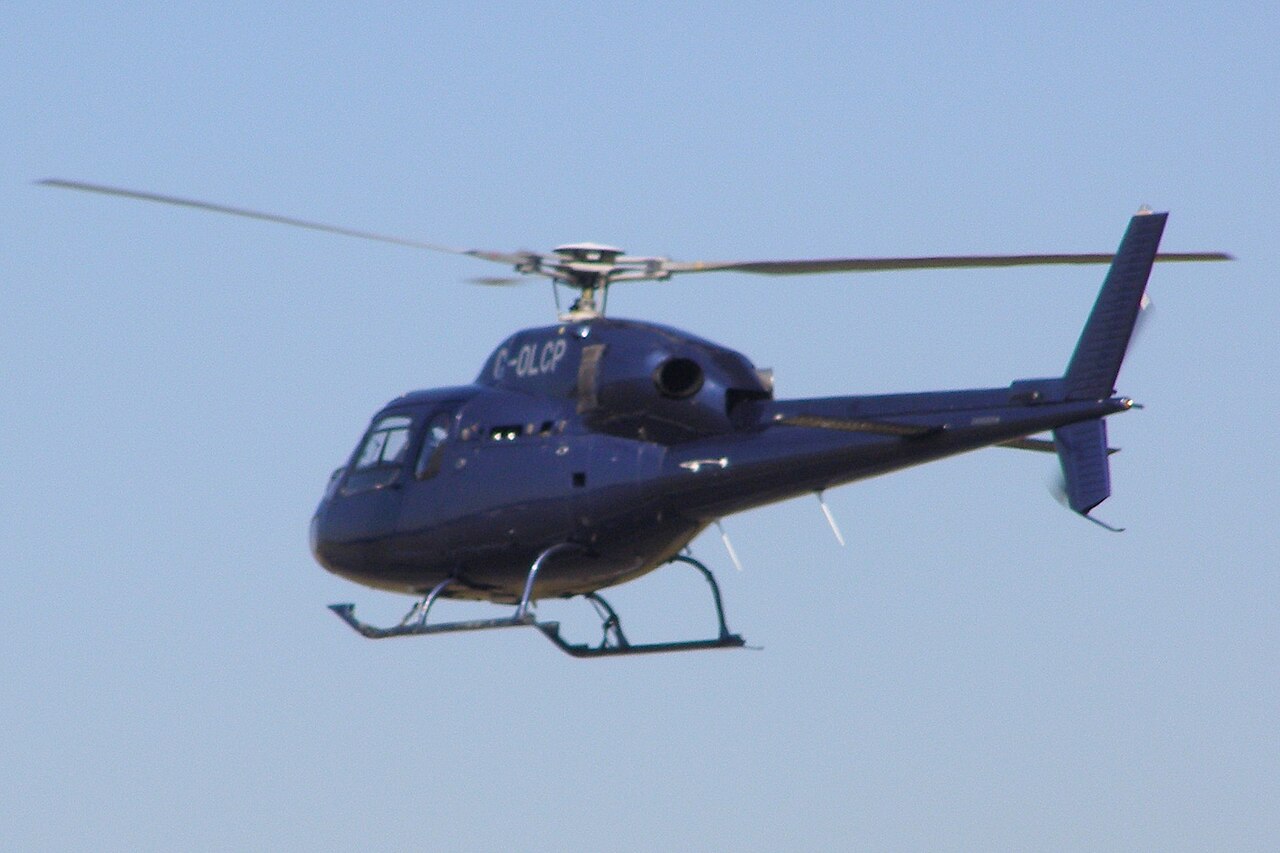
Photo: MilborneOne · 18 July 2006 · Photo source: AS355N-GOLCP · CC BY-SA 3.0 · Uncropped; resized by Wikimedia Commons.

At a glance
AS355 F2 ·250-C20F installation; separate from F1, N and NP
- Engines
- Two 250-C20F turboshaftsRolls-Royce/Allison installation.
- Main /tail rotor
- Three /two blades10.69 m /1.86 m diameters.
- Fuselage length /width
- 10.93 m /1.87 mBody dimensions.
- Maximum mass
- 2,540 kgF2 limit; N/NP differ.
- Cabin
- One pilot + up to five passengersSix passengers with the approved optional two-place seat.
- Fuel ·total /usable
- 736.7 /736.0 litresF2 installation.
In Air Defender
Role guidance · v0.8.16.0
Air Defender v0.8.16.0 has no dedicated AS355 entry in its general aircraft-reference catalogue.
Compare the single-engine AS350 and the Bell 407. Aircraft Data explains the game’s aircraft-information display.
Game catalogue values · v0.8.16.0
Read the selected flight
The game names the aircraft family, without a variant suffix. Read Flight Info for this contact’s reported type, height and speed. The real-aircraft specifications describe the named variant; they are not the current state of your selected flight.
In depth
Airframe and rotor layout
The F2 has a metal-sheet monocoque fuselage and skid landing gear. Three main-rotor blades span 10.69 m, while the two-bladed tail rotor spans 1.86 m.
Its 10.93 m body length and 1.87 m body width describe the fuselage, separately from the rotating blades. The engine installation and associated loading limits distinguish it from the single-engine AS350.
Twin 250-C20F engines
Two 250-C20F turboshafts power the F2. The engine and transmission limits distinguish all-engines-operating conditions from the case in which one engine is inoperative.
Two installed engines do not establish one universal engine-out performance figure. The approved equipment, operating category, weight and flight-manual conditions remain part of that capability.
Cabin and baggage
One pilot in the right seat is the minimum crew. The cabin permits up to five passengers, or six with the approved optional two-place seat and its operating supplement.
The right, left and rear holds have separate load limits. Cabin-floor limits also differ between the forward and rear areas; a passenger count alone does not determine how much baggage can be loaded.
Fuel and total loading
The F2 tank installation holds 736.7 litres in total, of which 736.0 are usable. The maximum aircraft mass is 2,540 kg.
The N and NP retain a related cabin layout but have different engines and loading approvals. Their higher weight limits should not be substituted for the F2’s limit.
From F2 to N
The F2’s original approval dates to December 1985. The N followed with approval on 13 June 1989 and two Arrius 1A engines.
The NP is a later development with Arrius 1A1 engines. These model letters identify real installation differences within the family, rather than a single specification shared by all Twin Squirrels.
Variants
AS355 F2
250-C20F-powered configuration; 2,540 kg maximum mass.
AS355 N
Arrius 1A-powered development approved in 1989.
AS355 NP
Later Arrius 1A1-powered development approved in 2007.
After 1998
2007 · AS355 NP
The NP received EASA approval on 15 February 2007. The NP has Arrius 1A1 engines and its own operating limits. Its 2007 approval places it after the game’s 1998 setting.