

Aircraft overview
The Hawk T1 is a single-engine, two-seat jet trainer with two cockpits, one behind the other. It prepares pilots for faster and more demanding operational aircraft, while its aerobatic handling also makes it suitable for formation display. The Red Arrows adopted the Hawk for the 1980 display season.
The T1 flying trainer and T1A weapons-training version have different roles. A Hawk family name alone does not establish that an aircraft is armed. Training, display and operational-support flights also place different demands on the same basic airframe.
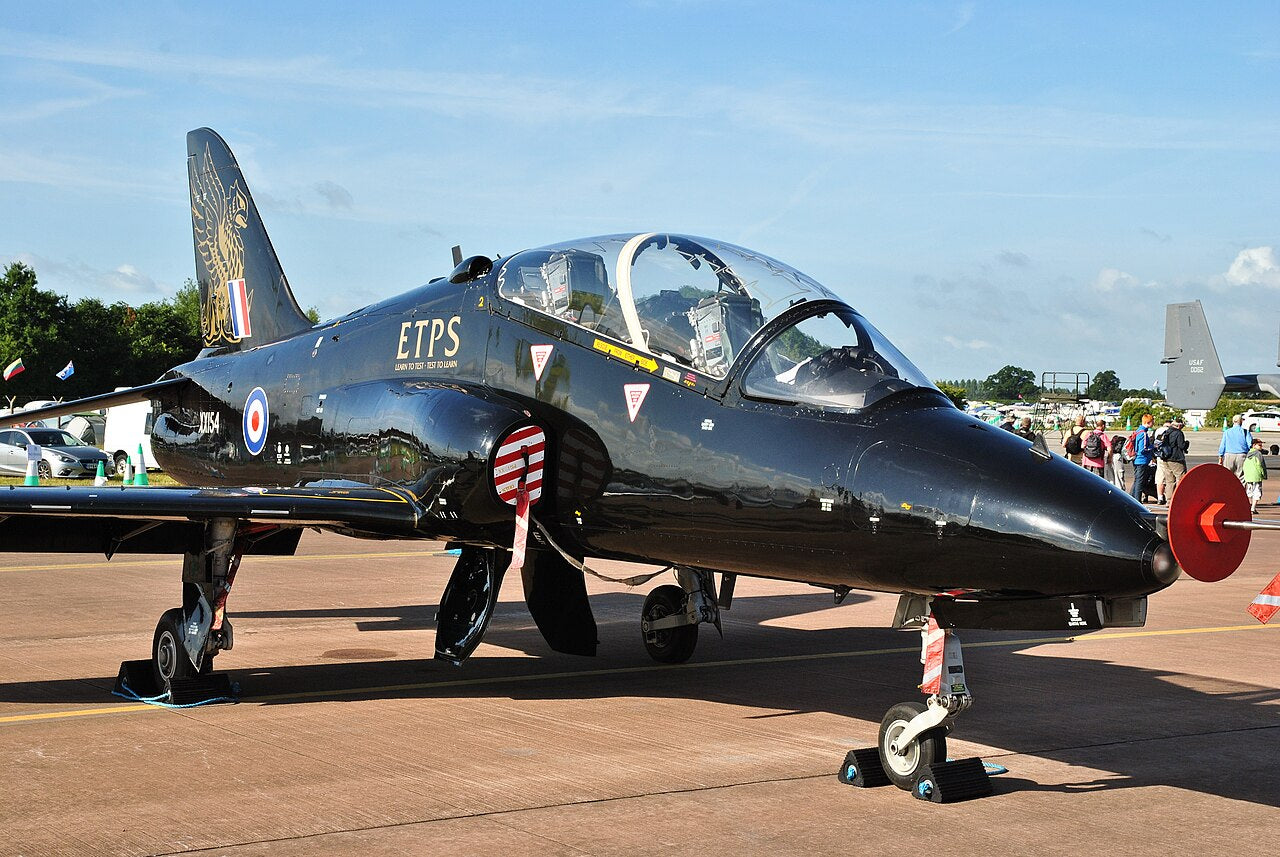
Photograph: John5199 · 18 July 2015 · Photo source: Hawk T1 - ETPS - Royal International Air Tattoo 2015 (19924781796) · CC BY 2.0

At a glance
Hawk T1/T1A · 2003 technical specification; weapons identified separately for T1A
- Role
- Advanced jet training; T1A weapons and tactical trainingWeapons and tactical training equipment apply to the T1A.
- Cockpits
- Two · one behind the otherStudent and instructor positions in the trainer.
- Engine
- One Rolls-Royce/Turbomeca Adour Mk 151 turbofanAn un-reheated engine; separate from the afterburning Adour variants used by Jaguars.
- Length / wingspan / height
- About 12 m / 9.4 m / 4 mRounded T1/T1A airframe dimensions.
- T1A weapon provision
- Two underwing pylons; optional 30 mm ADEN gun podThe T1A pylons are cleared for AIM-9L Sidewinder missiles or BL755 stores; the load depends on the mission.
- RAF service began
- 1976Advanced flying training and weapons training.
In Air Defender
Role guidance · v0.8.16.0
Air Defender’s v0.8.16.0 Hawk T1A can fly air combat training sorties and transfer between bases. Below Critical tension, combat tasking is refused. At Critical tension it can take point-defence tasks, including CAP. It has no air-intercept radar in the game.
The standard allocation places Hawks at Valley, Leeming and Cranwell. Their Hawk callsign pools are separate from other types based at the same airfield. Check the actual aircraft, fuel and task in ACTIVE OPS before issuing an order.
The historical specifications describe the real aircraft. The separate game table gives the simulation’s catalogue values. A trainer’s speed or appearance alone does not establish a track’s identity; use the identification checks.
Game catalogue values · v0.8.16.0
In-game specifications
These figures come from the game’s general aircraft reference. A matching civilian register entry can supply different fields in Aircraft Data. How to read the two layouts →
- Role
- Advanced Trainer / Point Defence
- Category
- Military Trainer
- Service ceiling
- 48,000 ftA reference upper height. Read Flight Info for the contact’s present height.
- Maximum speed
- 540 knotsA reference maximum, not the speed the aircraft is flying now.
- Cruise speed
- 420 knotsA typical speed for the main part of a flight, not a guaranteed commanded speed.
- Stall speed
- 95 knotsA reference for specified conditions. Stalling means the wing loses lift, not that an engine stops.
- Typical crew
- 2
- Powerplant
- Single turbofan engine (Rolls-Royce Adour) Compare engine types →
- Manufacturer
- BAE Systems (UK)
Use the right procedure
Related base entries
Compare these base entries with the aircraft actually available in your scenario.
In depth
An advanced trainer with a long service history
Hawker Siddeley developed the dual-control Hawk as an advanced training aircraft. The RAF first used it in 1976. The training system employed the type for flying instruction, weapons practice, tactical techniques and preparation for operational conversion.
The Red Arrows replaced their Folland Gnats with Hawks for the 1980 season. Their aircraft received smoke-generation equipment, while the basic two-seat layout allowed a second person to be carried on some transit flights. The number of cockpits does not prove that both are occupied.
Airframe and propulsion
The Hawk has an all-metal low-wing airframe, a moderately swept wing with slotted flaps, and an all-moving tailplane. The forward fuselage contains equipment bays and two pressurised tandem cockpits. The engine and a fuselage fuel tank occupy the centre section, with the jet pipe and an underslung airbrake aft.
Its Adour Mk 151 is an un-reheated turbofan. Besides propulsion, the engine drives equipment including the generator and hydraulic pumps. A ram air turbine provides emergency hydraulic power if the two normal hydraulic systems fail.
Flying training and weapons training
The T1 is the advanced flying trainer. The T1A adds equipment for weapons and tactical training, including air combat, air-to-air firing, air-to-ground firing and low-flying techniques.
The T1A has two underwing pylons cleared for Sidewinder missiles or BL755 cluster bombs, and can carry an ADEN cannon in a centreline pod. Its strike and interception sighting system and video recorder support aiming and debriefing. The weapons carried depend on the sortie.
Understanding trainer performance
The Hawk is fully aerobatic and operates in the transonic flight regime. A maximum reached in a dive is different from a sustained level-flight speed. That distinction matters when comparing a trainer with an interceptor or interpreting a short-lived speed observation.
Likewise, aircraft range and maximum altitude are reference limits with operating conditions. They do not describe the height, fuel remaining or purpose of the flight being observed. In Air Defender, those questions belong to the current track information and the identification process.
Variants
Hawk T1
The advanced flying trainer, with a tandem cockpit and non-afterburning Adour engine.
Hawk T1A
The weapons- and tactical-training standard, equipped for underwing stores and an optional centreline cannon pod. Its cleared armament is not universal to every T1.
Red Arrows Hawk
A T1 display configuration with smoke-generation modifications. The team adopted the Hawk for its 1980 season.
After 1998
31 March 2022 · No 100 Squadron withdrawal
No 100 Squadron withdrew its Hawk T1s on 31 March 2022. The Red Arrows continued flying the type after that date.