

Aircraft overview
The Nimrod R1 was the Royal Air Force’s specialist signals-intelligence aircraft. Its receivers and aerials collected electronic emissions for analysis, rather than carrying out the maritime patrol and anti-submarine mission of the Nimrod MR2. The aircraft served with No. 51 Squadron.
The most obvious recognition difference is at the tail: the R1 has no long magnetic anomaly detector boom. Additional aerials appear above and below the fuselage. Four flight crew operated the aircraft, with room for up to 25 mission-equipment operators. The maritime version is covered in the Nimrod MR2 reference.
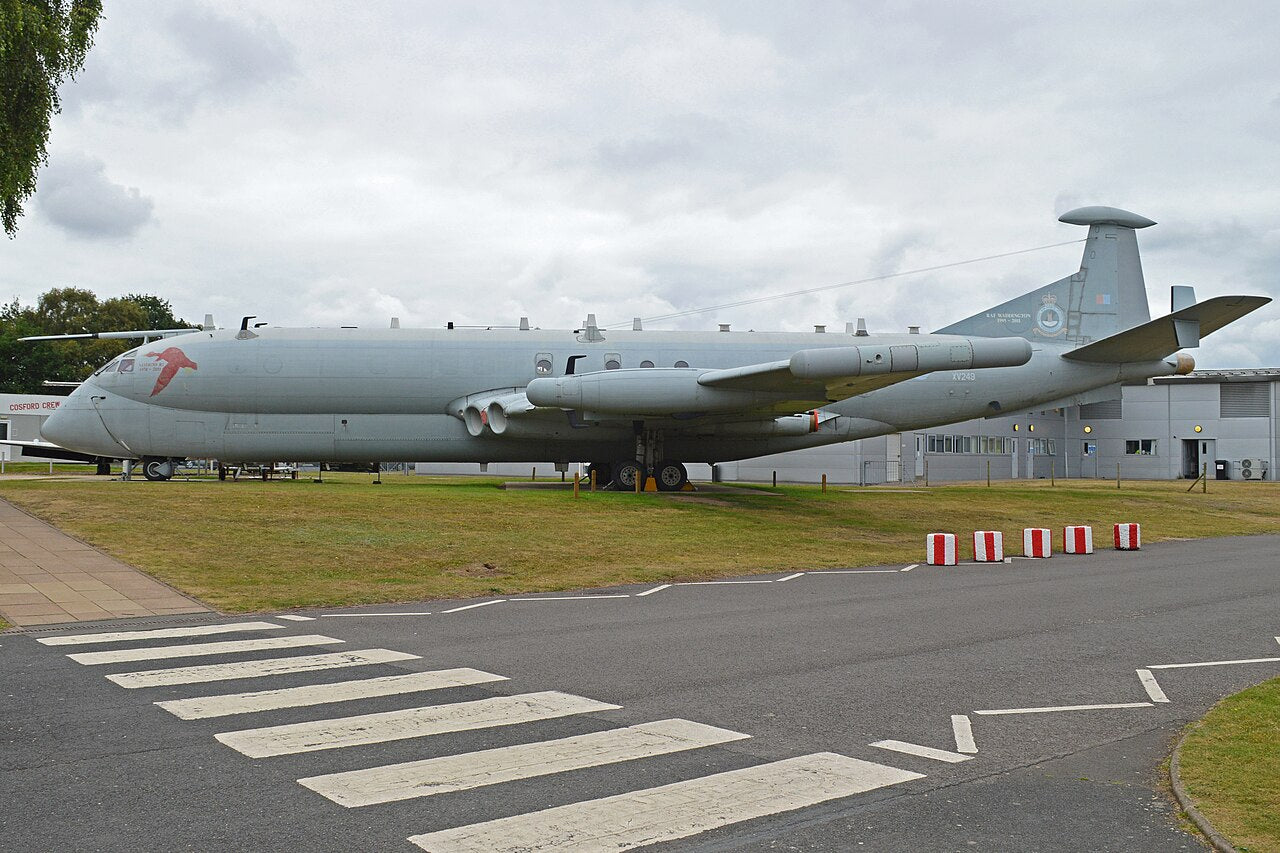
Photograph: Alan Wilson · 14 August 2016 · Photo source: Hawker Siddeley Nimrod R.1 ‘XV249’ (36531009942) · CC BY-SA 2.0

At a glance
Nimrod R1 · dimensions published in 2003
- Role
- Signals intelligence: electronic intelligence collection and reconnaissanceElectronic intelligence and reconnaissance; distinct from the maritime MR2 mission.
- Flight crew
- 4 · two pilots, flight engineer, navigatorThe flight crew operated and navigated the aircraft; mission-equipment personnel were carried separately.
- Mission crew
- Up to 25 · up to 29 people in totalUpper limits for the mission-equipment operators; actual crews vary with the task.
- Engines
- Four Rolls-Royce Spey turbofansInstalled in pairs at the wing roots; more than 12,000 lbf thrust per engine in the 2003 R1 description.
- Length
- 117 ft 8 in (35.9 m)R1 dimension published in 2003; separate from maritime-variant specifications.
- Wingspan
- 115 ft (35.1 m)R1 dimension published in 2003.
- Fleet
- Three-aircraft force, restored in December 1996MR2 XV249 was converted to replace R1 XW666 after its loss in 1995.
- First delivery
- July 1971 · RAF WytonThe R1 replaced the RAF’s Comet R2 electronic-intelligence aircraft.
- Operator and base
- No. 51 Squadron, RAF WaddingtonNo. 51 Squadron moved from Wyton to Waddington on 1 April 1995.
- Endurance
- Long loiter, extendable by air-to-air refuellingAir-to-air refuelling can extend time on task.
- Flight profile
- High levelUnlike the low-level maritime patrol work of the MR2.
In Air Defender
Role guidance · v0.8.16.0
Air Defender’s catalogue lists the Nimrod R1 for signals intelligence and electronic intelligence, separately from the maritime-patrol Nimrod MR2. Its game catalogue figures appear below, separately from the real-aircraft reference.
Use the Nimrod R1 tasking guide for the game’s listening-support aircraft, and EW bearings and diamonds for its reports. A bearing gives a direction to an emission. For airborne radar coverage, use the E-3D guide and the comparison of Nimrod R1 and AWACS.
Game catalogue values · v0.8.16.0
In-game specifications
These figures come from the game’s general aircraft reference. A matching civilian register entry can supply different fields in Aircraft Data. How to read the two layouts →
- Role
- Signals Intelligence / ELINT
- Category
- Military Patrol
- Service ceiling
- 42,000 ftA reference upper height. Read Flight Info for the contact’s present height.
- Maximum speed
- 500 knotsA reference maximum, not the speed the aircraft is flying now.
- Cruise speed
- 440 knotsA typical speed for the main part of a flight, not a guaranteed commanded speed.
- Stall speed
- 130 knotsA reference for specified conditions. Stalling means the wing loses lift, not that an engine stops.
- Typical crew
- 25
- Powerplant
- Four turbofan engines (Rolls-Royce Spey) Compare engine types →
- Manufacturer
- BAE Systems (UK)
Use the right procedure
Related base entries
Compare these base entries with the aircraft actually available in your scenario.
In depth
Development and the original aircraft
Three additional Nimrod airframes were ordered to replace the RAF’s ageing Comet R2 electronic-intelligence aircraft. They were built at Woodford alongside the maritime aircraft, with the first delivered to RAF Wyton in July 1971. Their designation was Reconnaissance Mk 1, shortened to R1.
The R1’s electronic-intelligence equipment and aerials gave it a different purpose from the maritime Nimrod. It contributed to the Falklands conflict in 1982. The aircraft’s role was to gather information from electronic emissions, rather than search for submarines with the MR2’s combination of radar, sonobuoys and magnetic detection.
Airframe, engines and recognition
The Comet-derived airframe has a swept wing and four Spey turbofans installed in pairs at the wing roots. The R1 has no magnetic anomaly detector boom at the tail. Its additional upper and lower aerials include a different collection-system installation from the maritime version.
The R1 dimensions published in 2003 are 117 ft 8 in long, approximately 35.9 m, with a span of 115 ft, approximately 35.1 m. Each engine is rated at more than 12,000 lbf of thrust. These figures apply to the R1 rather than the maritime version.
Long loiter time and air-to-air refuelling help the aircraft remain on task. R1 flying generally took place at high altitude, in contrast to the maritime Nimrod’s frequent low-level work over the sea. A role does not prescribe one fixed height or speed for every flight.
Signals collection and the crew
Electronic-support equipment detects and analyses electromagnetic emissions. Direction-finding helps establish where an emission comes from; its characteristics can help specialists recognise the source. Collection and analysis provide a different kind of information from an air-surveillance radar picture.
The R1 flight crew comprised two pilots, a flight engineer and a navigator. Up to 25 people operated its mission equipment, allowing a total complement of up to 29. A mission supervisor was also included in the 2003 crew arrangement. Crew numbers describe capacity and organisation, rather than a fixed headcount on every sortie.
The collection equipment changed during the aircraft’s career. The automated system tested under Project Extract in 2003 was a later development, not the equipment standard to assume for a 1998 aircraft.
The fleet and its bases
No. 51 Squadron moved from RAF Wyton to RAF Waddington on 1 April 1995 with the Nimrod R1. In 1995, XW666 was lost following an engine fire. A maritime Nimrod, XV249, was converted to replace it and delivered in December 1996, restoring the three-aircraft force.
This replacement explains why an MR2 airframe appears in the R1’s history. Conversion changed its mission and equipment; it did not make the operational R1 interchangeable with the maritime MR2. The common Nimrod name covers aircraft with substantially different jobs.
Variants
Nimrod R1
The signals-intelligence version: three original aircraft and a later conversion of MR2 XV249 to replace XW666 after its loss.
Nimrod MR1 and MR2
The maritime patrol and anti-submarine branch, with the tail magnetic anomaly detector boom. Different sensors, crew and mission; see the MR2 profile.
Nimrod AEW3
The airborne early-warning conversion had radar housings at the nose and tail. It reached crew-training trials but was cancelled in December 1986 before operational service. Its mission was different from the R1’s.
After 1998
2003 · new collection system
An R1 visited the US Navy’s Patuxent River test centre in April and May 2003 to test Project Extract, an automated electronic-warfare collection system intended to replace older manually operated equipment. It flew six missions and returned to Waddington on 4 May.
2011 · retirement
R1 XV249 took part in Operation Ellamy over Libya in 2011 before leaving squadron service on 28 June. The type’s final flight also took place on 28 June 2011.
References and further reading
R1 origins, fleet, 1995 loss and 1996 conversion
Crew, aerials and recognition features
- BAE Systems · Hawker Siddeley Nimrod: variants, crew and equipment
- NAVAIR · Nimrod R1 visit report, 6 May 2003