

Aircraft overview
The Beechcraft Bonanza is a family of all-metal, low-wing light aircraft developed for personal and business flying. Retractable landing gear and a six-cylinder piston engine distinguish it from simpler fixed-gear trainers. The V-tail Model 35 line is its best-known early form, but other Bonanzas have conventional tails.
Introduced in 1947, the family developed through successive changes to its engines, cabin and structure. The V35B was the final production V-tail version, approved on 24 October 1969 and phased out in 1982. The specifications below describe the V35B.
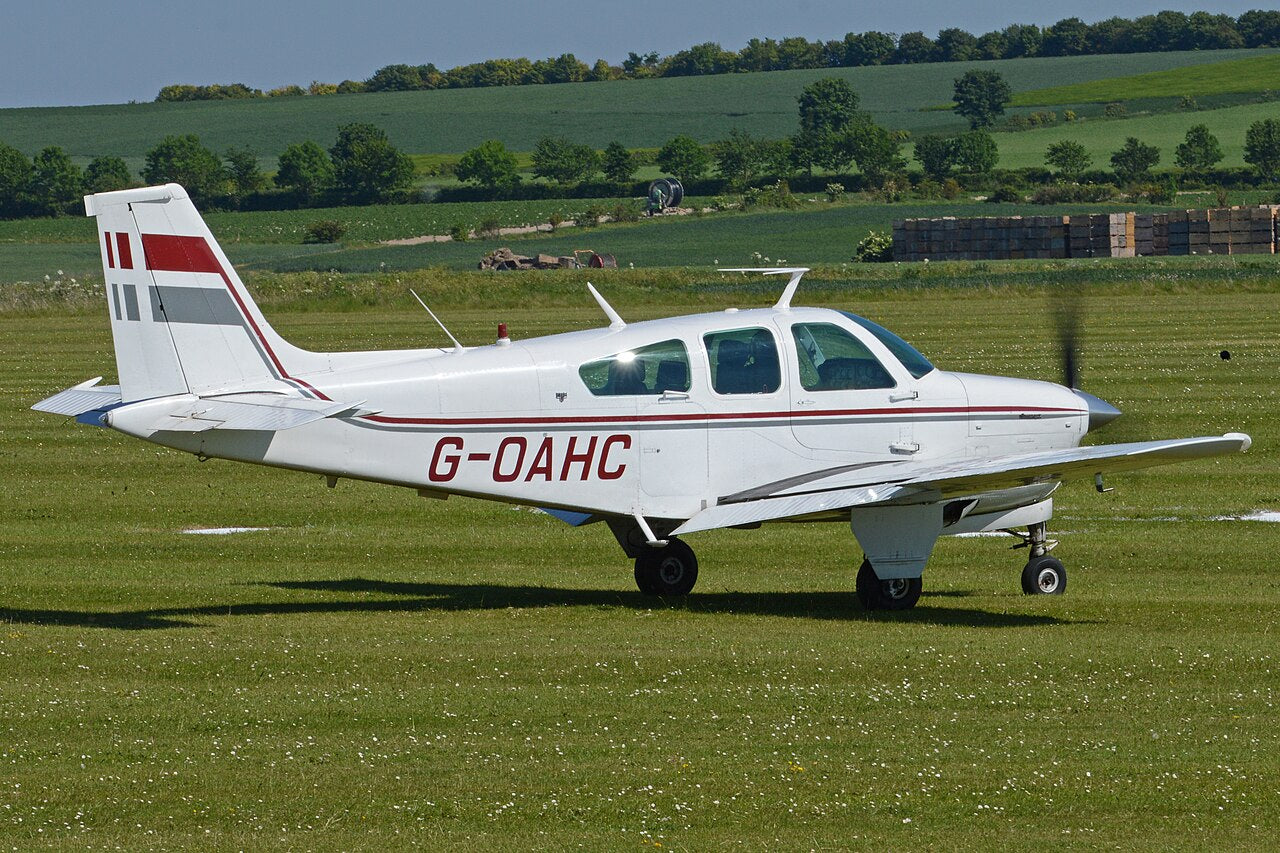
Photograph: Alan Wilson · 26 May 2017 · Photo source: Beech F33C Bonanza ‘G-OAHC’ (42198160391) · CC BY-SA 2.0

At a glance
Beech V35B · normally aspirated IO-520 installation; engine option and cabin arrangement identified separately
- Engine options
- Continental IO-520-B, -BA or -BBNormally aspirated V35B; turbocharged conversions are separate.
- Reference engine rating · IO-520-BB
- 285 hp at 2,700 rpmManufacturer’s sea-level standard-inlet rating; not every Bonanza engine.
- Maximum take-off weight
- 3,400 lbV35/V35A/V35B type-reference limit.
- Cabin seating options
- Four, five or six placesArrangement depends on the approved configuration; includes crew.
- Landing gear
- Retractable tricycle arrangementBonanza family layout.
- Tail configuration
- V-tail with ruddervatorsCombined pitch and directional control surfaces.
In Air Defender
Role guidance · v0.8.16.0
Air Defender v0.8.16.0 lists the general Beechcraft Bonanza as Personal Transport. Its family-level catalogue values remain separate from the V35B’s real engine and configuration.
Compare the fixed-gear Skylane and use Aircraft Data with flight-plan information. A familiar light-aircraft name does not establish the flight’s purpose or identity.
Game catalogue values · v0.8.16.0
In-game specifications
These figures come from the game’s general aircraft reference. A matching civilian register entry can supply different fields in Aircraft Data. How to read the two layouts →
- Role
- Personal Transport
- Category
- Light Aircraft
- Service ceiling
- 18,500 ftA reference upper height. Read Flight Info for the contact’s present height.
- Maximum speed
- 176 knotsA reference maximum, not the speed the aircraft is flying now.
- Cruise speed
- 152 knotsA typical speed for the main part of a flight, not a guaranteed commanded speed.
- Stall speed
- 57 knotsA reference for specified conditions. Stalling means the wing loses lift, not that an engine stops.
- Typical crew
- 1
- Powerplant
- Single piston engine (Continental IO-550, 285 HP) Compare engine types →
- Manufacturer
- Beechcraft (USA)
Use the right procedure
In depth
Development of the V-tail line
The original Model 35 introduced the V-tail Bonanza in 1947. Later versions added equipment, cabin changes and greater engine power. The V35B completed that production line, which ended in 1982.
The Debonair branch introduced a conventional tail in 1959. Its later equipment and interior standard developed toward the Bonanza line, and the Bonanza name was adopted. The two tail arrangements therefore coexist within the wider family history.
How the V-tail works
Two inclined tail surfaces perform the stabilising and control functions usually divided between a horizontal tail and a vertical fin. Their movable sections are called ruddervators.
The control linkage combines pitch and yaw inputs: the surfaces move together for pitch control and differentially for directional control. The pilot still uses conventional pitch and rudder controls; the mechanism combines their effects at the tail.
Six-cylinder engines and approved alternatives
The normally aspirated V35B engine options are the IO-520-B, -BA and -BB. The IO-520-BB is a six-cylinder, 520-cubic-inch engine rated at 285 hp at 2,700 rpm under the manufacturer’s stated sea-level conditions.
Turbocharged TC conversions use a TSIO-520 installation under a separate approval. The later six-seat A36’s IO-550-B installation belongs to a different model and production period, rather than every V-tail Bonanza.
Cabin and configuration
The V35 line permits different four-, five- and six-place arrangements. The 3,400 lb take-off limit includes the loaded aircraft; the seating option alone does not establish its available payload.
Approved propeller options include two- and three-bladed McCauley installations. Engine, propeller and loading limits depend on the individual approved configuration.
The 36 and A36 branch
The Model 36 was approved in May 1968, followed by the A36 in October 1969. Their longer-cabin, conventional-tail line is separate from the V35B. From 1984, the A36 uses the IO-550-B engine and a 3,650 lb take-off limit.
Variants
35 through V35B
V-tail development line; the final V35B was phased out in 1982.
33-series Debonair / Bonanza
Conventional-tail branch, with multiple engine and weight configurations.
36 / A36
Longer-cabin conventional-tail branch; approved in 1968 and 1969 respectively.
G36
Later Garmin G1000-equipped development of the conventional-tail line.
After 1998
2005–2006 · G36
The G36 received FAA approval on 2 November 2005 and superseded the A36 in 2006 with Garmin G1000 electronic flight instruments. The G36’s cockpit differs from the V35B’s.