

Aircraft overview
The King Air 200 family is a pressurised twin-turboprop design used for business transport, training and special-mission work. Its two wing-mounted engines, retractable tricycle landing gear and T-tail distinguish it from smaller single-engined utility aircraft.
The Model 200 developed from the A100 with a new wing arrangement, revised rear fuselage and more powerful engines. The B200 replaced the original PT6A-41 engines with PT6A-42s and received FAA approval on 13 February 1981.
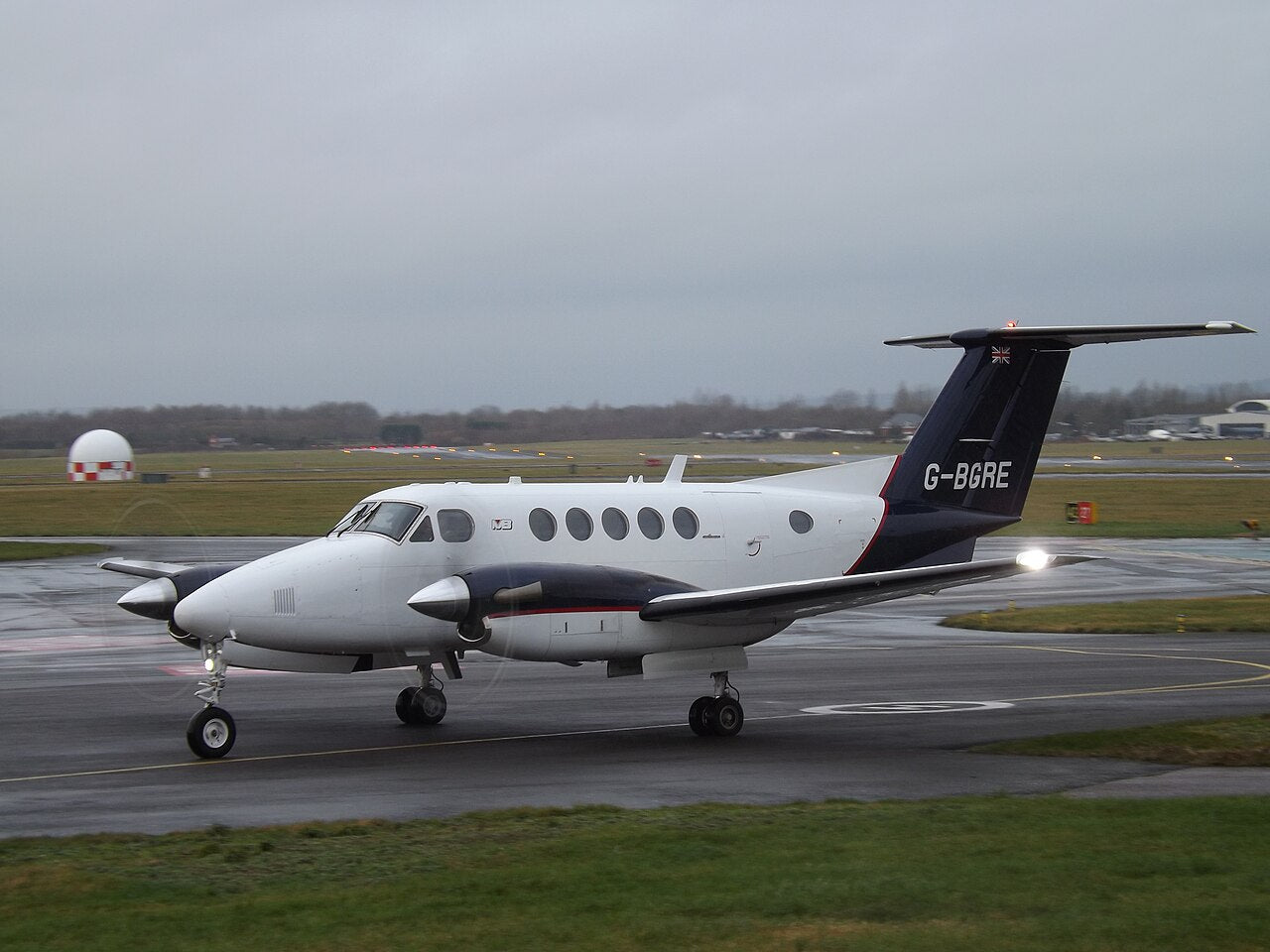
Photograph: James · 19 January 2019 · Photo source: G-BGRE Beech Super King Air 200 (Zephyr Aviation) (45895280375) · CC BY-SA 2.0

At a glance
Beech B200 · standard landing gear; specification dated December 2024, normal category; original 200 and later B200GT kept separate
- Engines
- Two Pratt & Whitney Canada PT6A-42 turbopropsB200 installation.
- Rated shaft power
- 850 shp per engineSelected take-off and maximum-continuous rating.
- Wingspan / length / height
- 16.61 m / 13.36 m / 4.52 mStandard landing gear; high-flotation configuration differs.
- Wing area
- 28.1496 m² · 303 ft²B200 reference.
- Maximum take-off / landing weight
- 12,500 lb / 12,500 lbNormal category; restricted-category increases excluded.
- Minimum flight crew
- One pilotCertification minimum; operating requirements remain separate.
- Cabin
- PressurisedPassenger, training and specialist interiors vary.
In Air Defender
Role guidance · v0.8.16.0
The v0.8.16.0 catalogue lists the general Beechcraft King Air 200 as Business Turboprop. The family name does not establish a B200GT engine, a military mission system or the cabin arrangement of an individual flight.
Compare the single-engined PC-12 and the larger Beechcraft 1900. Use Aircraft Data and flight-plan information to investigate a contact.
Game catalogue values · v0.8.16.0
In-game specifications
These figures come from the game’s general aircraft reference. A matching civilian register entry can supply different fields in Aircraft Data. How to read the two layouts →
- Role
- Business Turboprop
- Category
- Business Turboprop
- Service ceiling
- 35,000 ftA reference upper height. Read Flight Info for the contact’s present height.
- Maximum speed
- 289 knotsA reference maximum, not the speed the aircraft is flying now.
- Cruise speed
- 270 knotsA typical speed for the main part of a flight, not a guaranteed commanded speed.
- Stall speed
- 82 knotsA reference for specified conditions. Stalling means the wing loses lift, not that an engine stops.
- Typical crew
- 2
- Powerplant
- Twin turboprop engines (Pratt & Whitney Canada PT6A) Compare engine types →
- Manufacturer
- Beechcraft (USA)
Use the right procedure
In depth
From A100 to Super King Air
The Model 200 development introduced a new centre wing section, strengthened and extended outer wings, a revised rear fuselage and a T-tail. It used PT6A-41 engines rated at 850 shp.
The B200’s PT6A-42 retained the same nominal static power rating but introduced compressor, turbine and exhaust changes that improved cruise performance above 15,000 ft. It was a development of the 200, rather than merely a new marketing name.
Cabin and landing gear
The pressurised cabin supports a variety of passenger and specialist arrangements. Standard and high-flotation landing gear have different ground dimensions; the quick-reference measurements use the standard gear.
The B200C has a large cargo door. The additional-fuel T and CT versions have their own loading and operating provisions.
PT6A engines and propeller installations
Two PT6A-42 engines drive the B200’s propellers. A turboprop produces shaft power to turn a propeller rather than relying primarily on jet exhaust for thrust.
Approved propeller installations include three- and four-bladed arrangements, with applicability defined by serial number and modification.
Transport, training and special missions
The cabin and airframe have been used for passenger transport, medical and maritime-surveillance work. The equipment required for a particular specialist task is a separate installation.
Five B200s were imported for Royal New Zealand Air Force multi-engine training in 1998, initially on the civil register. That was an operational and national-acceptance milestone, rather than the type’s original introduction.
Crew and weight limits
The type-certificate minimum flight crew is one pilot. Cabin arrangements and operator requirements determine the actual crew and passenger provision.
The B200’s normal-category take-off and landing limits are both 12,500 lb. Higher restricted-category gross weights and special-mission changes are separate approvals.
Variants
200
Original Super King Air with PT6A-41 engines.
B200 / B200C
PT6A-42 development; the C version has a large cargo door.
T / CT versions
Additional-fuel configurations with their own loading and certification provisions.
B200GT / B200CGT
Later PT6A-52-powered development; not the historical B200 engine installation.
After 1998
2007 · B200GT generation
The B200GT and B200CGT received type approval in 2007. Their PT6A-52 engines and later equipment differ from the B200’s.