

Aircraft overview
The Bell 407 is a light single-turbine helicopter with a four-bladed main rotor, a two-bladed tail rotor and skid landing gear. Its cabin accommodates a pilot and up to six passengers, making it larger than the five-place JetRanger example.
The original 407 received Canadian type approval on 9 February 1996. The Rolls-Royce/Allison 250-C47B installation uses electronic engine control; later GX, GXP and GXi versions add different avionics or engine configurations.
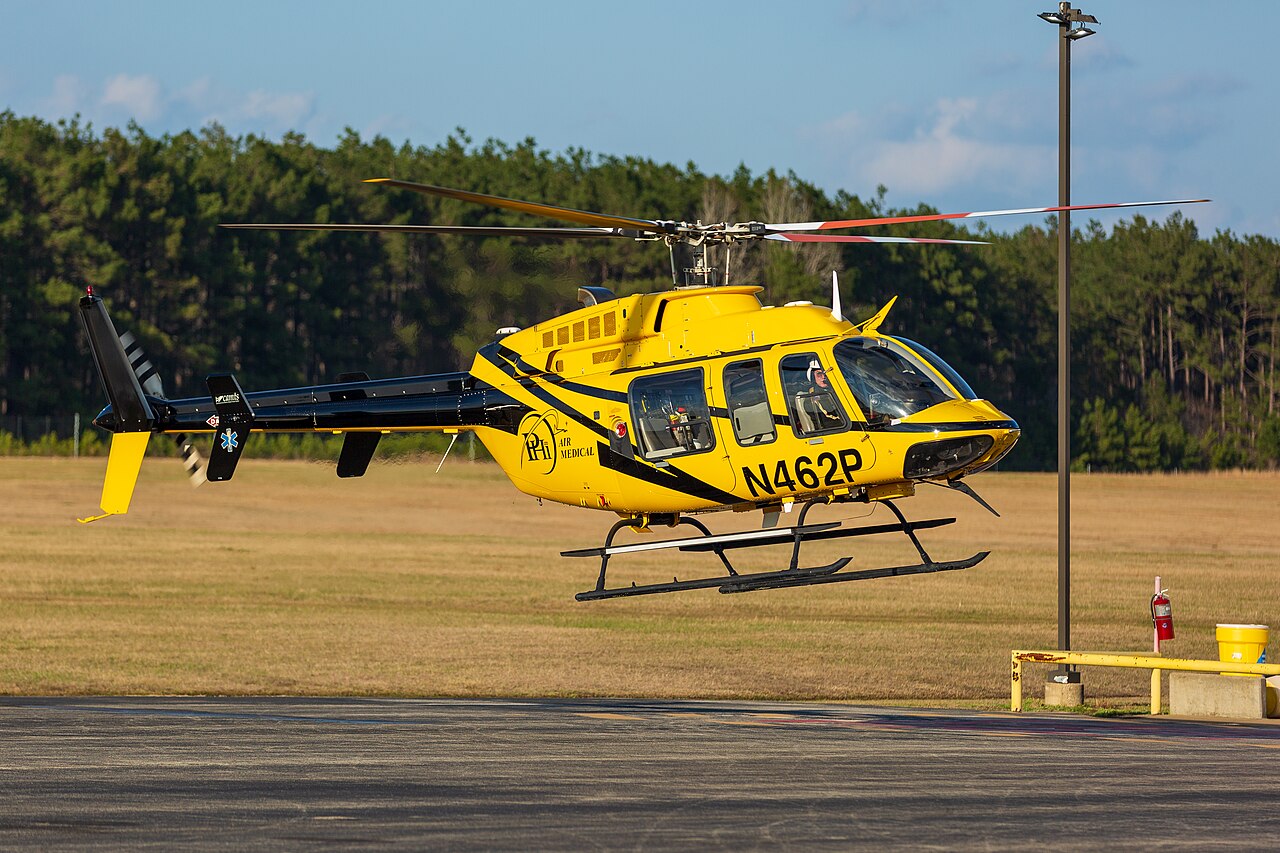
Photograph: JasonReina · 2021-02-24 · Photo source · CC BY-SA 4.0 · Unmodified photograph.

At a glance
Original Bell 407 ·250-C47B, baseline internal-loading configuration
- Engine
- One 250-C47B turboshaftRolls-Royce/Allison 250-C47B installation.
- Installed continuous / take-off power
- 630 /674 hpTake-off rating limited to five minutes.
- Main rotor
- Four blades ·10.66 m diameterSeparate from overall rotor-running length.
- Tail rotor
- Two blades ·1.65 m diameterConventional tail rotor.
- Fuselage length
- 10.42 mBody length; does not include the full rotor-running envelope.
- Maximum normal internal weight
- 5,000 lb ·2,268 kgBaseline reference; optional or external-load configurations have separate conditions.
- Cabin
- One pilot + up to six passengersMaximum passenger arrangement; actual interiors differ.
In Air Defender
Role guidance · v0.8.16.0
Air Defender v0.8.16.0 includes the Bell 407 as a civilian-helicopter reference. The catalogue description does not establish the load or purpose of an individual contact.
Compare the five-place JetRanger, then use Aircraft Data and flight-plan information for the selected flight.
Game catalogue values · v0.8.16.0
In-game specifications
These figures come from the game’s general aircraft reference. A matching civilian register entry can supply different fields in Aircraft Data. How to read the two layouts →
- Role
- Light Utility Helicopter
- Category
- Light Helicopter
- Service ceiling
- 20,000 ftA reference upper height. Read Flight Info for the contact’s present height.
- Maximum speed
- 133 knotsA reference maximum, not the speed the aircraft is flying now.
- Cruise speed
- 122 knotsA typical speed for the main part of a flight, not a guaranteed commanded speed.
- Stall speed
- Not specified as a stall-speed valueA zero in the game catalogue means no usable stall-speed figure is supplied; it does not mean the rotor blades cannot stall. FAA helicopter handbook: rotor-blade stall →
- Typical crew
- 1
- Powerplant
- Single turboshaft engine (Rolls-Royce 250-C47B) Compare engine types →
- Manufacturer
- Bell Helicopter (USA)
Use the right procedure
In depth
Rotor and airframe layout
Four main-rotor blades distinguish the 407 from the two-bladed JetRanger. The main rotor spans 10.66 m, with a 1.65 m two-bladed tail rotor.
The published body dimensions describe the fuselage and skids. They are not the total space occupied by the rotor tips while running.
Installed turbine power
The original 407 uses a 250-C47B turboshaft with a FADEC fuel-control system. Its installed limits are 674 hp for five minutes and 630 hp continuously.
These are the power limits for the Bell 407’s 250-C47B installation. Other 250-series engine installations have different ratings.
Cabin and loading
The 407 permits one pilot and up to six passengers. The baseline internal-loading limit is 5,000 lb (2,268 kg); an approved kit allows 5,250 lb.
External-load approvals have separate conditions and do not create an equivalent increase in cabin loading. Seats, fuel, baggage and installed equipment remain part of the relevant weight calculation.
Fuel and configuration
This 407 configuration has 483.7 litres of usable fuel. Optional equipment and higher-weight approvals have their own configuration limits.
Reference tank capacity describes an installation, not the amount remaining during a flight. The aircraft’s weight and centre-of-gravity limits continue to govern its loaded condition.
Type and configuration development
Canadian approval for the 407 dates to 9 February 1996. Later models retain the 407 designation but introduce changes to the engine and flight deck.
Variants
407
Original version powered by the 250-C47B engine.
407GX / GXP
Later G1000H-equipped versions; GXP uses the 250-C47B/8 installation.
407GXi
Later 250-C47E/4 installation with G1000H NXi avionics.
After 1998
GX, GXP and GXi variants · specification dated 2019
By 2019, the 407GX and GXP configurations used Garmin G1000H avionics, while the GXi used G1000H NXi. The GXP uses a 250-C47B/8 engine and the GXi a 250-C47E/4. These later configurations are separate from the original 1996 aircraft.