

Aircraft overview
The Boeing 707-320 family is a long-range, single-aisle transport with swept wings and four engines mounted beneath them. The turbofan-powered 707-320B is a passenger aircraft; the closely related -320C can be configured for passengers or cargo.
The -320B’s slim fuselage and single passenger deck distinguish it from later wide-body airliners. Its wing and four separate engine nacelles are prominent recognition features, while a -320C adds a main-deck cargo door on the left side.
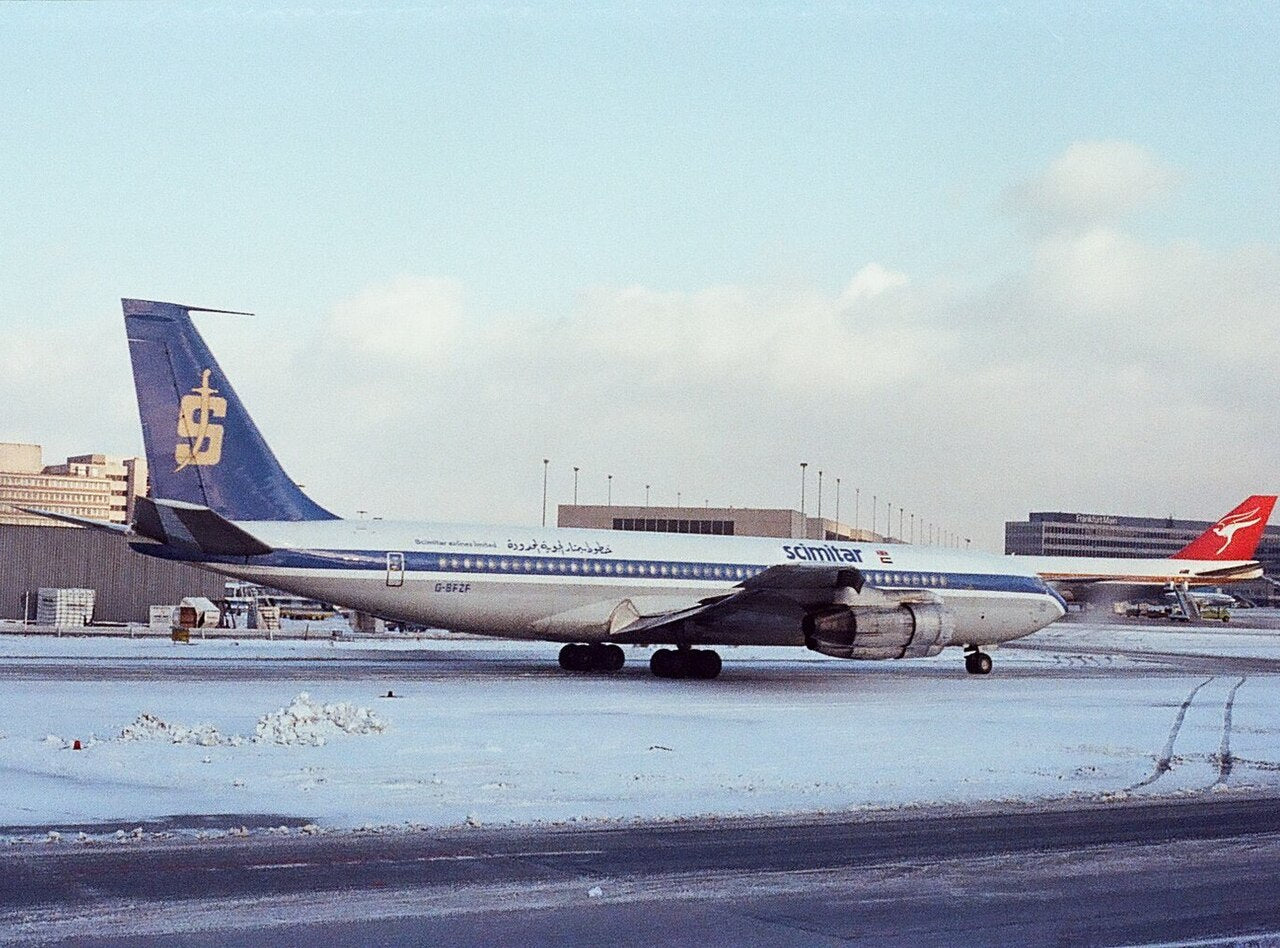
Photograph: Uli Elch · 12 January 1979 · Photo source · CC BY-SA 4.0 · Unmodified photograph.

At a glance
Boeing 707-320B · domestic configuration with JT3D-3B engines
- Engines
- Four Pratt & Whitney JT3D-3B turbofansBaseline installation in the 1973 technical study.
- Engine thrust
- 18,000 lbf eachSea-level static rating of the JT3D-3B.
- Length /wingspan
- 46.61 m /44.42 m-320B/-320C manufacturer drawing.
- Outside fuselage width
- 3.76 mManufacturer drawing.
- Maximum take-off /landing weight
- 327,000 lb /207,000 lbDomestic configuration; 148,500 kg / 94,000 kg rounded equivalents.
- Maximum all-economy seating
- 189 passengersPublished maximum layout; cabin arrangements vary.
- Usable fuel
- 23,855 US gal ·90,290 litresPublished -320B capacity; litre equivalent rounded.
In Air Defender
Role guidance · v0.8.16.0
Air Defender v0.8.16.0 lists the Boeing 707-320 in commercial and cargo transport roles. That general entry is separate from the named -320B configuration described here.
Compare the E-3D Sentry and the 747. A shared airframe family does not establish fitted sensors; use Aircraft Data and the relevant AWACS guide for game information.
Game catalogue values · v0.8.16.0
In-game specifications
These figures come from the game’s general aircraft reference. A matching civilian register entry can supply different fields in Aircraft Data. How to read the two layouts →
- Role
- Commercial Airliner / Cargo
- Category
- Commercial Airliner
- Service ceiling
- 43,000 ftA reference upper height. Read Flight Info for the contact’s present height.
- Maximum speed
- 540 knotsA reference maximum, not the speed the aircraft is flying now.
- Cruise speed
- 470 knotsA typical speed for the main part of a flight, not a guaranteed commanded speed.
- Stall speed
- 135 knotsA reference for specified conditions. Stalling means the wing loses lift, not that an engine stops.
- Typical crew
- 3
- Powerplant
- Four turbofan engines (Pratt & Whitney JT3D) Compare engine types →
- Manufacturer
- Boeing Commercial Airplanes (USA)
Use the right procedure
In depth
Intercontinental transport layout
The -320B carries its passenger cabin in a narrow fuselage, with a swept low wing, conventional tail and four underwing engine nacelles. The manufacturer’s drawing gives a 46.61 m plan-view length and 44.42 m span.
The main-deck cargo door shown on the -320C is forward of the left wing. The convertible version can use passenger or cargo arrangements; the factory planning tables also distinguish an all-freight layout.
The JT3D turbofan installation
The JT3D-3B baseline is an axial-flow turbofan. Its fan and multi-stage compressors are driven by turbines, and air leaves through separate fixed-area fan and core exhaust nozzles. The sea-level static thrust rating is 18,000 lbf per engine.
The engine designation matters: the proposed JT3D-9 refan was a modification study, not the standard installation on every 707-320B.
Passenger and cargo cabins
The maximum all-economy layout in the planning table has 189 passenger seats. A less dense, mixed arrangement can carry fewer; the technical study used a 149-passenger baseline interior.
The -320C’s convertible role allows a different use of the main-deck space. Passenger capacity, cargo volume and structural payload are separate constraints on the configuration.
Loading and fuel
The first -320B configuration shown has a 327,000 lb take-off limit, 207,000 lb landing limit and 190,000 lb zero-fuel limit. Its typical domestic operating-empty weight is 142,780 lb, giving a 47,220 lb structural payload limit in that example.
The published usable fuel capacity is 23,855 US gallons. Fuel capacity alone does not establish whether maximum fuel and maximum payload fit within the take-off limit.
Noise-reduction development
A 1973 Boeing study for NASA considered refanned engines and acoustically treated nacelles for the 707, 727 and 737. For the 707, the proposed JT3D-9 would have used a larger single-stage fan.
Funding limits ended the 707 part of that programme. These proposed engine and noise-treatment changes belong to the development study; the baseline specification above uses the JT3D-3B installation.
Variants
707-320B
Intercontinental passenger version with turbofan engines.
707-320C
Convertible passenger/cargo version with a main-deck cargo door.