

Aircraft overview
The Boeing 737-800 is a stretched passenger model in the Next-Generation 737 family. Two CFM56-7B turbofan engines sit beneath the swept wings, and its single-aisle cabin commonly uses six-abreast economy seating. It is a different engine generation from the later 737 MAX.
The first 737-800 was delivered to Hapag-Lloyd in April 1998, placing its introduction in Air Defender’s setting. The original wing had no blended winglets; airline service with the tall winglets began later.
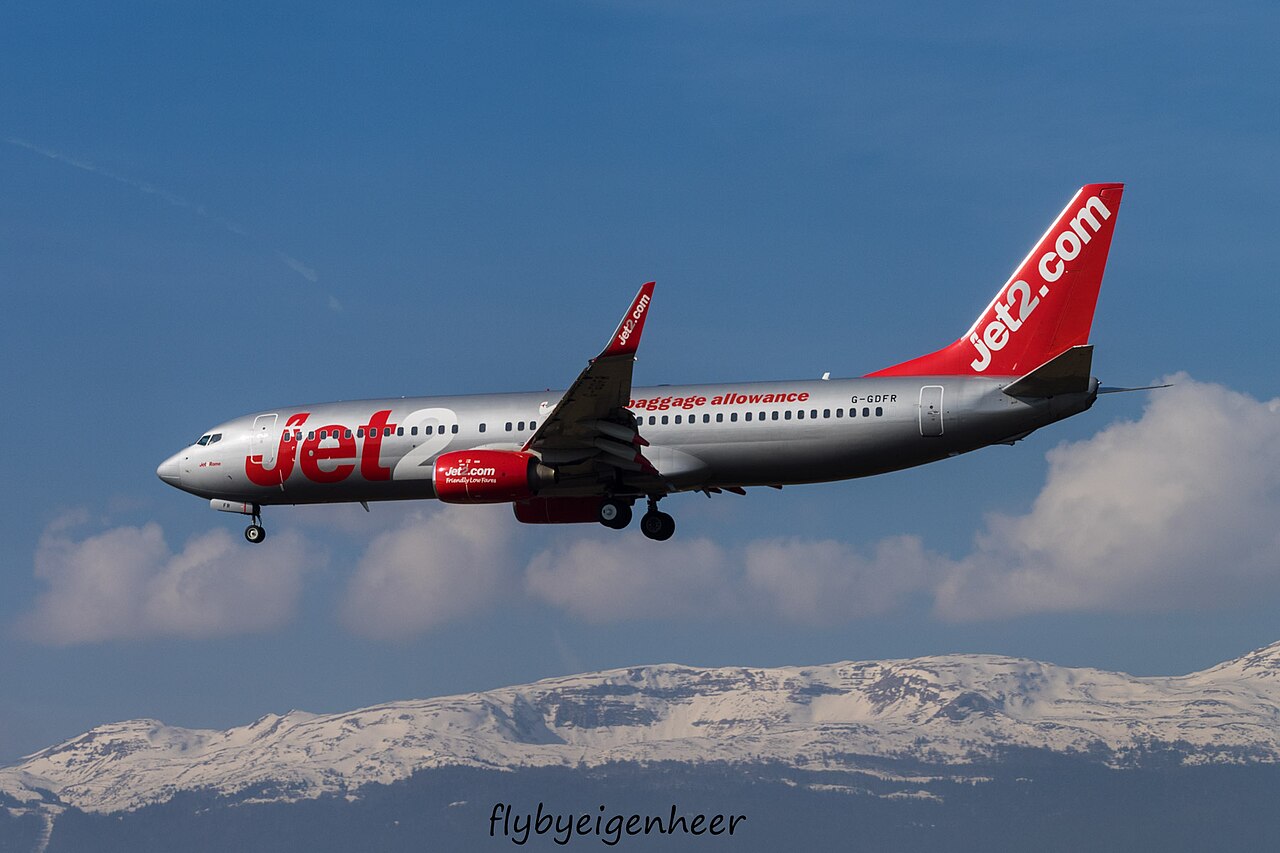
Photograph: flybyeigenheer · 16 February 2017 · Photo source: G-GDFR Boeing B737-8Z9-W B738 - EXS (32156161903) · CC BY-SA 2.0

At a glance
Boeing 737-800 passenger · standard wing; 155,500 lb maximum take-off weight configuration
- Engines
- Two CFM56-7B turbofansNext-Generation installation; not the MAX’s LEAP-1B.
- Length /wingspan
- 39.47 m /34.32 mStandard wing without blended winglets.
- Overall height
- 12.55 mManufacturer reference dimension.
- Maximum take-off /landing weight
- 155,500 lb /144,000 lb70,533 kg /65,317 kg; selected first passenger weight option.
- Passenger layout examples
- 160 two-class · 184 all-economyManufacturer examples, not every airline’s layout.
- Usable fuel
- 6,875 US gal ·26,024 litresPublished passenger configuration.
In Air Defender
Role guidance · v0.8.16.0
Air Defender v0.8.16.0 lists the Boeing 737-800 as a Commercial Airliner. The real-aircraft configuration here is separate from the game catalogue figures.
Compare the A320 and the 757, then use Aircraft Data and flight-plan information when investigating a contact.
Game catalogue values · v0.8.16.0
In-game specifications
These figures come from the game’s general aircraft reference. A matching civilian register entry can supply different fields in Aircraft Data. How to read the two layouts →
- Role
- Commercial Airliner
- Category
- Commercial Airliner
- Service ceiling
- 41,000 ftA reference upper height. Read Flight Info for the contact’s present height.
- Maximum speed
- 544 knotsA reference maximum, not the speed the aircraft is flying now.
- Cruise speed
- 453 knotsA typical speed for the main part of a flight, not a guaranteed commanded speed.
- Stall speed
- 130 knotsA reference for specified conditions. Stalling means the wing loses lift, not that an engine stops.
- Typical crew
- 2
- Powerplant
- Twin turbofan engines (CFM56 or LEAP-1B) Compare engine types →
- Manufacturer
- Boeing Commercial Airplanes (USA)
Use the right procedure
Civilian Aircraft Data
For a contact identified as Boeing 737-800 (B738), Aircraft Data can show this civilian entry instead of the general table above. Read the type code in the panel first: a different version of the aircraft can have different figures.
| Console field | Game reference value |
|---|---|
| ICAO type code | B738 |
| Role | AIRLINER |
| Weight class | Medium |
| Cruise speed | 447 knots |
| Maximum speed | 473 knots |
| Ceiling | 41,000 ft |
| Climb rate | 2,500 ft/min |
| Range | 3,115 NM |
| PAX | 162 |
PAX means the typical number of passengers in this reference. CARGO means the entry is shown as a freight aircraft; it is not a count of people aboard. Climb rate is the height gained each minute. Weight class groups aircraft by weight; it does not show today’s load.
These are reference figures, not the contact’s present speed, height, fuel or passenger count. How to open and read Aircraft Data → What the figures mean →
In depth
A new airliner in 1998
The 737-800 entered the Next-Generation family as a larger passenger model. Hapag-Lloyd received its first aircraft in April 1998 and planned to use the type to replace its earlier 737-400s and -500s.
The airline’s order and replacement plan explain the delivery context; they do not imply that the older models disappeared from service immediately.
CFM56-7B propulsion
The 737-800’s CFM56-7B engines distinguish the Next-Generation aircraft from the later LEAP-1B-powered MAX. Two aircraft called 737 can therefore have different engines and operating characteristics.
A model suffix is more useful than the family name alone when reading an aircraft reference. The -800 belongs to the Next-Generation passenger line.
Single-aisle passenger cabin
The planning examples have 160 seats in two classes or 184 in an all-economy layout. Economy seating is arranged in two groups of three across the aisle.
The passenger aircraft also has lower-deck baggage and cargo space. The converted 737-800BCF has different loading and cabin arrangements from the passenger aircraft.
Weight options and fuel
One passenger configuration has a 155,500 lb take-off limit, 144,000 lb landing limit and 136,000 lb zero-fuel limit. Other approved weight options reach higher limits.
The usable fuel capacity is 6,875 US gallons. Passenger, baggage, cargo and fuel loading must fit the applicable aircraft limits; a reference tank capacity is not fuel remaining.
Original wing and later winglets
The standard-wing 737-800 spans 34.32 m. The later blended-winglet configuration spans 35.79 m, with tips curving outwards and upwards to reduce aerodynamic drag.
Hapag-Lloyd began airline revenue service with those winglets in May 2001. The original 1998 configuration had no blended winglets.
Variants
737-800
Next-Generation passenger aircraft with CFM56-7B engines.
737-800 with blended winglets
Later wingtip configuration, introduced into airline revenue service in 2001.
737 MAX
Later family using LEAP-1B engines; separate from the 737-800.
After 1998
2001 · blended winglets
In May 2001, Hapag-Lloyd became the first airline to operate the 737-800 with blended winglets on commercial routes. Existing aircraft could also be retrofitted with the new wingtips.
References and further reading
Dimensions, cabin examples and passenger weight configurations
Completed 1998 delivery and later 2001 winglet service
- Boeing · First 737-800 delivery, 23 April 1998 announcement
- Boeing · 737 advanced-technology winglets enter airline revenue service, 21 May 2001