

Aircraft overview
The Boeing 767 is a twin-engine wide-body family for medium- and long-range passenger and freight transport. Its cabin has two aisles, and the flight deck uses digital systems with a two-pilot crew. Containers and baggage occupy holds below the passenger deck.
The 767-300 lengthens the original -200 by 21 ft 1 in to provide more passenger and cargo space. Extended-range and dedicated-freighter versions have their own fuel, loading and equipment configurations.
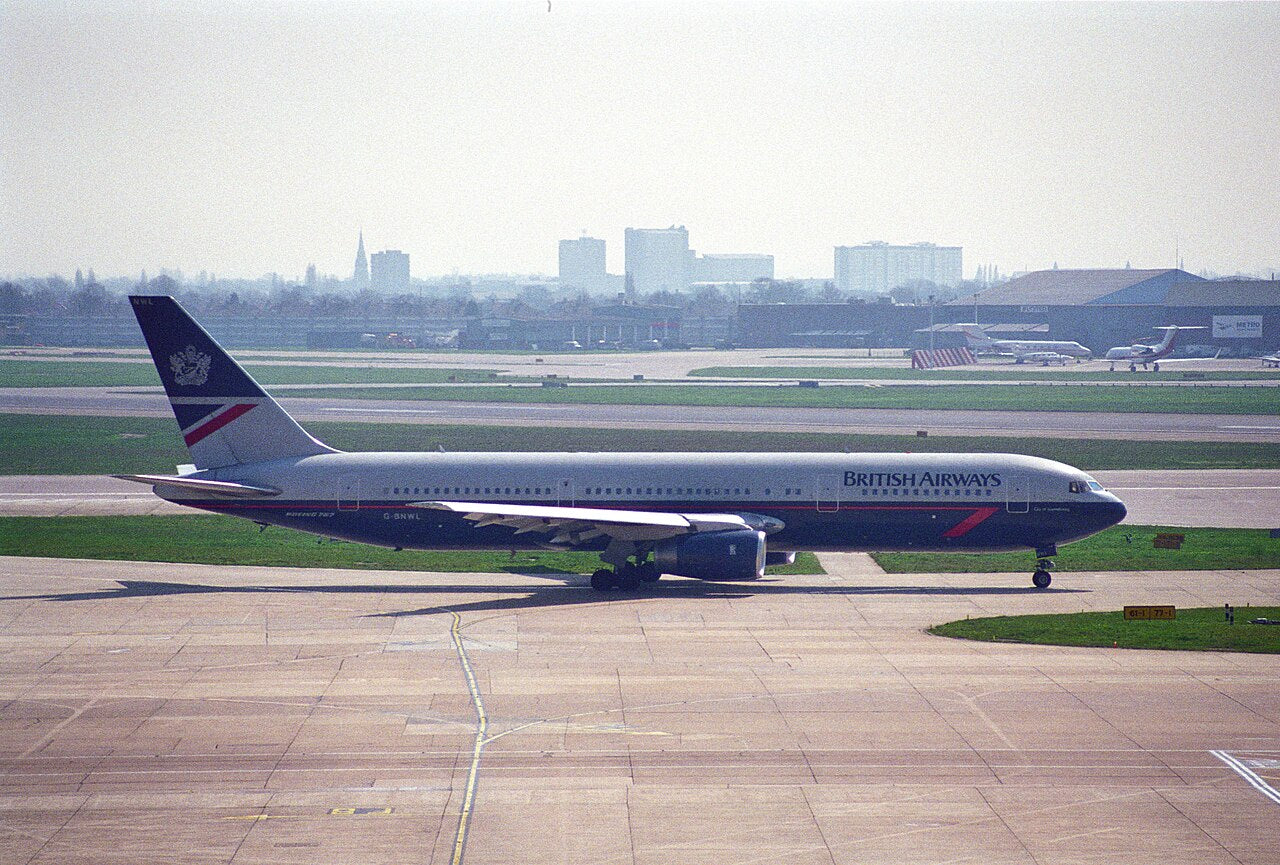
Photograph: Aero Icarus · 13 April 1996 · Photo source: G-BNWL@LHR;13.04.1996 (4992383845) · CC BY-SA 2.0

At a glance
Boeing 767-300 passenger · 345,000 lb maximum take-off weight configuration; separate from the -300ER and Freighter
- Engines
- Two high-bypass turbofansCF6, PW4000, JT9D or RB211 choices depend on the approved model/configuration.
- Flight crew
- Two pilotsDigital flight deck.
- Length / wingspan
- 54.94 m /47.57 mPlan-view length and standard drawing span.
- Maximum take-off / landing weight
- 345,000 lb /300,000 lb156,489 kg /136,077 kg; selected passenger weight option.
- Passenger layout example
- 261 · two classes24 first-class and 237 economy seats.
- Usable fuel
- 16,700 US gal ·63,216 litresSelected non-ER passenger configuration.
In Air Defender
Role guidance · v0.8.16.0
Air Defender v0.8.16.0 lists the Boeing 767 as a Commercial Airliner. Its general family record does not establish which passenger, extended-range or freight configuration a contact represents.
Compare the single-aisle 757 and the larger 777. Use Aircraft Data with flight-plan information for the selected contact.
Game catalogue values · v0.8.16.0
In-game specifications
These figures come from the game’s general aircraft reference. A matching civilian register entry can supply different fields in Aircraft Data. How to read the two layouts →
- Role
- Commercial Airliner
- Category
- Wide-body Airliner
- Service ceiling
- 43,100 ftA reference upper height. Read Flight Info for the contact’s present height.
- Maximum speed
- 493 knotsA reference maximum, not the speed the aircraft is flying now.
- Cruise speed
- 459 knotsA typical speed for the main part of a flight, not a guaranteed commanded speed.
- Stall speed
- 135 knotsA reference for specified conditions. Stalling means the wing loses lift, not that an engine stops.
- Typical crew
- 2
- Powerplant
- Twin turbofan engines (Pratt & Whitney PW4000 or GE CF6) Compare engine types →
- Manufacturer
- Boeing Commercial Airplanes (USA)
Use the right procedure
In depth
Passenger airframe and flight deck
The 767 has two underwing turbofan engines, a twin-aisle cabin and a two-pilot digital flight deck. Engine choices vary across the family: the original and later aircraft use different JT9D, CF6, PW4000 or RB211 installations.
The -300 fuselage stretch increases cabin and hold capacity while retaining the basic wing span of the -200/-200ER. The -300ER adds centre-tank fuel for its extended-range role.
Cabin arrangements
One -300 dual-class layout seats 261 passengers: 24 in first class and 237 in economy. Its economy cabin uses a two-three-two seating arrangement between the outer walls and two aisles.
Alternative doors and interior arrangements change the approved passenger capacity. The cabin example is separate from the aircraft’s exit limit and from the number travelling on any particular flight.
Loading and fuel
One -300 passenger configuration has a 345,000 lb take-off limit, 300,000 lb landing limit and 278,000 lb zero-fuel limit. Usable fuel is 16,700 US gallons.
The -200ER and -300ER have different fuel and weight options. Their larger tank figures do not apply automatically to the shorter-range passenger configuration.
Main-deck and lower-hold cargo
Passenger aircraft carry containerised and bulk cargo in their lower holds. The dedicated 767-300 Freighter adds a main-deck cargo door and pallet or container handling above those holds.
The Freighter’s main deck can use a manual handling arrangement or a powered transfer system. It has a crew entry door but no ordinary passenger-window and door arrangement along the cargo cabin.
The 1995 freighter development
The 767-300 Freighter first flew from Everett on 20 June 1995, with UPS as launch customer. It established a dedicated cargo version within the family before Air Defender’s 1998 setting.
Factory freighters, passenger aircraft and military derivatives have different equipment. Sharing a basic 767 airframe does not make their loading or mission systems interchangeable.
Variants
767-200 /-200ER
Original short-body models; ER versions add fuel and approved extended-range configurations.
767-300 /-300ER
Stretched passenger models. The -300ER has a different configuration from the non-ER -300.
767-300 Freighter
Dedicated main-deck cargo model first flown in 1995.