

Aircraft overview
The Boeing 777 is a large twin-engine airliner for medium- and long-range transport. Its wide circular fuselage contains a twin-aisle passenger cabin, with cargo holds below. A digital two-pilot flight deck and fly-by-wire controls are central features of the design.
The specifications below describe the original 777-200. The 777-300 adds two fuselage sections for more passengers and cargo; engine choices and approved weight options vary between configurations.
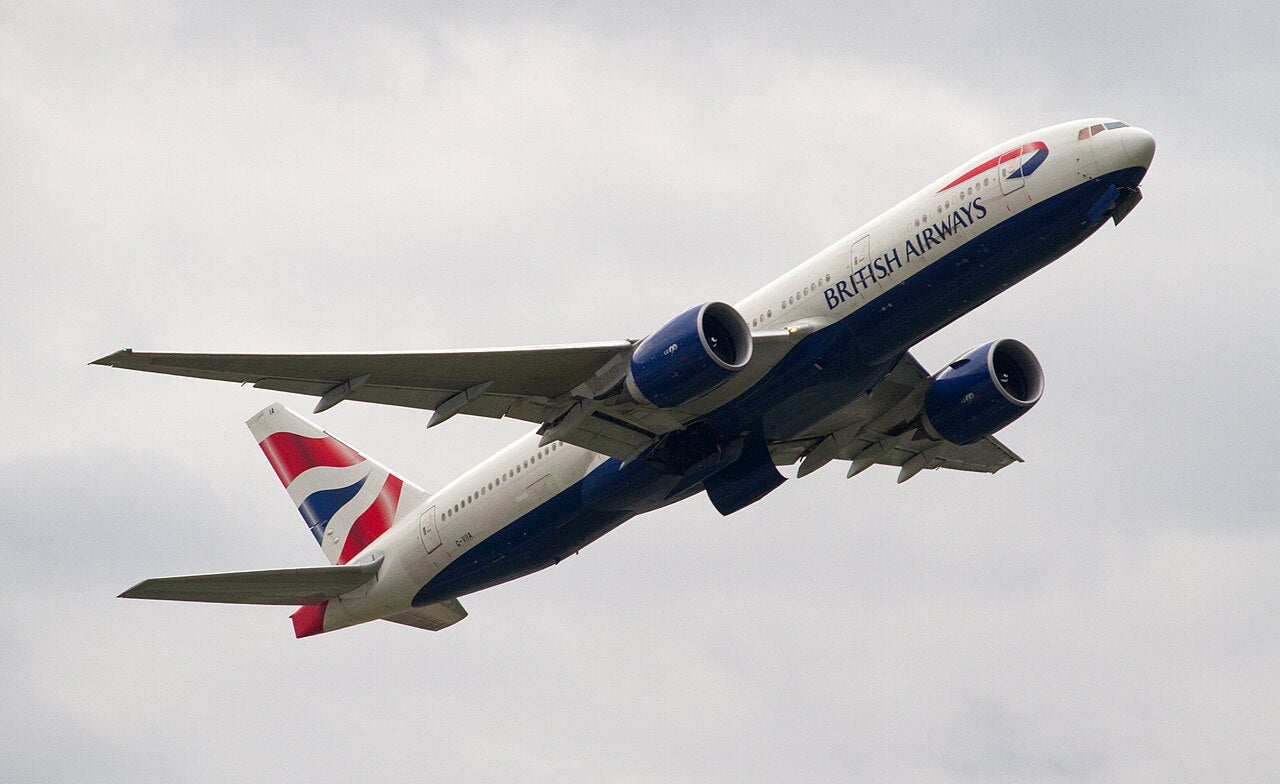
Photograph: Tony Hisgett · 9 June 2014 · Photo source: British Airways Boeing 777-236(ER) G-VIIA (14390367715) · CC BY 2.0

At a glance
Boeing 777-200 · baseline General Electric configuration
- Engines
- Two high-bypass turbofansGE90, PW4000 or Trent 800 installation; exact version varies.
- Flight crew
- Two pilotsDigital flight deck and fly-by-wire controls.
- Length /wingspan
- 63.73 m /60.93 mPlan-view length and drawing span of the original -200.
- Outside fuselage width
- 6.20 mExterior circular body dimension.
- Maximum take-off /landing weight
- 506,000 lb /441,000 lb229,517 kg /200,034 kg; selected baseline GE option.
- Passenger layout example
- 375 · two classes30 first-class and 345 economy seats.
- Usable fuel
- 31,000 US gal ·117,347 litresSelected baseline configuration.
In Air Defender
Role guidance · v0.8.16.0
Air Defender v0.8.16.0 lists the Boeing 777 as a Commercial Airliner. Its family-level record does not establish an exact model, engine or cabin for every contact.
Compare the 767 and the A330, then use Aircraft Data with flight-plan information for the selected aircraft.
Game catalogue values · v0.8.16.0
In-game specifications
These figures come from the game’s general aircraft reference. A matching civilian register entry can supply different fields in Aircraft Data. How to read the two layouts →
- Role
- Commercial Airliner
- Category
- Wide-body Airliner
- Service ceiling
- 43,100 ftA reference upper height. Read Flight Info for the contact’s present height.
- Maximum speed
- 512 knotsA reference maximum, not the speed the aircraft is flying now.
- Cruise speed
- 490 knotsA typical speed for the main part of a flight, not a guaranteed commanded speed.
- Stall speed
- 140 knotsA reference for specified conditions. Stalling means the wing loses lift, not that an engine stops.
- Typical crew
- 2
- Powerplant
- Twin turbofan engines (GE90 or Pratt & Whitney PW4000) Compare engine types →
- Manufacturer
- Boeing Commercial Airplanes (USA)
Use the right procedure
Civilian Aircraft Data
For a contact identified as Boeing 777-200 (B772), Aircraft Data can show this civilian entry instead of the general table above. Read the type code in the panel first: a different version of the aircraft can have different figures.
| Console field | Game reference value |
|---|---|
| ICAO type code | B772 |
| Role | AIRLINER |
| Weight class | Heavy |
| Cruise speed | 490 knots |
| Maximum speed | 511 knots |
| Ceiling | 43,100 ft |
| Climb rate | 2,600 ft/min |
| Range | 5,955 NM |
| PAX | 305 |
PAX means the typical number of passengers in this reference. CARGO means the entry is shown as a freight aircraft; it is not a count of people aboard. Climb rate is the height gained each minute. Weight class groups aircraft by weight; it does not show today’s load.
These are reference figures, not the contact’s present speed, height, fuel or passenger count. How to open and read Aircraft Data → What the figures mean →
In depth
Digital controls and cockpit
The two-pilot flight deck uses digital avionics and fly-by-wire flight controls. Pilot control inputs pass through electronic systems to command the control surfaces, rather than being carried solely by a direct mechanical linkage.
The aircraft combines aluminium and composite structural materials, carbon brakes and a wide circular fuselage. These features belong to the original design, separately from later 777 developments.
Engine choices
Early 777-200/-200ER installations include General Electric GE90, Pratt & Whitney PW4000 and Rolls-Royce Trent 800 engines. Each family has several versions with different thrust ratings and approved weight combinations.
The listed weights apply to the baseline General Electric configuration; other engine and model configurations have different approved limits.
Six-wheel main landing gear
Each main landing-gear assembly has six wheels. Automatic steering of the aft axle responds to nose-wheel steering angle, helping the aircraft turn with less tyre scrub on the ground.
This is a distinctive part of the original 777’s airport handling arrangement. It supports manoeuvring into gates and around paved areas without making the aircraft’s dimensions smaller.
Cabin and cargo
One two-class layout seats 375 passengers: 30 in first class and 345 in economy. A separate three-class example has 305 passengers, with 24 first, 54 business and 227 economy seats.
The lower-deck cargo arrangement accommodates containers ahead of and behind the wing area, plus bulk cargo. Seating layout and cargo arrangements are configuration choices rather than a live count of the aircraft’s load.
Baseline weights and the stretched -300
This -200 configuration has a 506,000 lb take-off limit, 441,000 lb landing limit and 420,000 lb zero-fuel limit. Its baseline usable fuel is 31,000 US gallons.
The -300 adds two body sections to increase passenger and cargo capacity. It retains the family concept but has its own length, loading limits and engine options.
Variants
777-200
Original body length; baseline configuration.
777-200ER
Extended-range weight and engine configurations, separate from the baseline -200.
777-300
Stretched derivative with two added fuselage sections.