

Aircraft overview
The CRJ200 is a small regional jet developed from the Challenger business-aircraft family. It has a swept low wing, two turbofan engines on the rear fuselage and a cabin for up to 50 passengers. It serves the regional routes linking smaller cities with an airline’s wider network.
CRJ200 is a commercial model name: the certified airframe designation is CL-600-2B19. The CF34-3B1 engines distinguish the CRJ200 from the CF34-3A1-powered CRJ100. The original CRJ100 entered service in 1992.
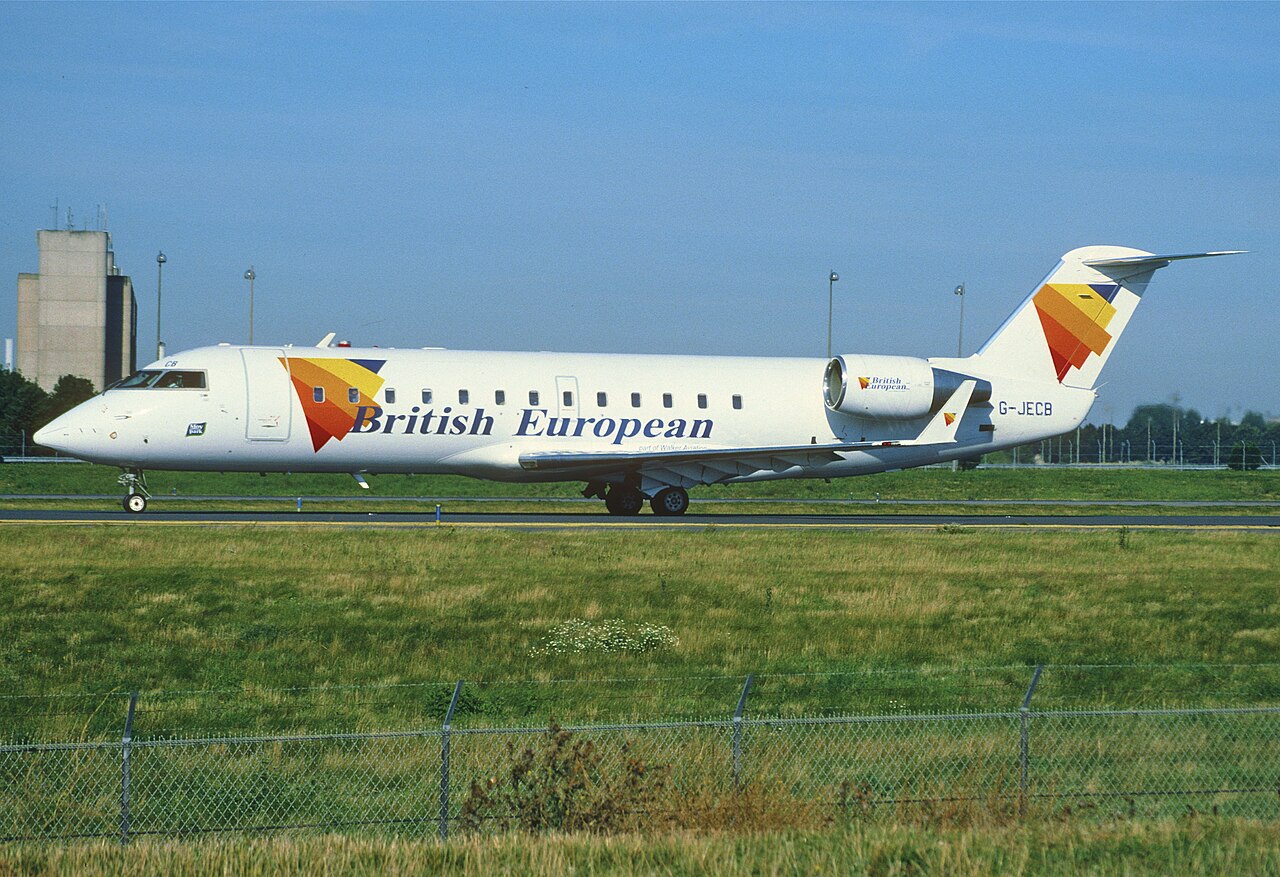
Photograph: Aero Icarus · 11 August 2001 · Photo source: 145di - British European Canadair CRJ200LR; G-JECB@CDG;11.08.2001 (8075013877) · CC BY-SA 2.0

At a glance
CRJ200 · CL-600-2B19 with CF34-3B1 engines; basic-weight specification dated September 2023
- Engines
- Two General Electric CF34-3B1 turbofansCRJ200 engine designation.
- Length / wingspan / height
- 26.77 m / 21.21 m / 6.22 mManufacturer CRJ200 dimensions.
- Maximum passenger seating
- 5048 when the specified forward wardrobe is installed.
- Minimum flight crew
- Two pilotsSeparate from cabin-crew requirements.
- Basic maximum take-off / landing mass
- 23,133 kg / 21,319 kgDifferent approved weight options exist.
- Usable fuel capacity
- 8,082 litresTwo main tanks and one centre tank.
- Maximum speed listed
- Mach 0.81Manufacturer operating reference; not the higher design Mach number.
In Air Defender
Role guidance · v0.8.16.0
The v0.8.16.0 catalogue identifies the CRJ200 as a Bombardier regional jet. Its game figures are shown separately from the named real-aircraft reference.
Compare the ERJ145 when learning the regional-jet group. Use Aircraft Data and flight-plan information to investigate the selected flight, then follow the identification guide.
Game catalogue values · v0.8.16.0
In-game specifications
These figures come from the game’s general aircraft reference. A matching civilian register entry can supply different fields in Aircraft Data. How to read the two layouts →
- Role
- Regional Jet
- Category
- Regional Aircraft
- Service ceiling
- 41,000 ftA reference upper height. Read Flight Info for the contact’s present height.
- Maximum speed
- 464 knotsA reference maximum, not the speed the aircraft is flying now.
- Cruise speed
- 450 knotsA typical speed for the main part of a flight, not a guaranteed commanded speed.
- Stall speed
- 105 knotsA reference for specified conditions. Stalling means the wing loses lift, not that an engine stops.
- Typical crew
- 2
- Powerplant
- Twin turbofan engines (General Electric CF34) Compare engine types →
- Manufacturer
- Bombardier (Canada)
Use the right procedure
In depth
Challenger-derived structure
The CL-600-2B19 uses a monocoque structure, in which the skin forms part of the load-carrying body. Its materials include aluminium alloys, steels, titanium and composites. The swept low wing and retractable tricycle landing gear accompany the rear-mounted engines.
CRJ100 and CRJ200 engines
CF34-3A1 and CF34-3B1 installations appear within the same certified airframe family. CRJ100 and CRJ200 identify these engine configurations commercially. They should not be confused with the larger CRJ700, CRJ900 or CRJ1000.
Passenger cabin and baggage
The normal maximum is 50 passengers; the specified forward-wardrobe installation reduces it to 48. The aft baggage compartment has a baseline volume of 6.48 m³ and a 1,224.7 kg load limit. A modification increases both, so the larger compartment should not be assumed on every aircraft.
Fuel and auxiliary power
The two main tanks each hold 2,650 litres of usable fuel, and the centre tank holds 2,782 litres. Together they provide 8,082 litres. The auxiliary power unit is a GTCP-36-150[RJ], separate from the two propulsion engines.
Weight options
The basic take-off limit is 23,133 kg. With option 0004 (JAA), it becomes 23,995 kg, while the corresponding landing limit becomes 21,205 kg. Selecting the higher take-off figure does not mean retaining the basic landing limit.
Variants
CRJ100
The CL-600-2B19 with CF34-3A1 engines.
CRJ200
CF34-3B1-powered configuration.
Larger CRJ family
CRJ700, CRJ900 and CRJ1000 have different dimensions, engines and capacities.
After 1998
2020 · programme ownership
Mitsubishi Heavy Industries acquired the CRJ programme in 2020. The Canadian type certificate transferred to MHI RJ Aviation ULC on 1 June 2020; the Bombardier name remains appropriate to the game’s historical catalogue.