

Aircraft overview
The Cessna 152 is a two-seat, single-engined light aircraft used for basic flying instruction. Its all-metal airframe has a high wing and fixed tricycle landing gear. A Lycoming piston engine drives a two-bladed propeller.
Developed from the Cessna 150, the 152 introduced a 110 hp engine installation, revised engine mounting and cooling arrangements, a 28-volt electrical system and a higher maximum weight. The standard 152 is distinct from the strengthened A152 Aerobat.
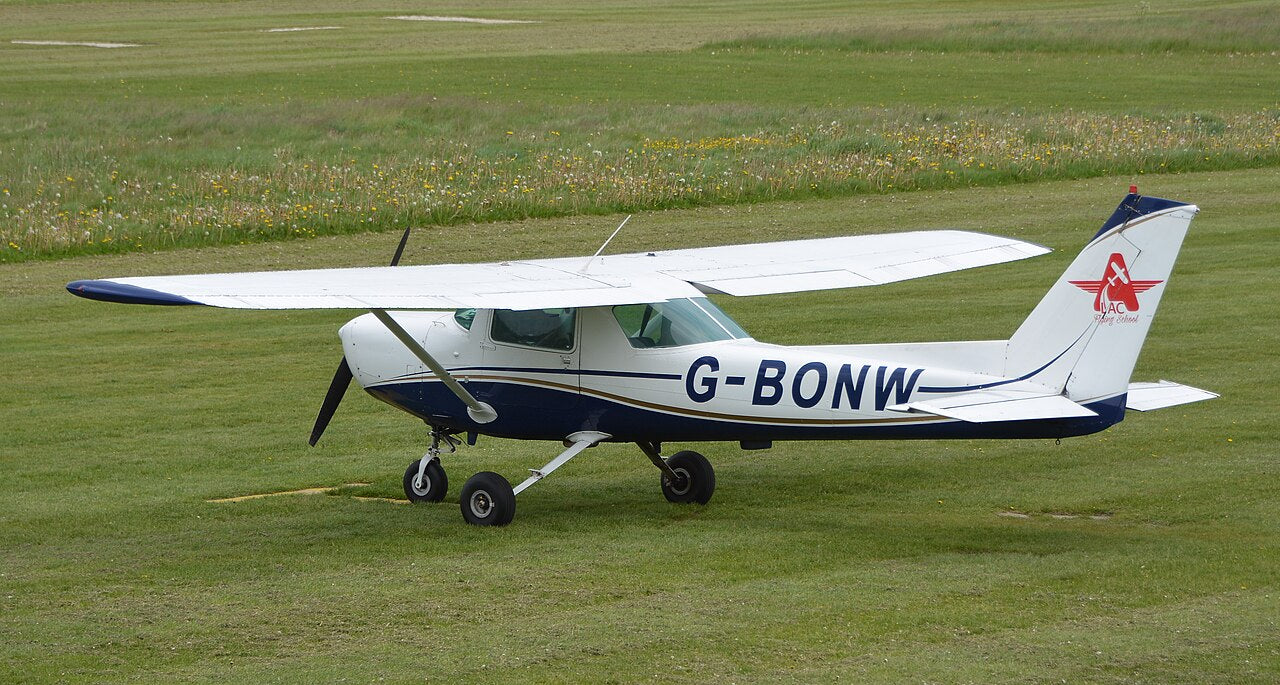
Photograph: Jonathan Payne · 13 May 2022 · Photo source: G-BONW C152 (52075376316) · CC BY-SA 2.0

At a glance
Cessna 152 · 1978 model with O-235-L2C engine and standard fuel tanks; A152 Aerobat limits excluded
- Engine
- Lycoming O-235-L2C · 110 bhp at 2,550 rpmInstalled aircraft rating.
- Propeller
- Two-bladed McCauley 1A103/TCM6958Fixed pitch; maximum diameter 69 in.
- Seating
- Two people, including the pilotStandard arrangement.
- Wingspan / length
- 33 ft 4 in / 24 ft 1 inWingspan includes strobe lights.
- Maximum height
- 8 ft 6 inWith beacon installed and the handbook’s stated tyre/nose-strut conditions.
- Maximum take-off / landing weight
- 1,670 lb / 1,670 lbWhole-aircraft limits.
- Standard fuel · total / usable
- 26 / 24.5 US galLong-range tanks are a separate installation.
In Air Defender
Role guidance · v0.8.16.0
Air Defender v0.8.16.0 lists the Cessna 152 in the Flight Training role. The catalogue’s typical crew figure describes the reference entry; it does not reveal how many people are aboard a particular contact.
Compare the four-seat Skyhawk and use Aircraft Data with flight-plan information. An aircraft type associated with flying lessons does not establish the purpose or identity of an individual flight.
Game catalogue values · v0.8.16.0
In-game specifications
These figures come from the game’s general aircraft reference. A matching civilian register entry can supply different fields in Aircraft Data. How to read the two layouts →
- Role
- Flight Training
- Category
- Light Aircraft
- Service ceiling
- 14,700 ftA reference upper height. Read Flight Info for the contact’s present height.
- Maximum speed
- 107 knotsA reference maximum, not the speed the aircraft is flying now.
- Cruise speed
- 90 knotsA typical speed for the main part of a flight, not a guaranteed commanded speed.
- Stall speed
- 43 knotsA reference for specified conditions. Stalling means the wing loses lift, not that an engine stops.
- Typical crew
- 1
- Powerplant
- Single piston engine (Lycoming O-235, 110 HP) Compare engine types →
- Manufacturer
- Cessna Aircraft Company (USA)
Use the right procedure
In depth
Development from the 150
The 150/152 family was designed around light training. The 152’s engine change required revisions to the cowling, exhaust, engine mount, propeller and cooling baffles. Its electrical system changed to 28 volts, and maximum weight rose to 1,670 lb.
Engine and propeller
This 1978 configuration uses an air-cooled, horizontally opposed four-cylinder engine with a carburettor. It drives the propeller directly. Its installed rating is 110 bhp at 2,550 rpm.
The fixed-pitch propeller has no in-flight blade-angle adjustment. The O-235-N2C is another approved 152 engine; the specifications here apply to the O-235-L2C installation.
Fuel and loading
Standard tanks provide 24.5 usable US gallons from a total of 26. The separate long-range installation increases those figures to 37.5 and 39 US gallons. The two tank options must not be combined.
The baggage areas have a combined 120 lb limit. That limit is separate from the aircraft’s total weight and balance restrictions; full seats, full tanks and maximum baggage are not an automatic permitted load.
Equipment and operating capability
Night flying, instrument flying and transponder capability depend on the equipment and approval of the individual aircraft. A 152 type name alone does not establish its avionics fit.
The Aerobat distinction
The A152 Aerobat has a strengthened airframe and higher load limits for aerobatic work. Those limits apply to the A152, rather than the ordinary 152.
Variants
152
Standard light trainer; approved O-235-L2C and O-235-N2C engine installations are model-specific.
A152 Aerobat
Strengthened aerobatic version, with its own operating limitations.