

Aircraft overview
Citation is a family of Cessna business jets, beginning with the straight-wing, turbofan-powered Model 500. The Citation II developed that concept into a larger pressurised aircraft, with a stretched cabin, larger wings and more powerful engines.
The Model 550 Citation II received FAA approval on 24 March 1978. Citation I, S/II, Bravo and V are separate developments, with different engines, weight limits and equipment.
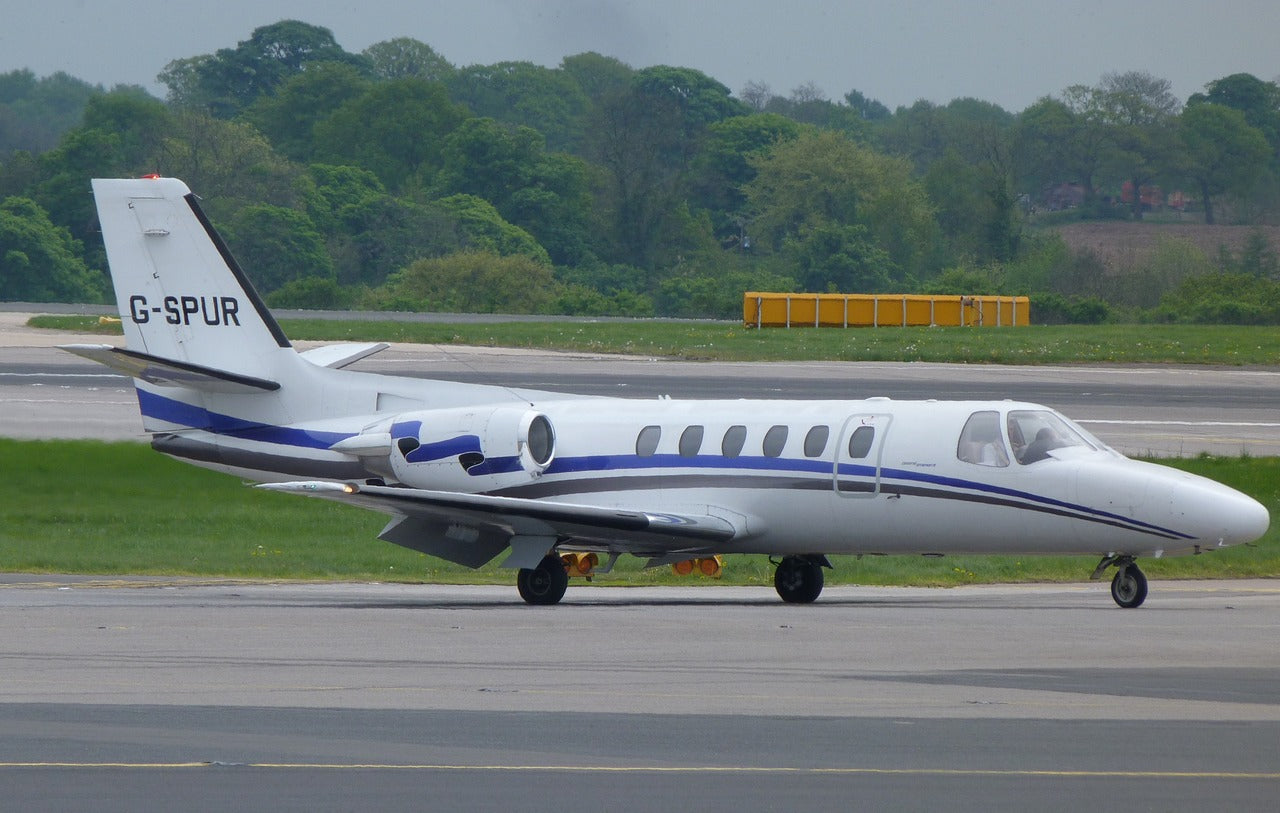
Photograph: Craig Sunter · 24 April 2011 · Photo source: Cessna Citation II (5650619961) · CC BY 2.0 · Proportionally resized; no crop.

At a glance
Cessna 550 Citation II · early serials 550-0001–550-0505; baseline weights without the optional zero-fuel-weight increase
- Engines
- Two Pratt & Whitney Canada JT15D-4 turbofansCitation II; Bravo uses PW530A engines.
- Take-off thrust
- 2,500 lbf per engineFive-minute all-engines-operating rating; standard day, sea level.
- Wingspan / length / height
- 15.90 m / 14.39 m / 4.57 mModel 550 dimensions.
- Minimum flight crew
- Two pilotsPilot and co-pilot.
- Maximum take-off / landing weight
- 13,300 lb / 12,700 lbSelected early serial group.
- Baseline zero-fuel weight
- 9,500 lbWithout the optional increase; later production differs.
- Standard fuel · total / usable
- 752 / 742 US galCombined capacity of the two wing tanks.
- Maximum operating altitude
- 43,000 ftCitation II operating limit.
In Air Defender
Role guidance · v0.8.16.0
Air Defender v0.8.16.0 lists the Cessna Citation Series as Business Aviation. Its general catalogue record spans a family; it does not identify a particular Citation model or engine installation.
Compare the Learjet 35 and use Aircraft Data with flight-plan information. The real Citation II figures here are separate from the game’s general reference values.
Game catalogue values · v0.8.16.0
In-game specifications
These figures come from the game’s general aircraft reference. A matching civilian register entry can supply different fields in Aircraft Data. How to read the two layouts →
- Role
- Business Aviation
- Category
- Business Jet
- Service ceiling
- 45,000 ftA reference upper height. Read Flight Info for the contact’s present height.
- Maximum speed
- 460 knotsA reference maximum, not the speed the aircraft is flying now.
- Cruise speed
- 420 knotsA typical speed for the main part of a flight, not a guaranteed commanded speed.
- Stall speed
- 85 knotsA reference for specified conditions. Stalling means the wing loses lift, not that an engine stops.
- Typical crew
- 2
- Powerplant
- Twin turbofan engines (Pratt & Whitney JT15D or Williams FJ44) Compare engine types →
- Manufacturer
- Cessna Aircraft Company (USA)
Use the right procedure
In depth
From Citation to Citation II
The Citation II lengthened the original Citation fuselage by 1.14 m. Larger wings, increased fuel capacity and more powerful JT15D-4 engines accompanied the cabin stretch.
The S550 Citation S/II superseded it in production in 1984, before Citation II production resumed in 1987 from serial 550-0550. Later production break points changed the loading limits.
JT15D-4 installation
Two JT15D-4 turbofans power the Citation II. Each has a five-minute take-off rating of 2,500 lbf under standard sea-level conditions and a maximum-continuous rating of 2,375 lbf. These ratings belong to the II, separately from the Bravo’s PW530A installation.
Fuel and loading configurations
Each wing tank holds 376 US gallons, of which 371 are usable. The two-tank total is 752 gallons, with 742 usable.
An early Citation II with the baseline weight limits has a 13,300 lb take-off limit and a 12,700 lb landing limit. Its baseline zero-fuel limit is 9,500 lb. An approved modification permits 11,000 lb zero-fuel weight with a reduced operating-speed limit; 11,000 lb became standard from serial 550-0550.
Cabin arrangements
The Citation II requires two pilots. Eligible aircraft with the applicable cabin modification can carry up to 13 people in total, including the pilots. That is an approved maximum for the specified configuration, rather than a standard 11-passenger business interior.
Variants
500 Citation / Citation I
Original straight-wing business-jet line from which the Citation II developed.
550 Citation II
Stretched aircraft with JT15D-4 engines; early baseline configuration.
550 Citation Bravo
PW530A-powered variant approved in 1997.
560 Citation V / Ultra
Further stretched development with different JT15D versions and later avionics.