

Aircraft overview
The Lightning F6 is a single-seat interceptor with two Rolls-Royce Avon engines mounted one above the other. The design places a strong emphasis on rapid climb, acceleration and high speed. It was built for the air-defence task, with range and endurance forming important limits on how it could be used.
The F6 improves on earlier Lightnings with a revised wing, a larger ventral fuel tank and provision for overwing ferry tanks. Its Red Top missiles and later ventral cannon installation distinguish its weapon fit from earlier marks. The RAF retired its last front-line Lightning interceptor in April 1988, before Air Defender’s 1998 setting.
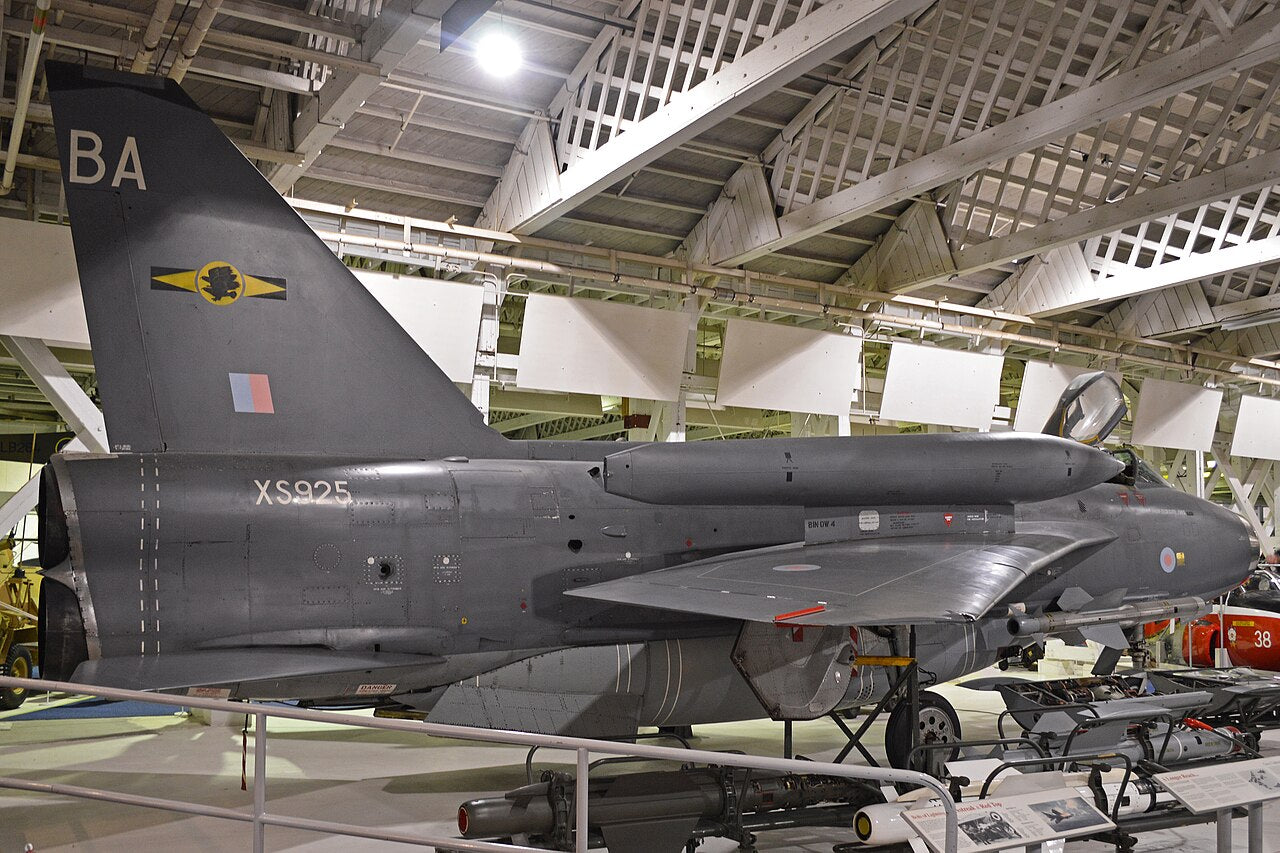
Photograph: Alan Wilson · 22 March 2015 · Photo source: English Electric Lightning F6 ‘XS925 - BA’ (17382373502) · CC BY-SA 2.0

At a glance
Lightning F6 · RAF single-seat interceptor
- Role
- Supersonic air-defence interceptorRAF air-defence version; export and training variants differ.
- Crew
- 1 pilotThe F6 is single-seat; T4/T5 trainers have two seats.
- Engines
- Two Rolls-Royce Avon 301R turbojets with reheat, mounted one above the otherProduction F6 propulsion; reheat provides additional thrust with greater fuel consumption.
- Wingspan
- 10.62 m · 34 ft 10 inRounded F6 dimensions.
- Length
- 16.84 m · 55 ft 3 inF6 airframe dimension.
- Maximum take-off weight
- 20,752 kg · 45,750 lbTotal aircraft weight at take-off, not a weapon-load allowance.
- Armament
- Red Top air-to-air missiles · two 30 mm ADEN cannon in the later ventral gun installationEarly F6 aircraft were gunless; the later cannon installation occupies the forward ventral pack.
In Air Defender
Role guidance · v0.8.16.0
The v0.8.16.0 Air Defender catalogue includes a Lightning F6 described as retained at Boscombe Down for trials and heritage alert work. That is the game’s premise. The RAF’s historical front-line Lightning service ended in 1988.
Game speed, ceiling and range values appear separately below. Compare the full designation in Aircraft Data and use the specification guide to interpret the figures. A catalogue maximum is not a current fuel state, tasking instruction or guarantee of aircraft availability.
Game catalogue values · v0.8.16.0
In-game specifications
These figures come from the game’s general aircraft reference. A matching civilian register entry can supply different fields in Aircraft Data. How to read the two layouts →
- Role
- Point Defence Interceptor
- Category
- Military Fighter
- Service ceiling
- 60,000 ftA reference upper height. Read Flight Info for the contact’s present height.
- Maximum speed
- 1,310 knotsA reference maximum, not the speed the aircraft is flying now.
- Cruise speed
- 540 knotsA typical speed for the main part of a flight, not a guaranteed commanded speed.
- Stall speed
- 160 knotsA reference for specified conditions. Stalling means the wing loses lift, not that an engine stops.
- Typical range
- 800 NMA reference flying distance, not fuel remaining or radar detection range.
- Typical crew
- 1
- Powerplant
- Twin Rolls-Royce Avon afterburning turbojets Compare engine types →
- Manufacturer
- English Electric (UK)
Use the right procedure
In depth
An interceptor built for speed and climb
The P.1 research aircraft first flew at Boscombe Down on 4 August 1954. The Lightning developed from this work as an interceptor intended to protect Britain’s V-bomber force. Its design favoured acceleration and rate of climb over long-range patrol endurance.
The F3 introduced Avon 301R engines, an enlarged squared-off fin and Red Top missiles. The F3A developed the fuel tank and wing, and the F6 carried these changes further with more fuel capacity and provision for overwing ferry tanks. Thirty-nine F6s were built new, with nine F3 and fifteen F3A aircraft converted to the standard.
Airframe, fuel and propulsion
Two Avon 301R turbojets occupy the fuselage in a vertically staggered arrangement. Both use reheat: additional fuel burns in the exhaust behind the turbines to increase thrust. The extra thrust is useful for acceleration and climb, but it comes with substantially higher fuel consumption.
The F6’s wingspan is about 10.62 m and its length about 16.84 m. The enlarged ventral pack and overwing tanks address fuel carriage, while the revised wing improves subsonic performance. Additional fuel capacity does not remove the distinction between fuel used to reach a target, fuel spent on task and fuel needed to return.
Weapons and the single-seat task
Red Top is the F6’s air-to-air missile. The F3 had omitted cannon, but guns returned on the F6 in a different location: two 30 mm ADEN cannon in the forward part of the ventral pack. This differs from the nose-mounted guns of earlier Lightnings.
The F6 has one pilot. The side-by-side T4 and T5 are training versions, while the export F53 has attack-store provisions absent from the RAF fighter. A shared Lightning name does not identify a common equipment fit.
RAF air defence and retirement
Production deliveries began in December 1959 to the Central Fighter Establishment, followed by the first operational squadron six months later. Lightning service extended beyond Britain to Germany, the Middle East and the Far East. Air defence remained its central RAF task.
Phantom re-equipment began in the early 1970s, while Nos 5 and 11 Squadrons at Binbrook retained the Lightning into the 1980s. The last front-line Lightning interceptor officially retired on 30 April 1988. Its presence in a 1998 game scenario therefore needs to be understood separately from that historical service record.
Variants
Lightning F1 and F1A
First production interceptors from 1959 with twin nose-mounted Aden cannon, two Firestreak missiles and AI.23 radar; the F1A added a refuelling probe. Short-ranged by design.
Lightning F2 and F2A
Improved F1 delivered from 1962; 31 were rebuilt as F2As to near-F6 standard with Avon 211R engines, Firestreak and an enlarged ventral tank, and served in low-level air defence over West Germany.
Lightning F3 and F3A
The F3 introduced Avon 301R engines, AI.23B radar, Red Top missiles and a squared-off fin, omitting cannon. The F3A added the larger ventral tank and cambered wing.
Lightning F6
Revised wing, larger ventral tank, provision for overwing ferry tanks, Red Top missiles and a later ventral cannon installation.
Lightning T4 and T5
Two-seat side-by-side trainers based on the F1A and F3 respectively. Different aircraft from the single-seat F6.
Lightning F52, F53, T54 and T55 · export
Saudi and Kuwaiti aircraft; the F53 was an F6 derivative with underwing pylons for bombs or rockets. Not RAF air-defence aircraft.