

Aircraft overview
The AS350 Ecureuil is a light single-turbine helicopter with a three-bladed main rotor, a conventional two-bladed tail rotor and skid landing gear. Its compact cabin and adaptable utility layout suit passenger transport and aerial work.
The B2 was approved on 26 April 1989. It developed from the B1 and uses a single Arriel 1D1 engine. The later H125 family name and equipment belong to a subsequent stage of Ecureuil development.
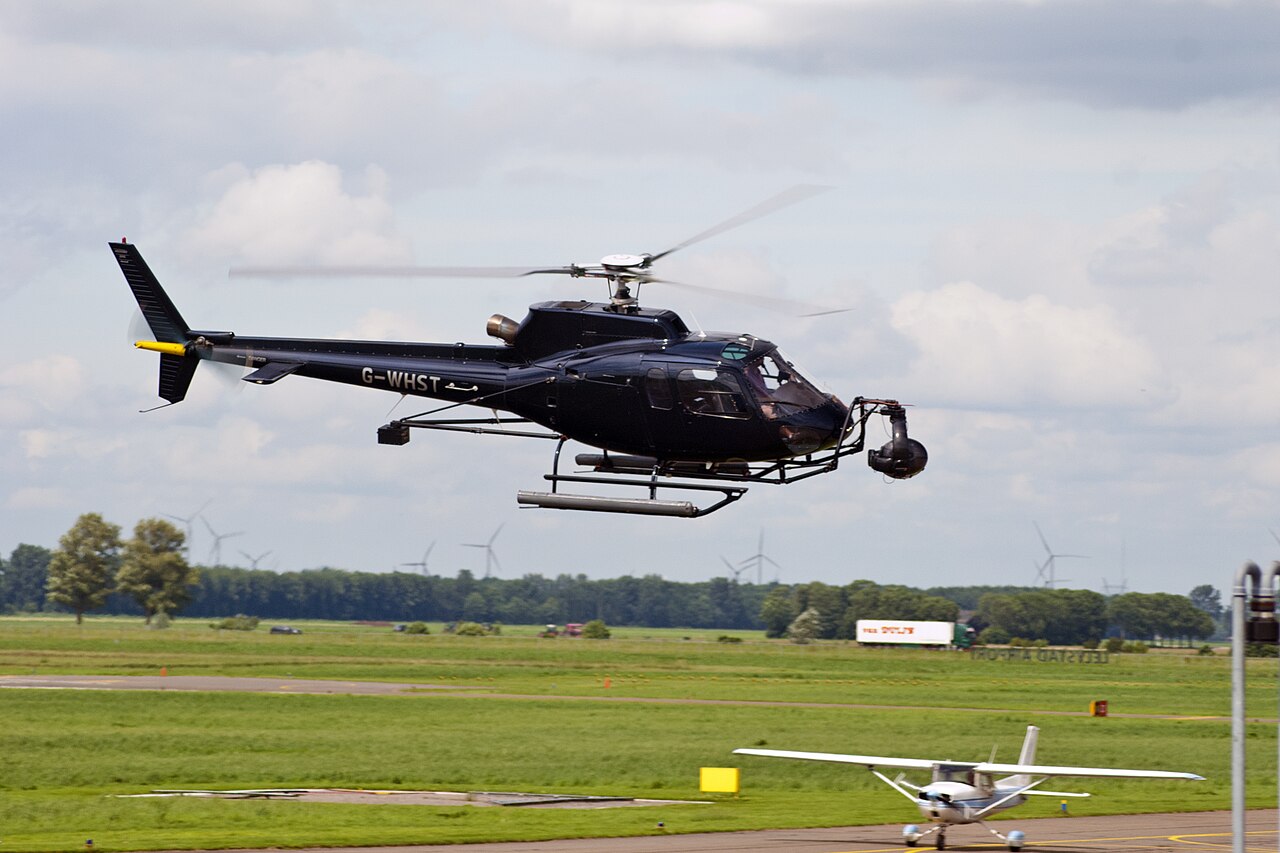
Photograph: RonaldV-tm · 29 June 2016 · Photo source · CC BY-SA 4.0 · Unmodified photograph.

At a glance
AS350 B2 · Arriel 1D1 installation; named cabin and fuel options
- Engine
- One Turbomeca Arriel 1D1 turboshaftManufacturer now Safran Helicopter Engines.
- Main /tail rotor
- Three /two blades10.69 m /1.86 m diameters.
- Fuselage length /width
- 10.93 m /1.87 mBody dimensions, separate from rotor-running envelope.
- Maximum mass
- 2,250 kgB2 limit.
- Cabin
- One pilot + up to five passengersSix passengers with the approved optional forward two-place seat.
- Fuel ·total /usable
- 540 /538.7 litresUsable quantity applies after AMS07-0289.
In Air Defender
Role guidance · v0.8.16.0
Air Defender v0.8.16.0 lists the AS350 as a light utility helicopter, with tourism, ambulance and law-enforcement examples. Those catalogue roles do not identify the task of every contact.
Compare the twin-engine AS355 and the A109, then use Aircraft Data and flight-plan information for the selected aircraft.
Game catalogue values · v0.8.16.0
In-game specifications
These figures come from the game’s general aircraft reference. A matching civilian register entry can supply different fields in Aircraft Data. How to read the two layouts →
- Role
- Light Utility Helicopter
- Category
- Light Helicopter
- Service ceiling
- 15,000 ftA reference upper height. Read Flight Info for the contact’s present height.
- Maximum speed
- 155 knotsA reference maximum, not the speed the aircraft is flying now.
- Cruise speed
- 139 knotsA typical speed for the main part of a flight, not a guaranteed commanded speed.
- Stall speed
- Not specified as a stall-speed valueA zero in the game catalogue means no usable stall-speed figure is supplied; it does not mean the rotor blades cannot stall. FAA helicopter handbook: rotor-blade stall →
- Typical crew
- 1
- Powerplant
- Single turboshaft engine (Turbomeca Arriel) Compare engine types →
- Manufacturer
- Eurocopter/Airbus Helicopters (France)
Use the right procedure
In depth
Ecureuil and the B2
The Ecureuil family first flew in 1974. The B2 was approved in 1989 as a development of the AS350 B1, with the Arriel 1D1 installation.
Later family members broadened the design’s work in passenger transport, utility flying, public services and emergency medical operations. Their equipment and performance remain separate from the B2 reference.
Airframe and rotors
The B2 uses a metal-sheet monocoque fuselage and skid landing gear. Its main rotor has three blades and a 10.69 m diameter; the conventional two-bladed tail rotor is 1.86 m across.
The published 10.93 m fuselage length describes the body, rather than the full envelope occupied by the rotors. The cabin and external equipment arrangement can vary with the approved configuration.
Single Arriel engine
One Arriel 1D1 turboshaft supplies power to the rotor drive. The engine, transmission and airframe have their own operating limits; a rating from another Arriel model does not describe this installation.
The original B2 cockpit and a later VEMD-equipped B2 are different configurations. VEMD means Vehicle and Engine Multifunction Display: it presents engine and aircraft-system information on two screens.
Passenger and baggage arrangements
The minimum crew is one pilot in the right seat. The standard maximum is five passengers; fitting the approved forward two-place seat allows six passengers under the applicable supplement.
Separate side and rear holds have their own loading limits. The combined occupants, baggage, equipment and fuel must remain within the B2’s 2,250 kg maximum mass and balance limits.
Fuel installation
The published tank capacity is 540 litres. The 538.7-litre usable capacity applies to the installation with the AMS07-0289 modification.
Optional mission equipment changes the aircraft’s empty weight and available load. The cabin’s maximum seating arrangement alone does not establish its useful load with full fuel.
Variants
AS350 B1 /B2
B2 development of the B1; the named B2 installation uses Arriel 1D1.
Later Ecureuil family
H125 and H130 are later commercial family names, with their own configurations.
After 1998
2006 · B2 monitoring-display configuration
The VEMD-equipped B2 flight manual received approval in November 2006. That later monitoring-display configuration is separate from the original 1989 B2 cockpit.