

Aircraft overview
The Ilyushin Il-78 Midas is an aerial-refuelling tanker developed from the Il-76MD transport. Additional fuel tanks and three external refuelling units allow it to pass fuel to other aircraft in flight, extending their operating reach.
The Il-78 first flew in 1983. The original version retains a transport role as well as its tanker duties: it can be converted to carry personnel, equipment, cargo or patients, and can deliver fuel for use at an airfield. Later Il-78 versions have different engines and equipment.
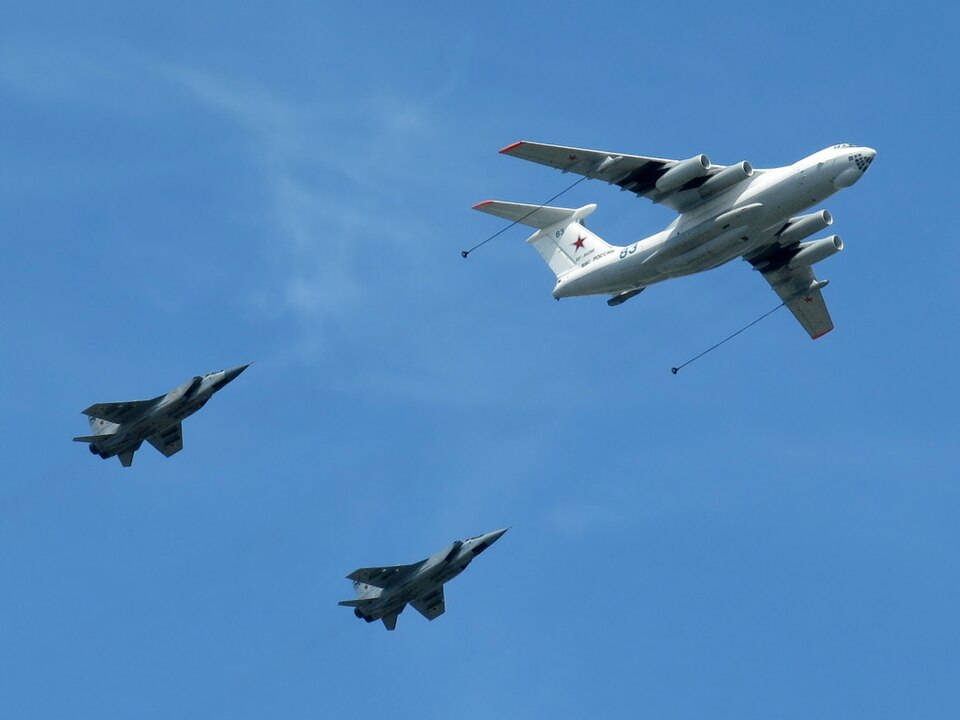
Photograph: Boevaya mashina · 9 May 2015 · Photo source · CC BY-SA 4.0 · Unmodified photograph.

At a glance
Il-78 · original D-30KP-powered tanker; later M-90A specifications are separate
- Principal role
- Aerial refuellingOriginal Il-78 also convertible for transport duties.
- Engines
- Four D-30KP Series 2 turbofansOriginal Il-78 reference, not the later PS-90-powered version.
- Length / wingspan
- 46.6 m / 50.5 mOriginal Il-78 airframe.
- Crew
- SixReal-aircraft manufacturer reference; separate from the game catalogue’s crew field.
- Maximum take-off mass
- 190 tonnesWhole aircraft at take-off, not transferable fuel.
- Refuelling units
- Three UPAZ unitsTwo beneath the wings and one at the rear fuselage.
In Air Defender
Role guidance · v0.8.16.0
Air Defender’s v0.8.16.0 catalogue lists the Il-78 Midas as an aerial-refuelling tanker. Its game figures, including a crew field of seven, appear separately below; the real-aircraft summary describes the original Il-78 reference.
For the selected contact, start with Aircraft Data and Flight Info. The player’s tanker procedures are covered in manual refuelling and tanker fuel. A tanker type appearing in the reference catalogue does not by itself make that aircraft available to command.
Game catalogue values · v0.8.16.0
In-game specifications
These figures come from the game’s general aircraft reference. A matching civilian register entry can supply different fields in Aircraft Data. How to read the two layouts →
- Role
- Aerial Refueling Tanker
- Category
- Military Tanker
- Service ceiling
- 39,370 ftA reference upper height. Read Flight Info for the contact’s present height.
- Maximum speed
- 460 knotsA reference maximum, not the speed the aircraft is flying now.
- Cruise speed
- 405 knotsA typical speed for the main part of a flight, not a guaranteed commanded speed.
- Stall speed
- 130 knotsA reference for specified conditions. Stalling means the wing loses lift, not that an engine stops.
- Typical crew
- 7
- Powerplant
- Four turbofan engines (Soloviev D-30KP) Compare engine types →
- Manufacturer
- Ilyushin (Russia)
Use the right procedure
In depth
Turning a transport into a tanker
The Il-78 uses the Il-76MD transport as its starting point. The tanker installation adds fuel storage and delivery equipment so it can support long-range, tactical and air-defence aircraft. Its 1983 first flight places the original programme within the Cold War period.
The original Il-78 can also be converted for transport work. Later aircraft with the Il-78 name may have different transport capabilities.
Three external refuelling stations
Two UPAZ refuelling units sit beneath the wings, with a third at the rear of the fuselage. They deploy the equipment used to pass fuel to the receiving aircraft. The two wing stations support smaller aircraft, while the aft station serves larger receivers.
The number of installed stations describes the tanker’s equipment. It does not mean every station is occupied during a particular flight. The aircraft being supported and the refuelling arrangement determine how the equipment is used.
Fuel storage and transfer
Two additional tanks occupy the cargo cabin. The transfer system can supply fuel from these tanks and from the wing tanks. The aircraft also consumes fuel for its own flight, so fuel carried and fuel available to pass are different quantities.
The original Il-78 can transport fuel to an airfield and refuel aircraft on the ground. Moving fuel to a destination is a separate task from meeting another aircraft in flight, even though both use the tanker’s fuel-handling installation.
Cruising and refuelling speeds
The original Il-78 has a reference cruising speed of 750 km/h and an aerial-refuelling speed range of 440–600 km/h. These figures describe different phases of operation; the refuelling range is not a maximum-speed specification.
The 190-tonne maximum take-off mass includes the aircraft, its crew, fuel and any other load. It is not an offload figure. A transferable-fuel figure needs its own mission conditions rather than being calculated from the maximum mass alone.
Variants
Il-78
The original Il-76MD-derived tanker with D-30KP engines, additional cabin fuel tanks and the ability to convert for transport work.
Il-78M-90A
A later-generation tanker based on the Il-76MD-90A, with PS-90A-76 engines and digital avionics. Its configuration is separate from the original Il-78 described here.
After 1998
Later generation · Il-78M-90A
The Il-78M-90A uses PS-90A-76 engines, modernised landing gear and digital flight and navigation equipment with screen displays. These later-generation features differ from the original Il-78 configuration described here for the 1998 setting.