

Aircraft overview
The Learjet 35 family is a pressurised light business jet with swept wings, wingtip fuel tanks and two turbofan engines mounted on the rear fuselage. The 35A developed the original aircraft with revised wing aerodynamics and higher approved weight configurations.
The 35 and longer-range 36 developed from earlier Learjet designs, with a fuselage stretch and a major change to turbofan propulsion. The 35A and 36A received FAA approval on 30 April 1976. The specifications below describe the 35A.
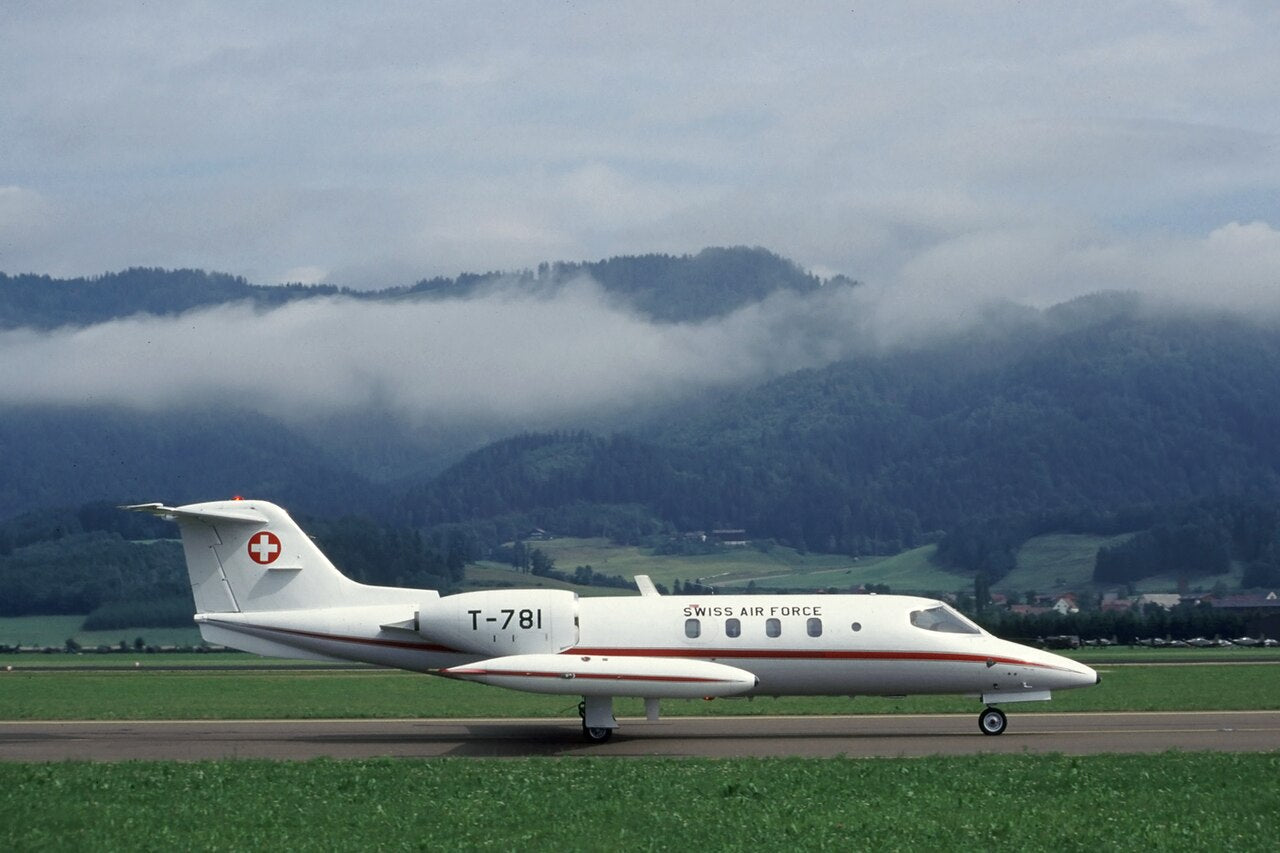
Photograph: Rob Schleiffert · June 1997 · Photo source: Swiss Lear (26594637844) · CC BY-SA 2.0

At a glance
Learjet 35A · TFE731-2-2B installation; weight-increase approvals identified separately
- Engines
- Two Garrett TFE731-2-2B turbofans35A installation.
- Engine thrust
- 3,500 lbf per engineSea-level rating.
- Seating
- Two crew + up to eight passengers35/35A arrangement; not the longer-range 36 cabin.
- Approved take-off weight example
- 18,000 lb35A with ECR 1495, 1512 or 1517.
- Higher weight configuration
- 18,300 lbWith ECR 2234 or modification AAK 90-3; not universal.
- Model approval
- 30 April 197635A/36A approval, separate from original 35/36.
In Air Defender
Role guidance · v0.8.16.0
Air Defender v0.8.16.0 lists the Learjet 35 as Business Aviation. The general record does not establish which 35-series configuration a contact represents or what mission it is performing.
Compare the Citation family and use Aircraft Data with flight-plan information. Business-jet type information is one part of investigating a contact, rather than proof of its identity.
Game catalogue values · v0.8.16.0
In-game specifications
These figures come from the game’s general aircraft reference. A matching civilian register entry can supply different fields in Aircraft Data. How to read the two layouts →
- Role
- Business Aviation
- Category
- Business Jet
- Service ceiling
- 45,000 ftA reference upper height. Read Flight Info for the contact’s present height.
- Maximum speed
- 464 knotsA reference maximum, not the speed the aircraft is flying now.
- Cruise speed
- 424 knotsA typical speed for the main part of a flight, not a guaranteed commanded speed.
- Stall speed
- 90 knotsA reference for specified conditions. Stalling means the wing loses lift, not that an engine stops.
- Typical crew
- 2
- Powerplant
- Twin turbofan engines (Garrett TFE731) Compare engine types →
- Manufacturer
- Learjet (USA)
Use the right procedure
In depth
Development of the 35 and 36
The 35/36 development introduced the 30-series wing, a 13-inch fuselage stretch and turbofan engines. The wing gained an outboard extension, a drooped leading edge and aerodynamic devices to control the airflow.
The 36 is the longer-range version, using a large fuselage fuel tank and a different passenger arrangement. The 36/36A accommodates six passengers plus two crew, compared with eight passengers plus two crew in the 35/35A.
Century III and Softflite changes
The A versions introduced the Century III wing changes from serials 35-067 and 36-018. A thicker leading edge and wingtip-tank strake reduced approach speed; earlier aircraft could receive the modification.
The later Softflite configuration entered production from 35-279 and 36-046. It altered the airflow-control devices, added a wing fence and leading-edge stall strip, and deleted the tip-tank strakes. These later aerodynamic changes differ from the original Model 35 configuration.
TFE731 turbofans
The 35A installation described here uses two TFE731-2-2B engines, rated at 3,500 lbf thrust each at sea level. In a turbofan, some air passes around the engine core; both that fan flow and the core exhaust contribute thrust.
Weight-increase configurations
The 18,000 lb take-off configuration depends on specified engineering changes. A later approval permits 18,300 lb under ECR 2234 or AAK 90-3.
The original 35/36 has a 17,000 lb maximum. Approved take-off weights therefore vary by model and modification standard.
Military and research applications
The US Air Force’s C-21 is the military version of the 35A, used for passenger and cargo airlift and configured for aeromedical evacuation when required. Its mission equipment is separate from a general civil business-jet fit.
A Model 35 was also used in a 1984 performance-modelling flight-test study, carrying a specialist nose boom and instrumentation. Those research additions were equipment on the test aircraft, rather than standard features of the family.
Variants
35 / 36
Original turbofan developments; the 36 carries additional fuselage fuel for longer-range work.
35A / 36A
Century III wing developments approved in 1976; later Softflite and weight changes have their own applicability.
C-21
US military 35A derivative for airlift and aeromedical work.
After 1998
C-21 avionics · specification dated 2019
The C-21 avionics upgrade programme was designed to provide a glass cockpit and meet 2020 airspace equipment requirements. That later programme is separate from a 1998 Learjet cockpit.