

Aircraft overview
The Hercules is a four-engine turboprop transport built to carry people, equipment and supplies. The RAF’s original C-130K fleet included the shorter C1 and the lengthened C3. Its rear-loading freight bay could take vehicles and palletised cargo, while other layouts carried troops, passengers or medical patients.
The longer C3 added cabin space through fuselage sections inserted ahead of and behind the wing. Loading remained a balance between available space, weight and the planned flight. The C-130J is a later generation with different engines, propellers and flight-deck arrangements from the C-130K.
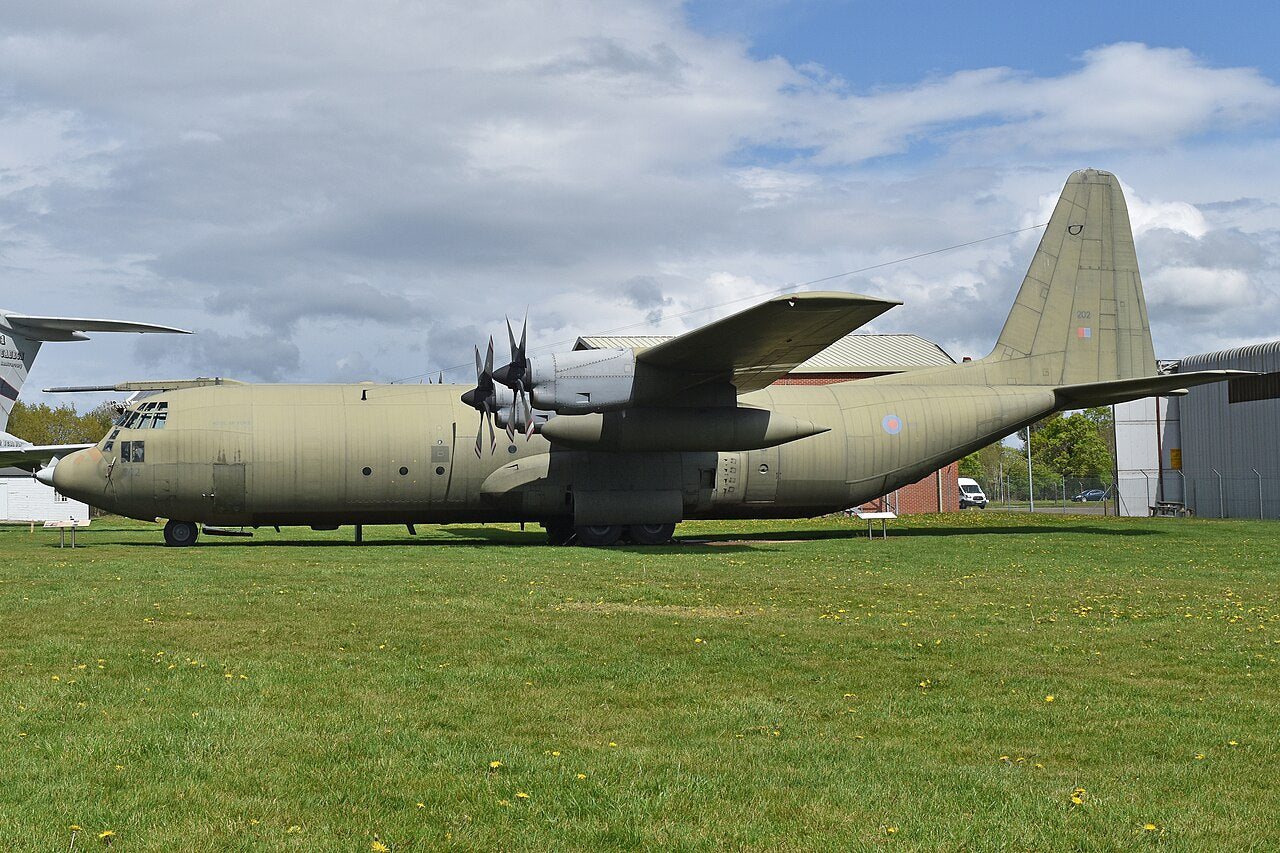
Photograph: Alan Wilson · 25 April 2019 · Photo source: Lockheed Hercules C.3 ‘XV202’ (49134354988) · CC BY-SA 2.0

At a glance
Hercules C-130K C1/C3 · older RAF transport family; later C-130J C4/C5 distinguished below
- Role
- Tactical transport and airborne deliveryPassengers, troops, vehicles and freight; medical and airdrop arrangements depend on the task.
- Engines
- Four Allison T56-A-15 turbopropsC-130K C1/C3. A turboprop uses a turbine to drive a propeller.
- C3 fuselage extension
- 4.57 m · 15 ftExtra length over the C1, not total aircraft length. Sections were inserted ahead of and behind the wing.
- Freight load
- Up to 20 tonnes in the C1/C3 referenceA maximum configuration-dependent load; cargo size, fuel, route and operating conditions constrain a particular mission.
- Passenger arrangements
- Up to 128 across the C1/C3 familyDepends on the mark and cabin arrangement. It is an alternative to a full freight load, not extra capacity to add to it.
In Air Defender
Role guidance · v0.8.16.0
Air Defender’s v0.8.16.0 catalogue describes the Hercules as a tactical transport. The catalogue’s crew, speed, height and range figures appear in the separate game-data block below. They are not a C-130J performance sheet.
For moving base supplies, use the SUP supply guide, the cargo-selection examples and the delivery-stage checks. These distinguish the aircraft’s starting base, the source of its cargo and the delivery destination.
Game catalogue values · v0.8.16.0
In-game specifications
These figures come from the game’s general aircraft reference. A matching civilian register entry can supply different fields in Aircraft Data. How to read the two layouts →
- Role
- Tactical Transport
- Category
- Military Transport
- Service ceiling
- 33,000 ftA reference upper height. Read Flight Info for the contact’s present height.
- Maximum speed
- 325 knotsA reference maximum, not the speed the aircraft is flying now.
- Cruise speed
- 290 knotsA typical speed for the main part of a flight, not a guaranteed commanded speed.
- Stall speed
- 100 knotsA reference for specified conditions. Stalling means the wing loses lift, not that an engine stops.
- Typical crew
- 5
- Powerplant
- Four turboprop engines (Allison T56) Compare engine types →
- Manufacturer
- Lockheed Martin (USA)
Use the right procedure
Related base entries
Compare these base entries with the aircraft actually available in your scenario.
In depth
C1 acquisition and the C3 stretch
The RAF acquired 66 C-130K Hercules aircraft between December 1966 and May 1968. They entered the fleet as C1 transports. Their work included long-distance transport as well as the movement of people and supplies supporting deployed aircraft.
Between 1980 and 1985, 30 aircraft were converted to C3 standard. Marshall of Cambridge inserted fuselage sections supplied by Lockheed ahead of and behind the wing, increasing length by 15 ft. The extra cabin space was useful on longer transport routes and for parachuting tasks.
Turboprop propulsion
The C1/C3 uses four Allison T56-A-15 turboprop engines. Each engine drives a propeller: most of the useful propulsive force comes from the propeller rather than a jet exhaust. This is the same broad engine category as the Tu-95, but the aircraft and their propeller arrangements are very different.
The C-130J changes the engine and propeller combination to AE2100D3 engines and six-bladed propellers. That later propulsion system forms part of a wider redesign, so a J-model speed, range or engine rating is not a substitute for a C-130K figure.
Cabin, cargo and medical arrangements
The freight bay can carry wheeled or tracked vehicles and palletised general cargo. A load can reach a space limit before reaching its permitted weight, while a dense load can reach the weight limit with cabin space still available. Fuel and route requirements also affect how much can be taken.
Passenger and troop seats provide another cabin arrangement. Medical evacuation uses stretcher fittings instead; the C1/C3 family’s published arrangements include 64 or 82 stretchers, depending on the mark and configuration. These capacities are alternatives for different layouts, not loads that can all be carried together.
Tactical transport and formation equipment
The Hercules can deliver people or stores by landing or by airdrop. Its transport-support role includes parachute delivery and operations from unprepared or semi-prepared surfaces by day or night. Suitability still depends on the landing surface, load and operating conditions.
In the early-2000s C1/C3 configuration, the C3 has station-keeping equipment to help maintain its position in a large formation when cloud or poor visibility hides the other aircraft. Defensive equipment also varies: some special-task aircraft carry enhanced warning and countermeasure systems. The equipment of one modified aircraft does not describe every Hercules.
Receiving fuel and acting as a tanker
Some C-130K aircraft received probes above the cockpit so that they could take fuel in flight. This is different from converting an aircraft into a tanker able to supply fuel to another aircraft. The probe is the receiving connection; giving fuel requires a different installation.
C3P denotes a probe-equipped C3. The addition of a probe changes endurance options, but it does not remove the need to plan the load, fuel reserves and a suitable landing destination.
Variants
Hercules C1
The original RAF C-130K transport with the shorter fuselage.
Hercules C3
The lengthened C-130K conversion, with fuselage sections ahead of and behind the wing adding 15 ft of length.
C3P
A probe-equipped C3 able to receive fuel in flight. Receiving fuel does not, by itself, make it a tanker.
Hercules C4 and C5 · C-130J
Later J-model aircraft. C4 is the longer version and C5 the shorter version, with different engines, six-bladed propellers and a revised flight deck.
After 1998
23 November 1999 · first RAF C-130J delivery
The first RAF C-130J was delivered to Lyneham on this date, initially for maintenance training and groundcrew familiarisation. Delivery and operational service are different milestones.
The subsequent C4/C5 configuration introduced a digital flight deck and head-up displays for two-pilot flight-deck operation, with a separate air loadmaster position in the hold. The C1/C3 has different crew and equipment arrangements.
References and further reading
C-130K roles, engines, loading and equipment
- Royal Air Force · Hercules C-130K C1/C3, archived 5 July 2007
- Royal Air Force · Aircraft & Weapons, ©08/03, pp. 24–25: C1/C3 transport roles; C4/C5 kept separate
C1/C3 conversion history and probe-equipped aircraft
C-130J delivery and later configuration
- UK Parliament · C-130J delivery to RAF Lyneham, 23 November 1999
- Royal Air Force · Aircraft & Weapons, ©08/03, pp. 24–25: C1/C3 transport roles; C4/C5 kept separate