

Aircraft overview
The Tornado GR1 is the RAF’s interdiction and strike version of the tri-national Tornado. Two RB199 turbofans power an aircraft with variable-sweep wings and a pilot and navigator seated one behind the other. Its principal job was attacking ground targets, rather than the air-defence interception task of the Tornado F3.
The strike family includes the GR1, the GR1A reconnaissance aircraft, the GR1B maritime-strike version and the later GR4 upgrade. These designations matter: they identify different equipment and tasks within a family that shares much of its airframe.
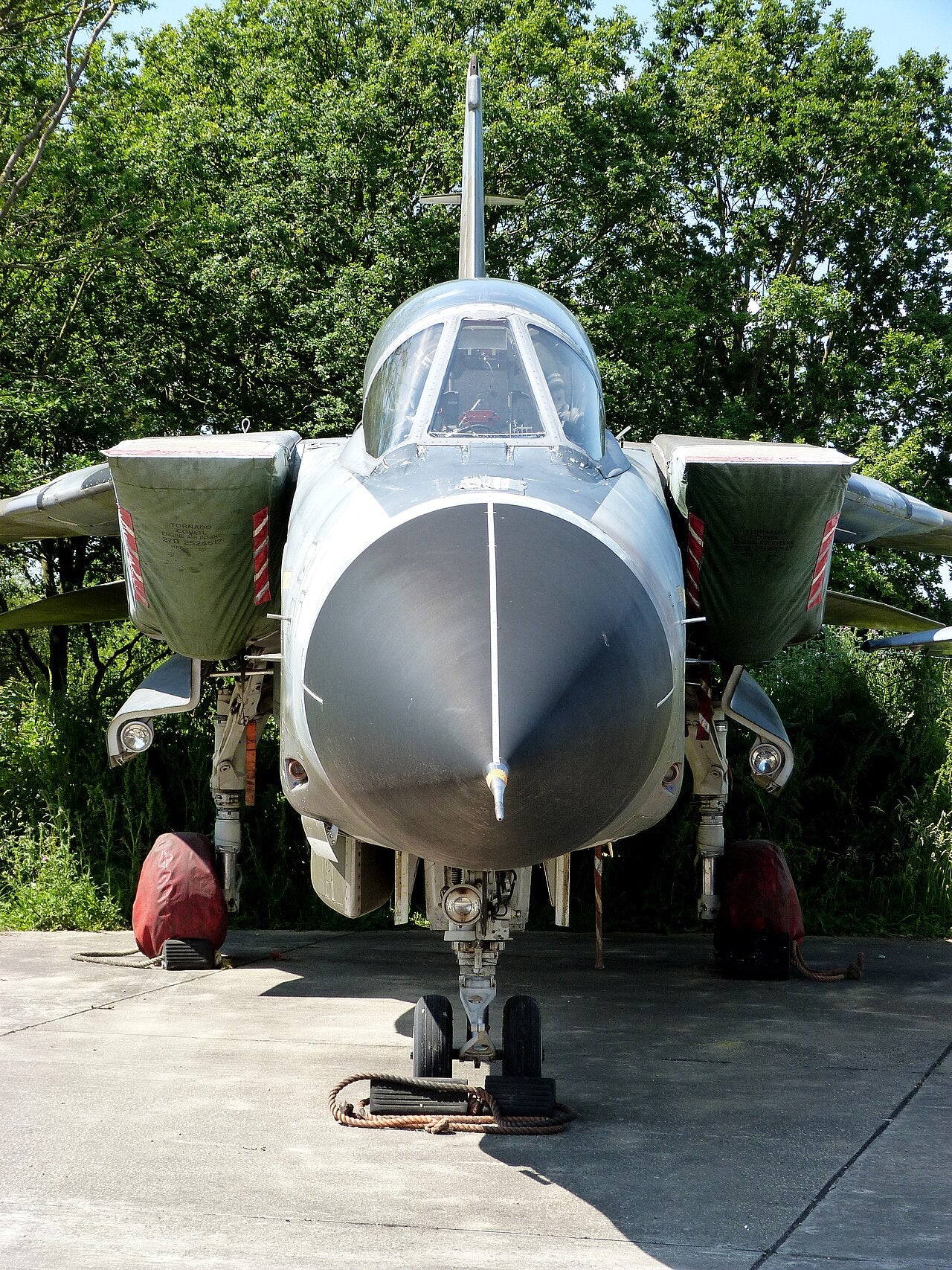
Photograph: Craig Sunter · 3 July 2011 · Photo source: Panavia Tornado at Yorkshire Air Museum (5901965404) · CC BY 2.0

At a glance
Tornado GR1 · GR1 dimensions and separately labelled February 1998 fleet figures
- Role
- Low-level interdiction and strikeThe GR1 is a strike aircraft; GR1A and GR1B have specialised reconnaissance and maritime roles.
- Crew
- 2Pilot and navigator seated one behind the other.
- Engines
- Two Turbo-Union RB199-103 reheated turbofansGR1 engine designation; thrust and fuel consumption vary with operating conditions.
- Wingspan · spread
- 13.90 m · 45 ft 7¼ inGR1 wings fully spread.
- Wingspan · swept
- 8.60 m · 28 ft 2½ inGR1 wings at 68 degrees of sweep.
- Length
- 16.7 m · 54 ft 9½ inRounded GR1 dimension; the F3 is a different airframe version.
- Guns
- Two 27 mm Mauser cannonGR1 weapon installation; reconnaissance and later versions have different equipment fits.
- Offensive payload and radius · 1998
- 4,500 kg · about 550 nmFebruary 1998 figures for the combined GR1/GR1A/GR4 fleet. Radius is a typical mission without air-to-air refuelling; actual load affects range.
In Air Defender
Role guidance · v0.8.16.0
Air Defender’s v0.8.16.0 catalogue contains separate Tornado GR1 and F3 entries. The GR1 is classified as a strike/attack aircraft. The game’s speed, ceiling and range values appear separately below; real-aircraft specifications do not set a contact’s present state.
Read the full designation in Aircraft Data, and compare it with the F3 reference. The linked identification guide explains how to investigate a track. An aircraft’s type and a track’s identity or intentions are different information.
Game catalogue values · v0.8.16.0
In-game specifications
These figures come from the game’s general aircraft reference. A matching civilian register entry can supply different fields in Aircraft Data. How to read the two layouts →
- Role
- Strike / Attack
- Category
- Military Strike
- Service ceiling
- 50,000 ftA reference upper height. Read Flight Info for the contact’s present height.
- Maximum speed
- 1,112 knotsA reference maximum, not the speed the aircraft is flying now.
- Cruise speed
- 520 knotsA typical speed for the main part of a flight, not a guaranteed commanded speed.
- Stall speed
- 140 knotsA reference for specified conditions. Stalling means the wing loses lift, not that an engine stops.
- Typical range
- 1,500 NMA reference flying distance, not fuel remaining or radar detection range.
- Typical crew
- 2
- Powerplant
- Twin turbofan engines with afterburners (Turbo-Union RB199) Compare engine types →
- Manufacturer
- Panavia (UK/Germany/Italy)
Use the right procedure
In depth
The Tornado programme and RAF versions
Britain, West Germany and Italy began the joint programme in 1968. The first prototype flew on 14 August 1974, and operational deliveries began in July 1980. Panavia brought the three partners together to produce the variable-sweep aircraft.
The core IDS version served with the partner nations and Saudi Arabia. The RAF designated its attack aircraft GR1 and incorporated additional fuel in the fin. It subsequently developed the GR1A reconnaissance and GR1B anti-shipping versions. The GR4 mid-life-upgrade prototype first flew in May 1993.
Airframe and propulsion
The GR1’s wings move between a span of about 13.90 m fully spread and 8.60 m at 68 degrees sweep. Overall length is about 16.7 m. The F3 has a longer forward fuselage and different dimensions.
Two Turbo-Union RB199-103 turbofans provide propulsion. Reheat adds fuel behind the turbines for additional thrust, with increased fuel use. Speed and range need their conditions: a high-altitude maximum or a ferry-range figure does not describe a loaded low-level attack mission.
Crew, weapons and operating radius
The pilot and navigator work in tandem cockpits. The GR1 has two 27 mm Mauser cannon and provision for AIM-9 Sidewinder missiles. Its main task is air-to-ground attack.
Weapons used by the strike force include conventional bombs, Paveway laser-guided bombs and the ALARM anti-radar missile. GR1Bs carry Sea Eagle for the maritime-strike role. Weapon provision is version- and mission-dependent; a family-level stores list is not the load of every Tornado.
The February 1998 MOD comparison gave the grouped GR1/GR1A/GR4 fleet a maximum offensive payload of 4,500 kg and a typical combat radius of 550 nautical miles without air-to-air refuelling. The load chosen for an operation affects the aircraft’s range. A specification-table maximum is not the weapon load carried by every flight.
The 1991 Gulf campaign
RAF Tornado GR1s attacked Iraqi airfields at low level with JP233 runway-denial weapons during the 1991 Gulf War. The campaign also included medium-level bombing with 1,000 lb bombs and laser-guided attacks with Paveway II. The RAF force flew more than 1,500 operational sorties, mostly at night, and lost six GR1s in combat.
Low-level airfield attack, medium-level bombing, reconnaissance and maritime strike call for different equipment and tactics. A Tornado’s version, equipment and assigned task determine which mission it can carry out.
Why the F3 is a different Tornado
The air-defence branch was developed for long-range interception and combat air patrol. Foxhunter radar occupies its redesigned forward fuselage, while radar-guided missiles are carried beneath the body. The F3 is not a GR1 with a different mission selected.
The distinction matters in Air Defender’s catalogue as well as in history. Use the full GR1 or F3 designation, then consult the appropriate reference. A shared family name does not establish a common radar, weapon fit or set of performance figures.
Variants
Tornado IDS
The interdiction-and-strike branch used by the programme’s partner nations and Saudi Arabia. National versions differ in detail.
Tornado GR1
The RAF strike version, incorporating additional fuel in the fin.
Tornado GR1A
The RAF tactical-reconnaissance version, with specialised reconnaissance equipment distinct from the standard GR1 fit.
Tornado GR1B
The anti-shipping version modified for the Sea Eagle missile.
Tornado GR4
The RAF mid-life upgrade. Its prototype first flew in May 1993, and the designation appears with GR1 and GR1A in the February 1998 MOD comparison.
Tornado ADV · F2/F3
The separate air-defence branch. The F3’s radar, fuselage and air-to-air weapons differ from the strike versions.
References and further reading
Strike versions and F3 distinctions
GR1 airframe, crew, engines, weapons and operations
- National Museum of the U.S. Air Force · Panavia Tornado GR1 technical notes
- Panavia · RB199 engine design and propulsion