

Aircraft overview
The Piper PA-28 Cherokee is a single-engined light aircraft family with a low wing and a cabin suited to private flying and instruction. The early PA-28-160 has fixed tricycle landing gear, a rectangular wing and a 160 hp Lycoming engine.
The PA-28-160 received approval on 31 October 1960, before the Cherokee’s introduction in 1961. The family subsequently developed into the Warrior, Archer, Dakota and Arrow, with changes to power, wings, landing gear and operating limits.
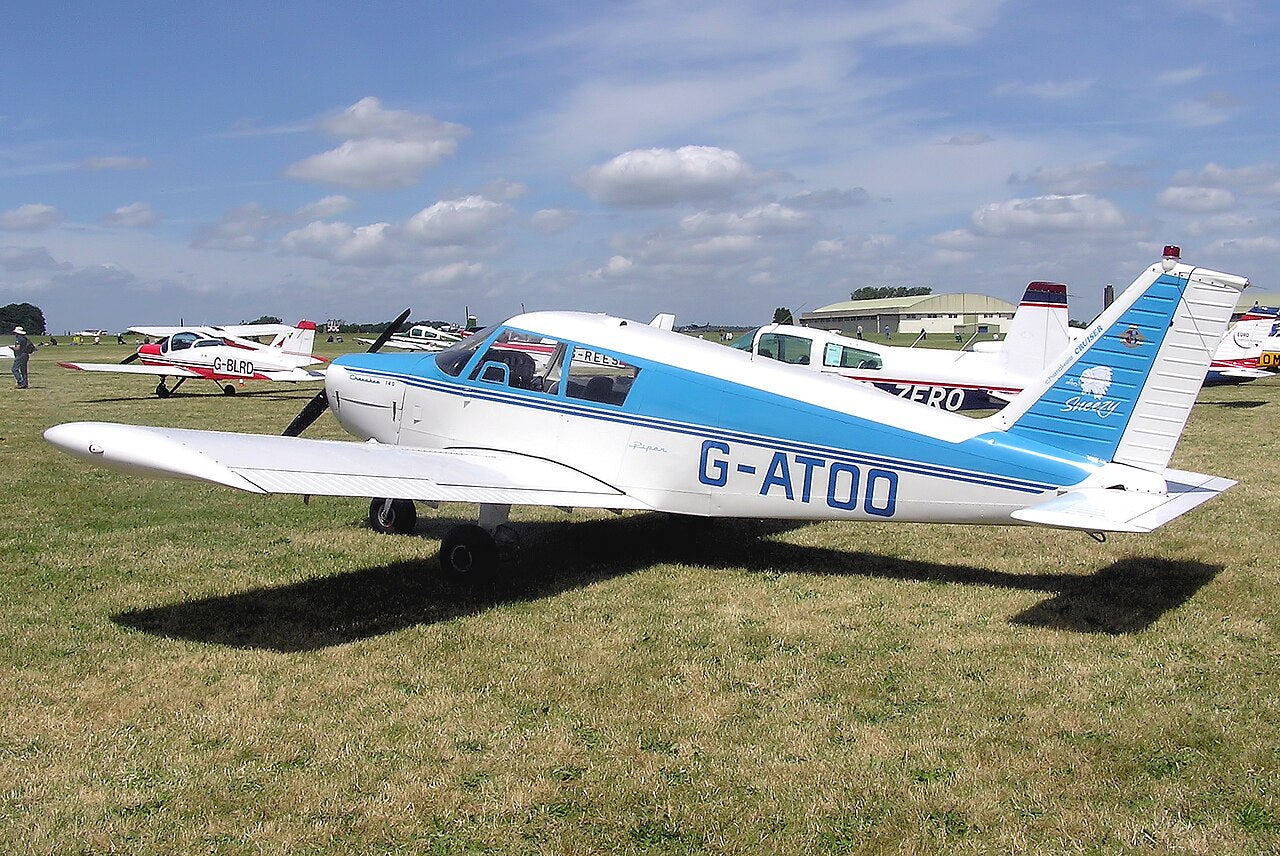
Photograph: Adrian Pingstone · July 2005 · Photo source · Public domain


At a glance
PA-28-160 Cherokee · normal category; serial applicability identified where limits change
- Engine options
- Lycoming O-320-B2B or O-320-D2AApproved carburetted installations for the PA-28-160.
- Engine rating
- 160 hp at 2,700 rpmPA-28-160 limit for all operations.
- Seating
- Four people, including the pilotNormal category.
- Maximum aircraft weight
- 2,200 lbWhole-aircraft limit, not payload.
- Fuel capacity
- 50 US galTwo wing tanks; total capacity.
- Never-exceed speed
- 148 knots CASCalibrated airspeed limit; not a cruise speed.
- Wingspan · early aircraft
- 30 ftEarly configuration, serials 28-1–28-1760.
In Air Defender
Role guidance · v0.8.16.0
Air Defender v0.8.16.0 lists the general PA-28 Cherokee as General Aviation. The catalogue’s family entry is separate from the PA-28-160 example and does not establish a particular engine, serial number or current load.
Compare the later Warrior and the high-wing Skyhawk. Use Aircraft Data and flight-plan information to investigate the contact.
Game catalogue values · v0.8.16.0
In-game specifications
These figures come from the game’s general aircraft reference. A matching civilian register entry can supply different fields in Aircraft Data. How to read the two layouts →
- Role
- General Aviation
- Category
- Light Aircraft
- Service ceiling
- 13,000 ftA reference upper height. Read Flight Info for the contact’s present height.
- Maximum speed
- 130 knotsA reference maximum, not the speed the aircraft is flying now.
- Cruise speed
- 108 knotsA typical speed for the main part of a flight, not a guaranteed commanded speed.
- Stall speed
- 51 knotsA reference for specified conditions. Stalling means the wing loses lift, not that an engine stops.
- Typical crew
- 1
- Powerplant
- Single piston engine (Lycoming O-320, 150-160 HP) Compare engine types →
- Manufacturer
- Piper Aircraft (USA)
Use the right procedure
In depth
The Cherokee family
The Cherokee entered Piper’s range in 1961. Its development produced several related types, including the Warrior, Archer, Dakota and Arrow. Their common ancestry does not make their specifications interchangeable.
The original PA-28-150 and PA-28-160 are distinct approved models. The 150 has a 150 hp installation and a 2,150 lb maximum weight, compared with 160 hp and 2,200 lb for the PA-28-160.
Wing and landing-gear arrangement
The early Cherokee has a low, rectangular wing and fixed nosewheel landing gear. The 30 ft span in the original service drawing applies to the illustrated early serial group. The later Warrior’s semi-tapered wing is a different configuration.
Powerplant and propeller options
The PA-28-160’s approved engines are the O-320-B2B and O-320-D2A, with a 160 hp limit at 2,700 rpm. Sensenich propeller installations differ between the early serial group and aircraft from 28-1761 onward.
The never-exceed limit is 148 knots calibrated airspeed. That upper limit is separate from normal cruising performance and from an indicated-air-speed limit on another PA-28 version.
Cabin, fuel and baggage
The normal-category arrangement provides four places. Two wing tanks give a total fuel capacity of 50 US gallons. The permitted load must remain within the aircraft’s weight and centre-of-gravity limits.
The early baggage limit is 125 lb for serials 28-1–28-1760 and 28-1760A. Aircraft 28-1761–28-4377 have a 200 lb limit. The earlier group can receive a 200 lb allowance under Piper Service Spares Letter 242; the higher allowance requires that modification.
Variants
PA-28-150 / PA-28-160
Original Cherokee versions with different engine ratings and weight limits.
Warrior, Archer, Dakota and Arrow
Later developments of the Cherokee family; their individual specifications remain separate.