

Aircraft overview
The SEPECAT Jaguar is an Anglo-French combat aircraft developed for tactical support and training. The RAF’s single-seat GR1 became a ground-attack and reconnaissance aircraft. Two Adour turbofans power a compact airframe with an 8.68 m wingspan and a length of about 16.8 m.
RAF frontline service began in 1974. The type served in Germany, the 1991 Gulf War and the Balkans. The later GR1A and GR3 upgrades belong to the same development line, with different equipment standards.
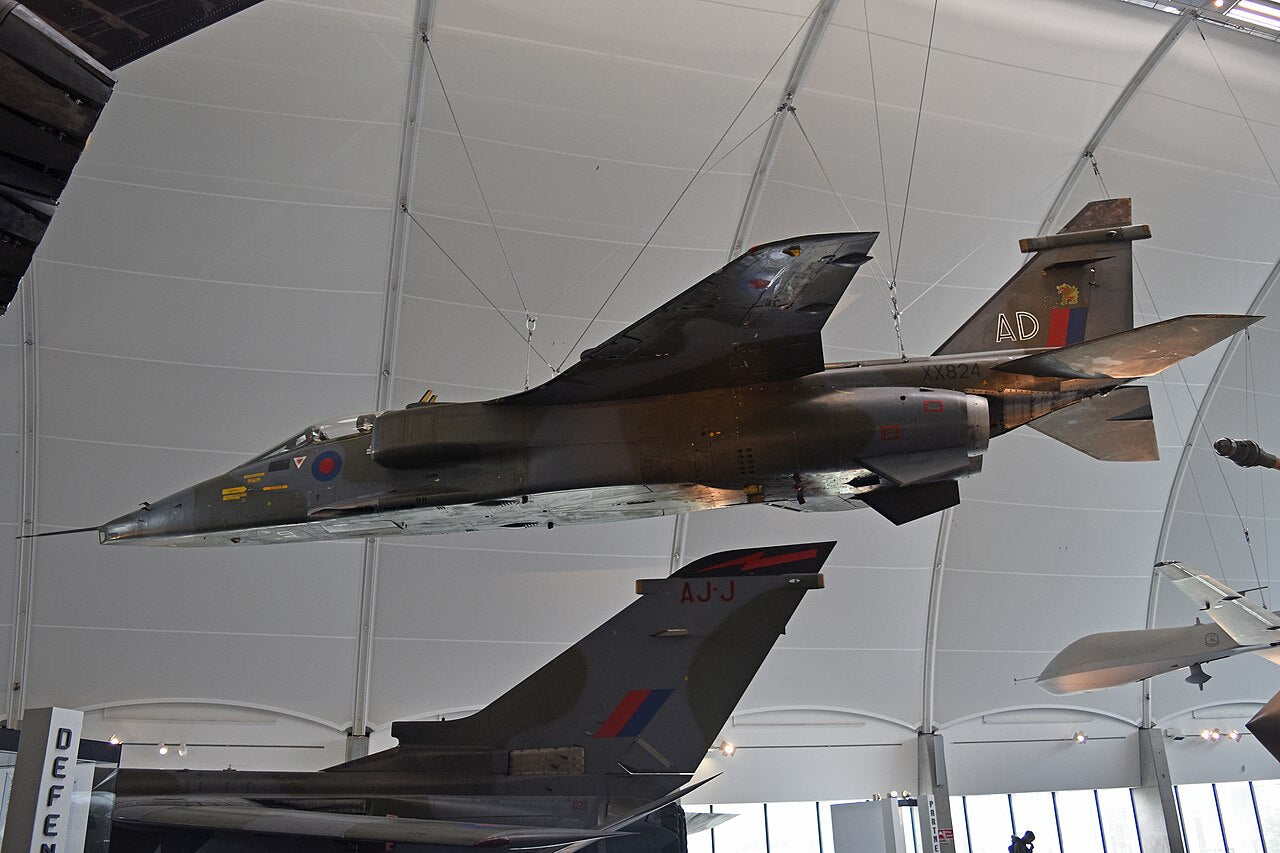
Photograph: Alan Wilson · 3 October 2020 · Photo source: SEPECAT Jaguar GR.1 ‘XX824 AD’ (51070992308) · CC BY-SA 2.0

At a glance
Jaguar GR1 airframe · separately labelled 1998 GR1A/GR3 fleet figures
- Role
- Single-seat tactical support and ground attackThe RAF’s single-seat attack and reconnaissance branch.
- Crew
- 1One pilot.
- Engines
- Two Rolls-Royce/Turbomeca Adour turbofansEngine marks changed: Mk 102 was followed by Mk 104 in the RAF fleet before the 1991 Gulf War.
- Wingspan
- 8.68 m · 28 ft 6 inGR1 airframe dimensions.
- Length
- 16.8 m · 55 ft 2 inGR1 airframe dimensions.
- Maximum offensive payload · 1998
- 2,900 kgFebruary 1998 figure for the combined GR1A/GR3 fleet; actual carriage depends on the mission.
- Combat radius · 1998
- About 400 nmTypical radius without air-to-air refuelling, for the grouped GR1A/GR3 fleet; load configuration affects the range.
- RAF service
- 1974–2007Frontline RAF service; later variants continued the development of the GR1.
In Air Defender
Role guidance · v0.8.16.0
Air Defender has a separate Jaguar GR1 aircraft-catalogue entry, classified as a strike/attack type. The game’s reference speed, ceiling and range figures appear below. They do not establish the equipment, identity or intentions of a particular contact.
Use Aircraft Data to compare the full designation. The linked guides cover flight plans and track identification. A real-world GR1A or GR3 upgrade should not be assumed simply because the game uses the family name Jaguar GR1.
Game catalogue values · v0.8.16.0
In-game specifications
These figures come from the game’s general aircraft reference. A matching civilian register entry can supply different fields in Aircraft Data. How to read the two layouts →
- Role
- Strike / Attack
- Category
- Military Strike
- Service ceiling
- 45,900 ftA reference upper height. Read Flight Info for the contact’s present height.
- Maximum speed
- 840 knotsA reference maximum, not the speed the aircraft is flying now.
- Cruise speed
- 460 knotsA typical speed for the main part of a flight, not a guaranteed commanded speed.
- Stall speed
- 130 knotsA reference for specified conditions. Stalling means the wing loses lift, not that an engine stops.
- Typical range
- 875 NMA reference flying distance, not fuel remaining or radar detection range.
- Typical crew
- 1
- Powerplant
- Twin turbofan engines with afterburners (Rolls-Royce/Turbomeca Adour) Compare engine types →
- Manufacturer
- SEPECAT (UK/France)
Use the right procedure
In depth
An Anglo-French programme
The Jaguar began as a joint British-French project for a combat trainer and tactical support aircraft. The RAF adopted its single-seat version for attack and reconnaissance. It began equipping frontline squadrons in 1974 and formed an important part of RAF Germany’s Cold War capability.
Tornado re-equipment displaced the Jaguar from that German role in 1985, while the type continued elsewhere in RAF service. The 1991 Gulf War and subsequent Balkan operations demonstrated both its attack and photographic-reconnaissance roles.
Airframe and Adour engines
The single-seat aircraft has two Adour turbofans, a joint Rolls-Royce and Turbomeca engine family. The GR1 airframe dimensions are approximately 8.68 m span and 16.8 m length. Engine versions need separate identification: the original RAF Mk 102 was followed by Mk 104 before the Gulf deployment.
The Gulf’s high temperatures reduced available engine thrust. During the Gulf deployment, the force received engine changes alongside revised defensive equipment. These adaptations were specific to that operation; Jaguar configurations changed over the type’s service life.
Weapons, load and operating radius
In February 1998, the Ministry of Defence gave the combined GR1A/GR3 fleet a maximum offensive payload of 2,900 kg and a typical combat radius of 400 nautical miles without air-to-air refuelling. A combat radius includes reaching the operating area and returning; it is different from a one-way ferry range.
Gulf War weapon use included 1,000 lb bombs, CRV-7 rockets and CBU-87 cluster bombs. Defensive changes included chaff and flare equipment and provision for overwing AIM-9L missiles. The Jaguars did not carry AIM-9L operationally during the Gulf campaign because the anticipated Iraqi air threat did not materialise.
Reconnaissance and operational use
Reconnaissance was a distinct operational task. Jaguars flew strike and reconnaissance missions during the 1991 Gulf War. In the Balkans, aircraft configured for reconnaissance photographed Udbina airfield in Croatia, providing imagery for planning a NATO strike in which RAF Jaguars also participated.
An attack aircraft’s designation therefore does not tell a controller what it is doing on a particular flight. Photographic reconnaissance, transit and an attack mission are different activities, even when the same aircraft type can undertake all three.
Variants
Jaguar GR1
The RAF single-seat tactical support, attack and reconnaissance version introduced to frontline service in 1974.
Jaguar GR1A and GR3
Later RAF single-seat standards. The February 1998 MOD payload and radius figures apply to these two designations as a group; they do not separate individual configurations.
French and export Jaguars
Other national versions of the Jaguar programme. Their engines, mission equipment and weapons are separate from the RAF GR1 specification.
After 1998
RAF ©08/03 guide · later GR3/A equipment
The later GR3/A equipment included improved navigation, new displays, a digital data bus and night-vision-compatible lighting, with an Adour Mk 104 to Mk 106 engine upgrade in progress. This later fit does not describe the full 1998 GR1A/GR3 fleet.
2007 · RAF retirement
The Jaguar left RAF frontline service in 2007. This retirement belongs to the later history of the type, after the 1998 setting of Air Defender.
References and further reading
Programme, airframe and RAF operational history
- RAF Museum · SEPECAT Jaguar GR.1 historical role
- RAF Museum · Jaguar GR1 technical panel, pp54–55
- BAE Systems · Jaguar: programme and aircraft role
1998 GR1A/GR3 payload and radius
Adour design and Gulf War equipment changes
- RAF Museum · Rolls-Royce/Turbomeca Adour: twin-shaft turbofan design
- RAF Air Historical Branch · Jaguar operations in the Gulf War, pp. 47–49: engines and equipment changes