

Aircraft overview
The Sikorsky S-61N is an amphibious transport helicopter developed for overwater work, particularly oil-rig support. Its boat-shaped lower fuselage and side sponsons distinguish it from the land-based S-61L.
The N first flew on 7 August 1962. Its FAA transport-category approval followed on 9 September 1963. Two CT58 engines drive the rotor system, and the normal flight crew consists of two pilots.
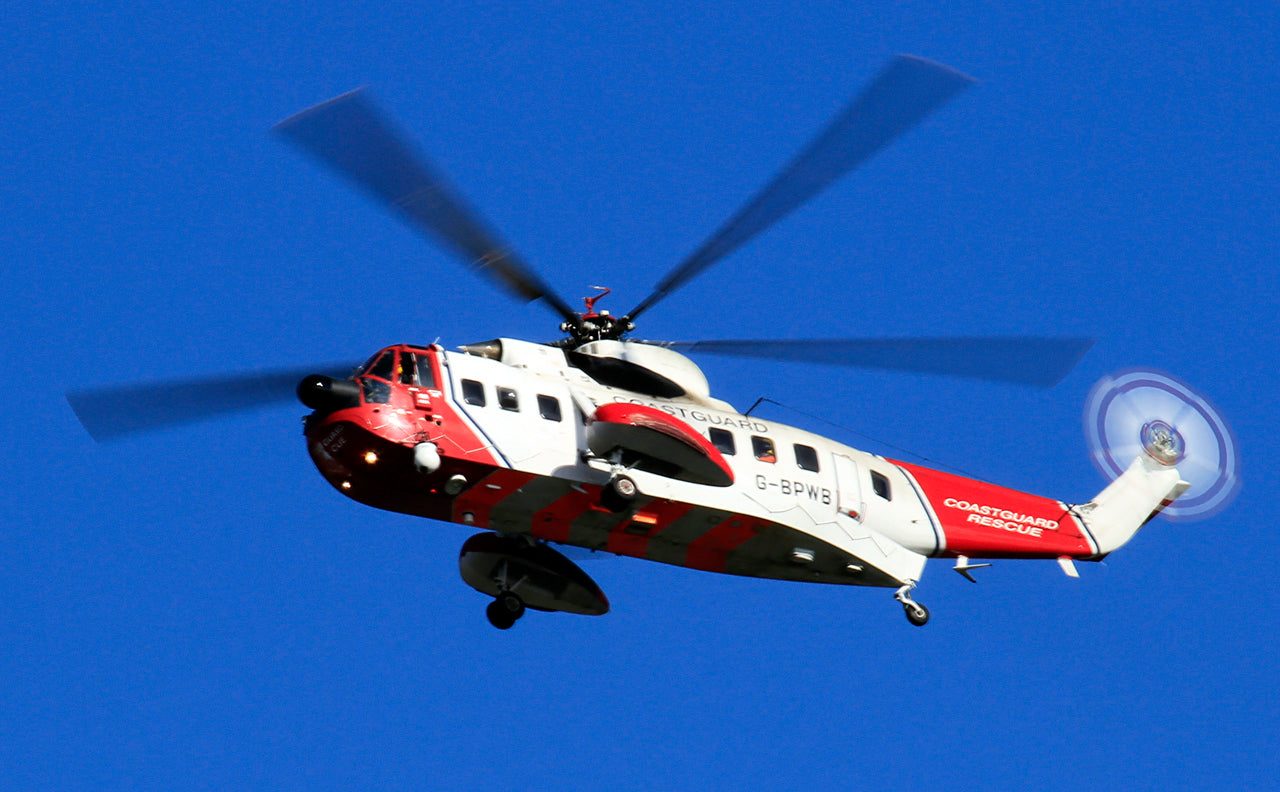
Photograph: Kok Vermeulen · 2010-08-18 · Photo source: G-BPWB CoastGuard over EHRD (4905540670) · CC BY 2.0 · Unmodified photograph.

At a glance
S-61N · CT58-110-1 installation under FAA 1H15
- Engines
- Two General Electric CT58-110-1 turboshaftsSelected approved installation.
- Installed take-off power
- 1,250 shp per engine · five minutesTwo-engine combined take-off limit: 2,300 shp.
- Continuous power
- 1,050 shp per engineCombined continuous limit: 2,100 shp.
- Maximum mass
- 19,000 lb · approximately 8,618 kgCategory A take-off profiles can require lower weights.
- Flight crew
- Two pilotsPublished minimum.
- Certified passenger ceiling
- 39Exit-related maximum; separate from a particular operator’s cabin layout.
- Never-exceed speed
- 130 kt calibrated airspeedOperating limit, separate from cruise speed.
In Air Defender
Role guidance · v0.8.16.0
Air Defender v0.8.16.0 presents the S-61N as an offshore transport helicopter used on North Sea support flights during the 1990s.
Compare the S-76 and the Super Puma. The Sea King HAR.3 is a related military reference with different engines, equipment and mission arrangements.
Game catalogue values · v0.8.16.0
In-game specifications
These figures come from the game’s general aircraft reference. A matching civilian register entry can supply different fields in Aircraft Data. How to read the two layouts →
- Role
- Offshore Transport Helicopter
- Category
- Light Helicopter
- Service ceiling
- 14,000 ftA reference upper height. Read Flight Info for the contact’s present height.
- Maximum speed
- 143 knotsA reference maximum, not the speed the aircraft is flying now.
- Cruise speed
- 120 knotsA typical speed for the main part of a flight, not a guaranteed commanded speed.
- Stall speed
- Not specified as a stall-speed valueA zero in the game catalogue means no usable stall-speed figure is supplied; it does not mean the rotor blades cannot stall. FAA helicopter handbook: rotor-blade stall →
- Typical crew
- 2
- Powerplant
- Twin turboshaft engines (General Electric CT58) Compare engine types →
- Manufacturer
- Sikorsky (USA)/Westland (UK license production)
Use the right procedure
In depth
The commercial overwater version
The S-61L and S-61N adapted the S-61 family for commercial transport. The N retained the amphibious arrangement for overwater operations, with oil-rig support an important application.
Its August 1962 first flight and September 1963 FAA approval are separate milestones. The civil N should also be distinguished from the military Sea King variants developed within the wider S-61 family.
Hull, sponsons and landing gear
The N modifies the S-61L with a hull, side sponsons, retractable landing gear and a modified tail pylon. The hull and sponsons provide the configuration’s amphibious capability.
The land-based S-61L has a different undercarriage arrangement. Airframe or cabin figures from the military SH-3 or the rear-ramp S-61R describe other members of the family.
Installed power and transmission limits
In the CT58-110-1 installation, each engine has a five-minute take-off rating of 1,250 shaft horsepower and a continuous rating of 1,050. The figures apply under the stated sea-level, static, standard-day conditions.
The combined two-engine limit is 2,300 shaft horsepower for take-off and 2,100 continuously. Adding the two individual take-off ratings would overstate the permitted combined output.
Crew and transport loading
The minimum crew is two pilots. The certification entry permits up to thirty-nine passengers on the basis of emergency exits; an operator’s offshore seating layout and equipment determine the actual cabin capacity.
The published 19,000 lb maximum mass is also subject to the selected Category A take-off profile. Passenger seats alone do not establish the load that can be carried for a particular departure.
Operating limits
The never-exceed limit is 130 knots calibrated airspeed. It is an airframe operating limit, rather than a quoted normal cruise speed or a groundspeed.
One-engine-inoperative ratings and take-off profiles have separate conditions and time limits. They describe approved emergency operation, rather than the normal power available throughout a flight.
Variants
S-61L
Land-based commercial transport from which the N was developed.
S-61N
Amphibious commercial transport with hull, sponsons and retractable gear.
Military Sea King / S-61R
Related family branches with different equipment and airframe arrangements.
After 1998
2013 · continued service
The first S-61N, serial 61143, was still serving with the Irish Coast Guard under contract in 2013.