

Aircraft overview
The Sikorsky S-76 is a twin-turbine transport helicopter with retractable landing gear and four-bladed main and tail rotors. It combines a compact transport cabin with a streamlined airframe suited to passenger and offshore work.
The S-76A received FAA approval on 21 November 1978. Its Allison 250 installation differs from the PT6B-powered S-76B and the Arriel-powered S-76C.
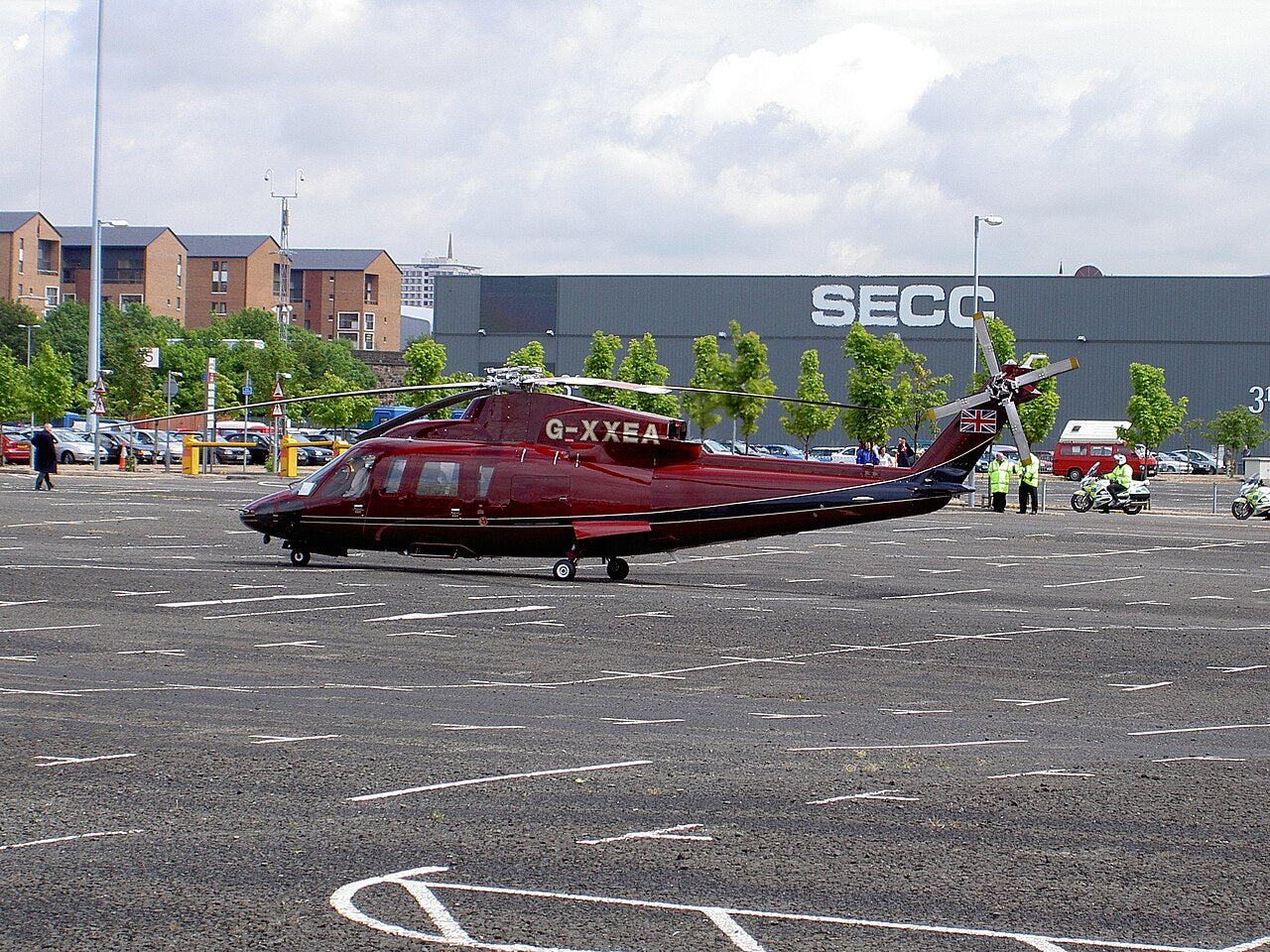
Photograph: Alf van Beem · 2004-06-03 · Photo source · CC0 1.0 · Unmodified photograph.

At a glance
S-76A · Allison 250-C30 / 250-C30S installation
- Engines
- Two Allison 250-C30 or 250-C30S turboshaftsApproved A-model installation; Arriel conversions are separate.
- Main / tail rotor
- Four / four blades13.41 m / 2.44 m diameters.
- Fuselage length / width
- 13.22 m / 2.13 mHull dimensions; stabiliser width is separate.
- Maximum mass
- 10,500 lb · 4,763 kgS-76A configuration.
- Passenger arrangement
- Up to 12 in the cabin + one cockpit passengerCockpit passenger place is unavailable when occupied by the second pilot.
- Fuel · total / usable
- 1,084 / 1,064 litresPublished A-model tank installation.
In Air Defender
Role guidance · v0.8.16.0
Air Defender v0.8.16.0 lists the S-76 as an offshore transport helicopter associated with medium-range North Sea crew-change flights.
Compare the S-61N and the Super Puma. Flight plans help place a contact’s route in context.
Game catalogue values · v0.8.16.0
In-game specifications
These figures come from the game’s general aircraft reference. A matching civilian register entry can supply different fields in Aircraft Data. How to read the two layouts →
- Role
- Offshore Transport Helicopter
- Category
- Light Helicopter
- Service ceiling
- 15,000 ftA reference upper height. Read Flight Info for the contact’s present height.
- Maximum speed
- 155 knotsA reference maximum, not the speed the aircraft is flying now.
- Cruise speed
- 140 knotsA typical speed for the main part of a flight, not a guaranteed commanded speed.
- Stall speed
- Not specified as a stall-speed valueA zero in the game catalogue means no usable stall-speed figure is supplied; it does not mean the rotor blades cannot stall. FAA helicopter handbook: rotor-blade stall →
- Typical crew
- 2
- Powerplant
- Twin turboshaft engines (Allison/Rolls-Royce 250 or Pratt & Whitney PT6) Compare engine types →
- Manufacturer
- Sikorsky (USA)
Use the right procedure
In depth
Airframe and rotors
The S-76 has a tricycle retractable undercarriage and a conventional main-rotor/tail-rotor arrangement. Both rotors have four blades.
The main rotor is 13.41 m in diameter and the tail rotor 2.44 m. The 2.13 m hull width is distinct from the 3.05 m span across the stabiliser.
A-model engines and later installations
The original S-76A installation uses Allison 250-C30 or 250-C30S engines. Approved conversions introduced Arriel 1S and 1S1 engines under the A+ and A++ commercial names.
The S-76B uses PT6B-36-series engines. The C production branch uses Arriel engines, with the C+ using the Arriel 2S1.
Crew and cabin arrangement
The A-model seating provision is twelve cabin passengers and one cockpit passenger. A second pilot occupies that cockpit place, so the maximum passenger count depends on the crew arrangement.
Visual-flight operation permits one pilot. Instrument-flight operation normally requires two, with single-pilot IFR limited to appropriately equipped aircraft operated under the approved flight manual or supplement.
Fuel and loading
The standard A-model tank installation contains 1,084 litres in total, of which 1,064 are usable. Its maximum aircraft mass is 4,763 kg.
The baggage compartment has a 272 kg limit. Cabin cargo-floor loading is limited to 366 kg per square metre; the combined loading must also satisfy the aircraft’s weight and balance requirements.
Equipment and operating envelope
The A-model approval includes day and night visual flight and instrument flight in non-icing conditions. Its en-route altitude limit is 15,000 ft; take-off and landing limits are lower and depend on the approved installation.
The power-on never-exceed limit can reach 155 knots indicated airspeed but varies with weight and density altitude. It is distinct from the lower landing-gear operating and extended-gear limit of 130 knots.
Variants
S-76A
Allison 250-C30/C30S engines; 4,763 kg maximum mass.
S-76B
PT6B-36-series engines; FAA model approval 31 October 1985.
S-76C / C+
Arriel-powered production branch. The S-76C received FAA approval on 15 March 1991. The C+ uses Arriel 2S1 engines.
After 1998
2005 · S-76C++ in China
The S-76C++ entered the Chinese market in 2005. Its Arriel 2S2 engines distinguish this later development from the Allison-powered S-76A.