

Aircraft overview
The Sukhoi Su-27 Flanker is an all-weather fighter-interceptor developed to counter the American F-15. Its role is to find and engage other aircraft, combining fighter performance with radar and infrared sensing.
The family includes single-seat fighters and two-seat trainers. The Su-27SK is a single-seat version. The Su-27UB has a second cockpit for an instructor and retains a combat capability; its crew arrangement and equipment differ from the single-seat version.
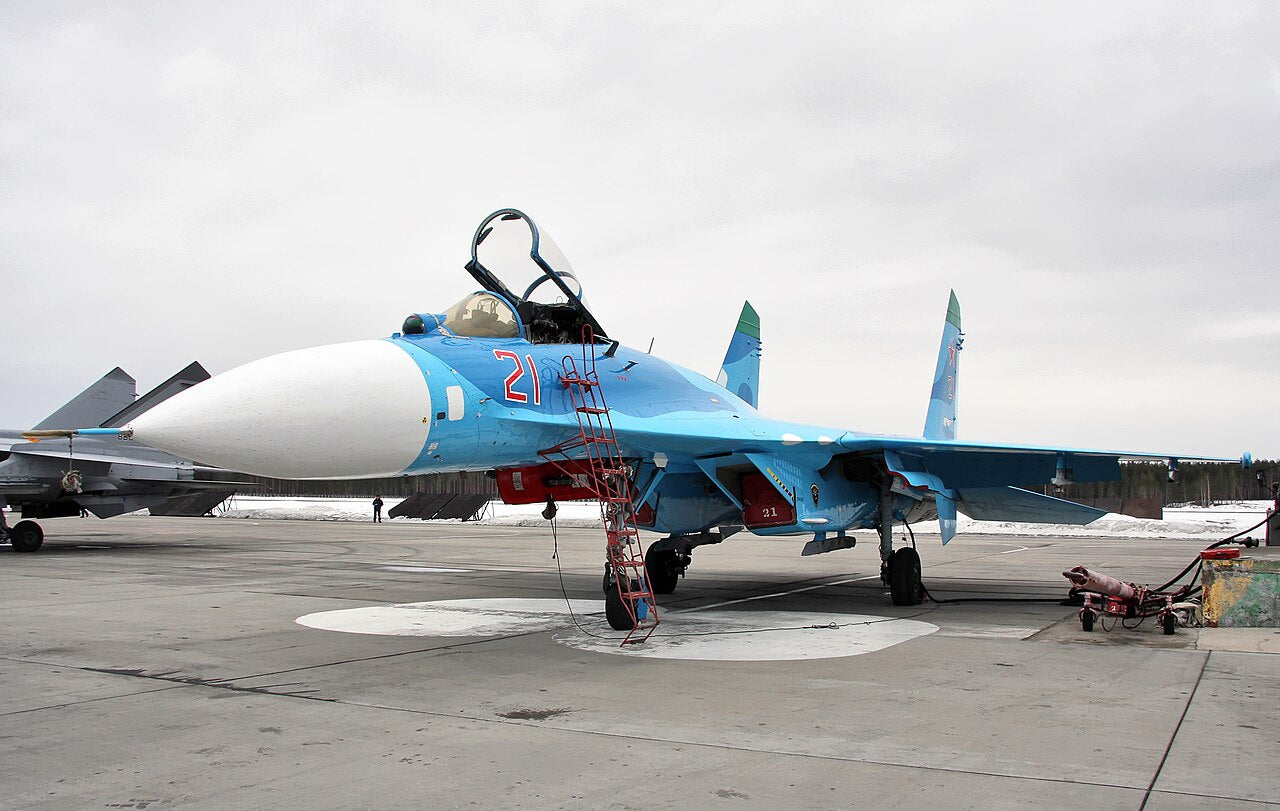
Photograph: Vitaly V. Kuzmin · 2011-04-12 · Photo source · CC BY-SA 4.0 · Unmodified photograph.

At a glance
Su-27SK · single-seat export version; later equipment configuration is dated below
- Principal role
- All-weather fighter-interceptorSu-27 family role.
- Crew
- One pilotSu-27SK, distinct from the two-seat UB trainer.
- Engines
- Two AL-31F enginesSingle-seat SK reference; afterburner and full-power ratings are distinct.
- Length / wingspan
- 21.9 m / 14.7 mSu-27SK dimensions.
- Height
- 5.9 mSu-27SK airframe dimension.
- Maximum take-off mass
- 30,450 kgTotal aircraft mass, including fuel and carried stores.
- Maximum internal fuel
- 9,400 kgFuel carried inside the aircraft; not its total take-off mass.
In Air Defender
Role guidance · v0.8.16.0
Air Defender’s v0.8.16.0 catalogue describes a single-seat Su-27 air-superiority fighter. The catalogue does not specify every export or equipment standard. Its game values are shown in their own block below.
Use Aircraft Data for type information and the trackblock for the contact’s reported height, speed and identity. Follow the identification procedure rather than treating a fighter’s name or performance as proof of its present mission.
Game catalogue values · v0.8.16.0
In-game specifications
These figures come from the game’s general aircraft reference. A matching civilian register entry can supply different fields in Aircraft Data. How to read the two layouts →
- Role
- Air Superiority Fighter
- Category
- Military Fighter
- Service ceiling
- 59,055 ftA reference upper height. Read Flight Info for the contact’s present height.
- Maximum speed
- 1,317 knotsA reference maximum, not the speed the aircraft is flying now.
- Cruise speed
- 520 knotsA typical speed for the main part of a flight, not a guaranteed commanded speed.
- Stall speed
- 130 knotsA reference for specified conditions. Stalling means the wing loses lift, not that an engine stops.
- Typical crew
- 1
- Powerplant
- Twin turbofan engines with afterburners (Saturn AL-31F) Compare engine types →
- Manufacturer
- Sukhoi (Russia)
Use the right procedure
In depth
Fighter and training roles
The original Su-27 programme addressed the requirement for an all-weather fighter-interceptor in the same generation as the F-15. Its main work is air combat rather than the dedicated strike role of the Su-24 Fencer.
The Su-27UB entered Soviet service in 1986 as an advanced trainer. The instructor sits behind the front pilot and has dual controls. A single pilot can operate the aircraft from the front seat, and the trainer retains combat capability.
Airframe, fuel and propulsion
The Su-27SK is 21.9 m long with a 14.7 m wingspan. Two AL-31F engines provide propulsion, with separate ratings for normal full power and afterburner operation.
Internal fuel capacity is up to 9,400 kg. Fuel mass is only part of the aircraft’s loaded mass; weapons, crew and the airframe also contribute. A maximum fuel capacity does not mean every sortie starts with that amount.
Understanding a stated combat configuration
The Su-27SK normal take-off reference is 23,430 kg with two R-27R1 missiles, two R-73E missiles and 5,270 kg of fuel. The 30,450 kg maximum take-off mass is a separate limit.
The normal figure belongs to that stated configuration. A different weapons load, fuel quantity or customer equipment fit changes the comparison.
Finding and aiming at a target
The Su-27SK fire-control fit described in 2011 combines search-and-track radar with infrared search and track, a laser rangefinder and a helmet-mounted target designator. A wide-angle head-up display presents information in the pilot’s forward view.
Radar and infrared sensing provide different ways of observing a target. The helmet-mounted designator supports aiming, while the weapons-control system manages the use of the selected weapon.
Variants
Su-27SK
Single-seat export fighter. Equipment can vary with the customer’s configuration.
Su-27UB
Two-seat advanced trainer with an instructor in the rear cockpit and dual controls, retaining combat capability.
Later Su-30 and Su-35 developments
The Su-27 family also served as a foundation for later combat-aircraft developments. Their newer equipment differs from the SK configuration.
After 1998
Su-27SK export equipment · specification dated 2011
The SK configuration recorded in 2011 includes a navigation computer, autopilot, radio-navigation equipment, GPS, identification equipment and a data-communications terminal. Its defensive fit lists radar warning, chaff and flare dispensers, and a pod-mounted jammer.
The 2011 date identifies this configuration, not the service-entry date of each item. Equipment can vary by period and customer, so this is not a universal Su-27 fit for 1998.