

Aircraft overview
The Tupolev Tu-142 Bear-F is a long-range maritime patrol and anti-submarine aircraft developed from the Tu-95 bomber. Four turboprop engines, each driving two propellers that turn in opposite directions, give it the familiar Bear outline. Its longer forward fuselage and specialised search equipment distinguish the naval aircraft from the bomber branch.
Its main task is to find submarines over large areas of ocean and, when required, attack them. Sonobuoys dropped into the sea provide acoustic information, while other sensors help search for a submarine or a vessel on the surface. The Tu-142M-series developed through successive search-system improvements. The Tu-142MR is a separate submarine-communications relay, and the later Tu-95MS returned the Tu-142-derived airframe to the strategic missile-carrier role.
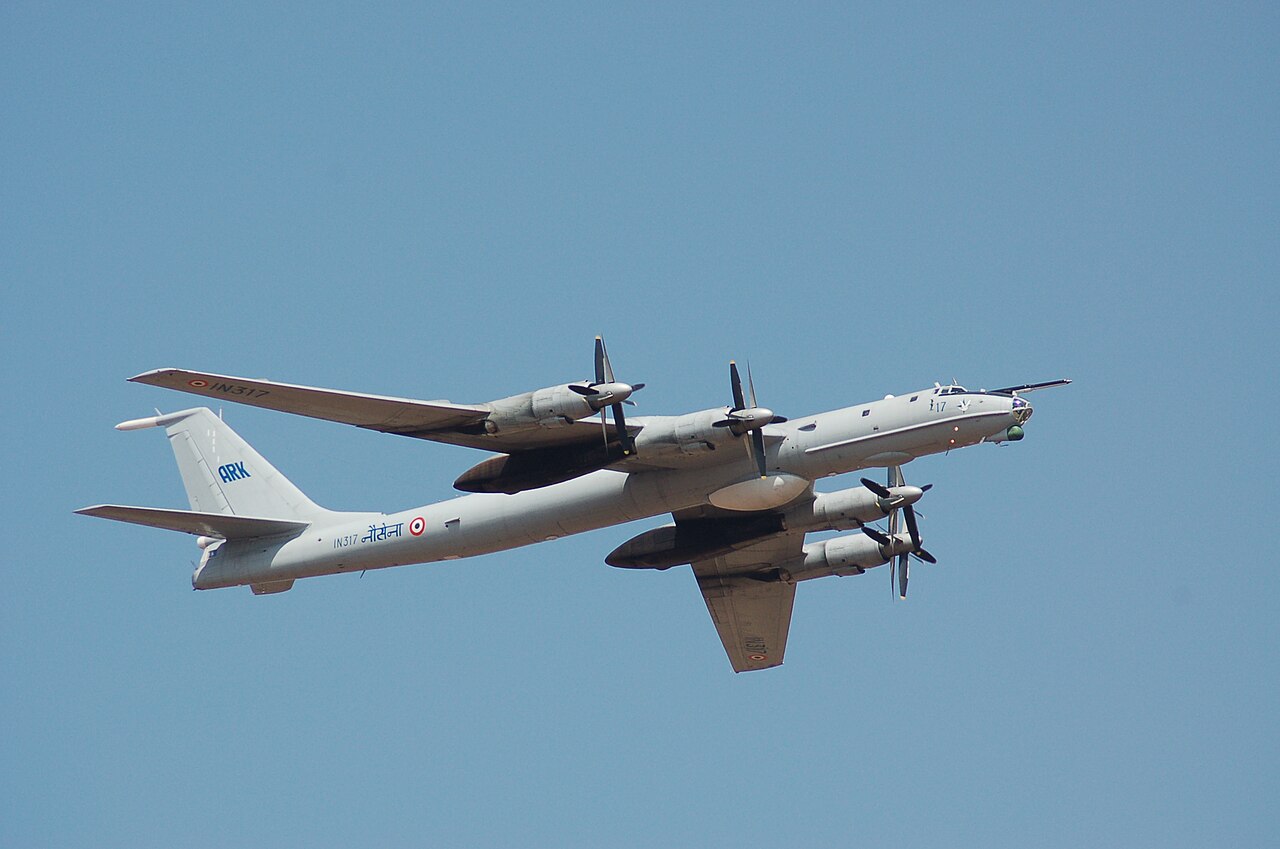
Photograph: Alec Wilson · 2007-02-07 · Photo source: IN317 (13992232974) · CC BY-SA 2.0 · Unmodified photograph.

At a glance
Tu-142M-series anti-submarine aircraft. Figures belonging to a particular version are identified below.
- Role
- Long-range maritime patrol and anti-submarine warfareThe Tu-142MR relay has a different mission.
- NATO reporting name
- Bear-FBear-J identifies the Tu-142MR communications branch.
- Engines
- Four Kuznetsov NK-12 turbopropsEach drives two contra-rotating propellers. Engine subtypes differ within the wider family.
- Crew
- 10Tu-142M-series crew complement.
- Length
- 53.08 m over the refuelling probeTu-142M; the measurement includes the nose probe.
- Search systems
- Berkut-95; later Korshun and ZarechyeBerkut-95 belongs to the original Tu-142; Korshun to the MK standard and Zarechye to the MZ.
- Mission equipment
- Search radar, sonobuoys and magnetic anomaly detectionFits and sensor locations changed between versions.
- Mission weapons
- Anti-submarine torpedoes, depth charges and sea minesThese are carriage capabilities, not a statement of an individual flight’s load.
- First flight
- 1968Original Tu-142 prototype.
- Acceptance into service
- December 1972Original Tu-142, rather than every later version.
- Indian export aircraft
- Eight Tu-142ME, delivered in 1988Export aircraft based on the Korshun-equipped Tu-142MK.
In Air Defender
Role guidance · v0.8.16.0
Air Defender lists the Tu-142 Bear-F as a maritime patrol and anti-submarine aircraft. Its catalogue figures are shown separately below. They describe the game’s general type entry, rather than establishing one exact real-world variant or the equipment carried by this contact.
Use Aircraft Data with the contact’s Flight Info, available flight plan and identification checks. A maritime patrol role does not establish whether a contact is Assumed Friendly or Hostile. The Tu-142 description also does not mean that it supplies radar tracks to your console: Nimrod and AWACS have their own game functions.
Game catalogue values · v0.8.16.0
In-game specifications
These figures come from the game’s general aircraft reference. A matching civilian register entry can supply different fields in Aircraft Data. How to read the two layouts →
- Role
- Maritime Patrol / ASW
- Category
- Military Patrol
- Service ceiling
- 39,400 ftA reference upper height. Read Flight Info for the contact’s present height.
- Maximum speed
- 460 knotsA reference maximum, not the speed the aircraft is flying now.
- Cruise speed
- 405 knotsA typical speed for the main part of a flight, not a guaranteed commanded speed.
- Stall speed
- 140 knotsA reference for specified conditions. Stalling means the wing loses lift, not that an engine stops.
- Typical crew
- 11
- Powerplant
- Four turboprop engines (Kuznetsov NK-12MV) Compare engine types →
- Manufacturer
- Tupolev (Russia)
Use the right procedure
In depth
Development
The Tu-142 programme developed a land-based aircraft able to search for missile-armed submarines far from shore. Work began in the early 1960s, drawing on the maritime reconnaissance branch of the Tu-95 family. The prototype flew in 1968 and the type was accepted into service in December 1972.
The naval airframe was substantially revised. It had a longer fuselage ahead of the wing, a redesigned wing with greater leading-edge camber and double-slotted flaps, and a rudder with a larger chord. Chord is the distance from a surface’s leading edge to its trailing edge. Early aircraft used unusually large twelve-wheel main landing-gear bogies; subsequent production returned to four-wheel bogies.
Production began at Kuibyshev, now Samara. The Taganrog plant built Tu-142 aircraft from 1973 to 1994, producing more than 100 across several versions. Improvements centred on the search equipment, avionics and crew accommodation rather than changing the aircraft’s basic anti-submarine purpose.
Airframe, propulsion and crew
The long fuselage, swept wing and four large engine installations retain the Bear family’s distinctive appearance. Each NK-12 engine drives two propellers on the same axis, rotating in opposite directions. The propulsion arrangement combines turbine engines with propellers, rather than the jet exhaust providing all the thrust.
The Tu-142M moved the magnetic detector from the tailplane tips to a boom at the top of the fin and removed the rear observation blisters. The M measures 53.08 metres over its nose refuelling probe and has a normal crew of ten. Later improvements raised the flight-deck roof and improved accommodation. These are changes within the naval family; the shorter Tu-95MS bomber has a different crew complement.
Finding a submarine
The original Tu-142 used the Berkut-95 search-and-sighting system. Its equipment combined a surface-search radar, magnetic detection and information from sonobuoys. A sonobuoy is dropped into the water to listen for underwater sound and transmit information back to the aircraft. These tools answer different questions: a radar can search the surface, while acoustic information helps investigate a submarine below it.
On early aircraft, the magnetic detector was carried at the tailplane tips. Later aircraft placed it in a fin-tip boom. A magnetic anomaly detector senses a local change in the magnetic field; it is a separate sensor from the radar and the sonobuoys.
The Tu-142MK uses the Korshun search system. The Tu-142MZ introduced the Zarechye search-and-sighting system and revised electronic-countermeasures equipment. The MZ also has a conspicuous sensor fairing beneath the nose, absent from the MK. The equipment standard matters when comparing two aircraft carrying the same broad Bear-F reporting name.
Armament and mission equipment
The original Tu-142 carried sonobuoys and weapons in two bays in the rear fuselage. Its loads included torpedoes, sea mines and nuclear or conventional depth charges. A tail gun position provided defensive armament. Equipment and loads differ between later versions.
The search equipment and weapons form different parts of the mission: finding a possible submarine, establishing its position and attacking it are separate tasks. A type’s carriage capability does not reveal what a particular aircraft has aboard, and a radar track alone cannot establish that it has used a weapon.
Operational use before 1998
Soviet naval aviation operated specialised members of the Bear family. The Tu-95RTs Bear-D carried out maritime surveillance and targeting, the Tu-142 Bear-F undertook anti-submarine patrols, and the Bear-J branch provided submarine communications. Tu-142 anti-submarine aircraft served with the Northern and Pacific Fleets.
During the Cold War, naval Bears deployed to locations including Cuba, Angola and Cam Ranh Bay in Vietnam. Tu-142 deployments to Cuba began in 1983, extending Soviet observation of naval activity in the North Atlantic and the approaches to the south-eastern United States. Long endurance and access to distant airfields made maritime aircraft useful well beyond their home coastlines.
For the 1998 setting, distinguish the anti-submarine MK and MZ standards from the MR relay. A similar silhouette can conceal a different task and equipment fit. The Bear-F is also distinct from the Tu-95MS strategic missile carrier, despite their shared ancestry.
Variants
Tu-142 · original Bear-F
The first anti-submarine standard, using Berkut-95. The prototype flew in 1968 and service acceptance followed in December 1972. Its early landing gear and detector installation differed from later production aircraft.
Tu-142M and Tu-142MK
The M introduced changes including the fin-tip magnetic detector and removal of the rear observation blisters. The Korshun-equipped MK brought revised avionics and improved crew accommodation. Tu-142M-series aircraft normally have a crew of ten.
Tu-142ME · Indian export version
An export version of the Tu-142MK. Eight were delivered to the Indian Navy in 1988.
Tu-142MZ
The later anti-submarine standard with the Zarechye search system, revised electronic countermeasures and a sensor fairing beneath the nose. It remains distinct from the MR communications aircraft.
Tu-142MR · Bear-J
A communications relay developed at Taganrog, first flown in 1977. It communicates with submerged submarines using a very-low-frequency system and a trailing wire antenna several kilometres long. The aircraft has a large ventral antenna pod, an unglazed nose and a forward-pointing fairing at the top of the fin.
After 1998
March 2017 · Indian Navy retirement
The Indian Navy retired its Tu-142M aircraft at INS Rajali on 29 March 2017 after 29 years of service. This was the end of Indian operation of the type, rather than the retirement of every Tu-142 worldwide.
2018–2021 · continuing Russian overhaul
A Tu-142MK returned to Russian naval aviation after overhaul at Taganrog in November 2018. In February 2021, Beriev’s work still included repair and modernisation of Tu-142 aircraft. These overhauls and updates belong to the type’s later history, after the game’s 1998 setting.
References and further reading
Development, naval variants, crew and airframe changes
- Jane’s All the World’s Aircraft · Tupolev Tu-95 and Tu-142 entry. Edition not identified in the supplied extract.
- Aircraft background · aviamuseum.com.ua
Taganrog production, MK/MZ/MR systems and Indian export aircraft
Cold War naval missions and deployments
Indian retirement and later Russian overhaul
- Indian Ministry of Defence · Year End Review 2017: Tu-142 retirement
- Beriev · Tu-142MK returned after overhaul, 19 November 2018
- Beriev · Albatross No. 02 (61), 20 February 2021, p. 4: Tu-142 production and versions