

Aircraft overview
The Tupolev Tu-16 Badger is a twin-engine, swept-wing jet bomber developed in the early 1950s. The family expanded beyond bombing to include missile carriers, reconnaissance aircraft, tankers and electronic-warfare platforms. Its two engines sit close to the fuselage at the wing roots, rather than in separate pods beneath the wings.
The prototype, known as aircraft 88-1, first flew on 27 April 1952. Badger is the NATO reporting name. Different members of this large family carried different equipment, so the name alone does not identify a particular weapon, sensor or mission.
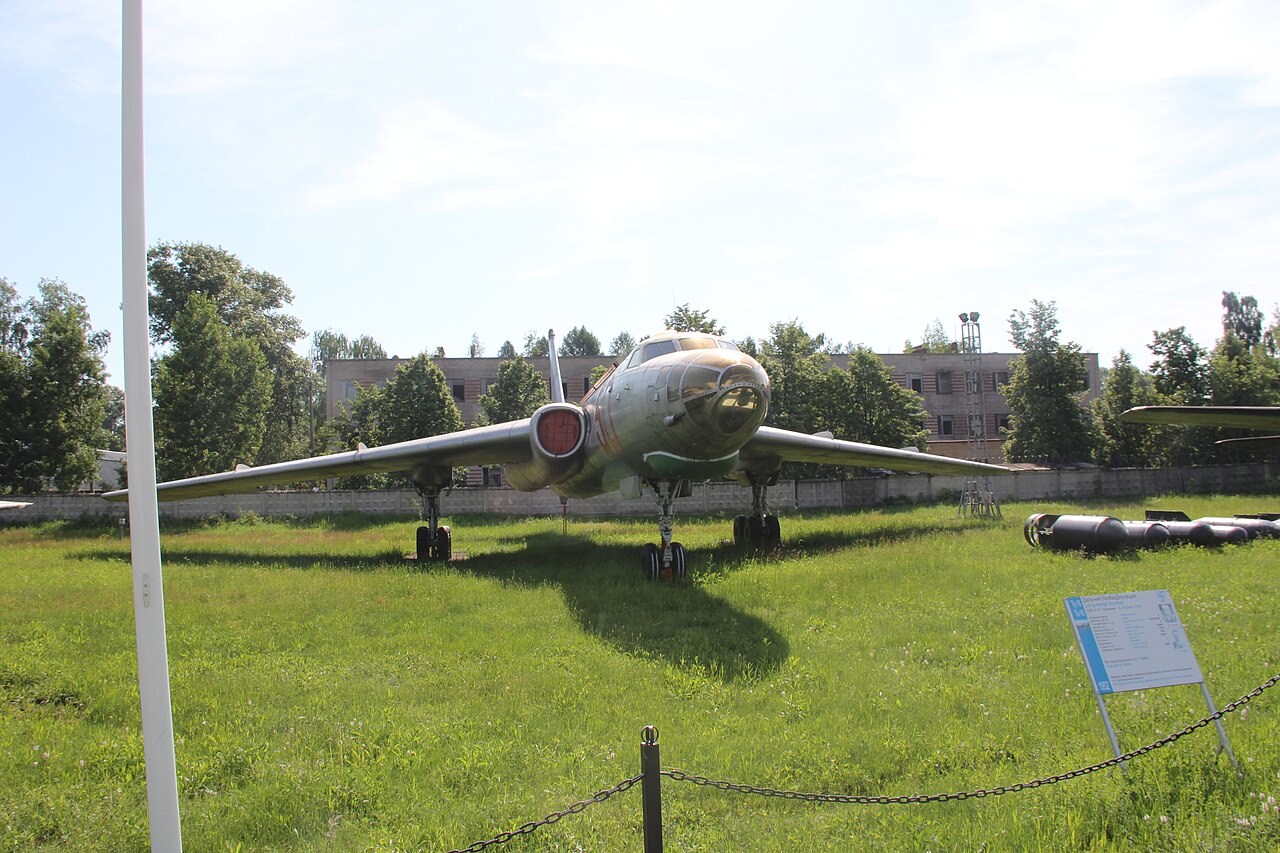
Photograph: Clemens Vasters · 2013-05-30 · Photo source: Tupolev Tu-16, NATO "Badger" (8912612004) · CC BY 2.0 · Unmodified photograph.

At a glance
Tu-16 family · general recognition data; mission variants are distinguished below
- Role
- Bomber, missile carrier and specialist support aircraftRole and equipment depend on the variant.
- Crew
- 6 in the general recognition configurationSpecialist versions can differ; this is not a count for every Tu-16.
- Engines
- Two non-afterburning turbojetsAM-3-family engines; AM-3A and RD-3M are among the Tu-16 installations.
- Wingspan
- About 33 mRounded type-recognition dimension, not a variant-specific engineering drawing.
- First flight
- 27 April 1952Aircraft 88-1 prototype.
- Principal naval mission fits
- Bombs and mines; anti-ship missiles; electronic surveillance and jammingThese describe different versions, not equipment fitted together to every Badger.
- Refuelling version
- Tu-16Z wing-to-wing tankerZ transliterates the Russian letter З; it is not the numeral 3.
In Air Defender
Role guidance · v0.8.16.0
Air Defender has a Tu-16 Badger aircraft-catalogue entry. Its game figures are shown separately below. The family entry does not establish which historical equipment fit a contact has, and a catalogue description of a typical mission is not proof of what a particular flight is doing.
Read Aircraft Data with the contact’s current height, speed, movement and available flight plan. Use the identification checks before changing its identity. If you suspect a missile launch, examine the evidence for that event rather than assuming every Badger is carrying or firing a weapon.
Game catalogue values · v0.8.16.0
In-game specifications
These figures come from the game’s general aircraft reference. A matching civilian register entry can supply different fields in Aircraft Data. How to read the two layouts →
- Role
- Strategic Bomber / Maritime Strike
- Category
- Military Bomber
- Service ceiling
- 42,000 ftA reference upper height. Read Flight Info for the contact’s present height.
- Maximum speed
- 595 knotsA reference maximum, not the speed the aircraft is flying now.
- Cruise speed
- 450 knotsA typical speed for the main part of a flight, not a guaranteed commanded speed.
- Stall speed
- 150 knotsA reference for specified conditions. Stalling means the wing loses lift, not that an engine stops.
- Typical crew
- 6
- Powerplant
- Twin turbojet engines (Mikulin RD-3M) Compare engine types →
- Manufacturer
- Tupolev (Russia)
Use the right procedure
In depth
Development from aircraft 88
The design grew from the need for a long-range jet bomber at the end of the 1940s. Tupolev pursued a swept-wing aircraft while Ilyushin developed the straight-wing Il-46. The Tupolev design became aircraft 88, with Dmitry Markov responsible for developing the new machine.
Aircraft 88-1 made its first flight from Zhukovsky on 27 April 1952, remaining airborne for 12 minutes. The prototype was overweight, and a second aircraft, 88-2, incorporated weight reduction. Production required substantial changes at the Kazan aircraft factory.
The airframe became the basis for a wide range of military roles. The game’s Tu-16 entry describes the aircraft type; it does not identify which countries operated it in 1998.
Airframe and propulsion
The Tu-16 has a swept wing and tail, with its engine nacelles recessed into the fuselage sides at the wing roots. The arrangement gives the aircraft a distinctive central engine installation. Its family-level recognition span is approximately 33 metres.
The AM-3 engine family uses an eight-stage axial compressor, a combustion chamber with 14 flame tubes within a common casing, a two-stage turbine and a fixed exhaust nozzle. A turbine starter starts the engine; fuel also acts as the cooling medium in a fuel-oil heat exchanger.
AM-3A and RD-3M are among the engines associated with Tu-16 installations. The AM-3 design was also used for other aircraft, including the Tu-104 airliner. Engine designations and ratings must therefore stay tied to their installation rather than being treated as one identical specification throughout the family.
Wing-to-wing refuelling
The Tu-16Z was a tanker adaptation of the bomber. Its wing-to-wing refuelling system used a hose extending from the tanker’s right wing. The aircraft needing fuel approached from behind and to the right, positioning its left wing to capture the hose and connect to a refuelling inlet.
This demanded close, precise formation flying near the tanker’s wingtip turbulence. It was a different arrangement from probe-and-drogue refuelling, where a receiving aircraft inserts a probe into a basket at the end of a hose.
Some Tu-16 aircraft were later converted from wing-to-wing equipment to a hose-and-drogue system. A tanker designation therefore matters: refuelling equipment is not interchangeable simply because two aircraft belong to the same bomber family. Air Defender’s refuelling procedure is covered separately.
Missile and electronic-warfare versions
Naval Badger A aircraft performed free-fall bombing, minelaying and tanker work. Badger C missile-carrier fits included one AS-2 or two AS-6 missiles; Badger G aircraft could carry two AS-5 or AS-6 missiles. These are alternative variant fits.
Badger H, Badger J and some Badger C aircraft carried electronic-surveillance and countermeasures equipment. Surveillance gathers information from emissions; countermeasures interfere with an opposing system. Those tasks differ from releasing a strike weapon.
The family illustrates why aircraft identification and intention are separate questions. Recognising a Badger is the start of understanding the platform, but its mission equipment determines whether it is a bomber, a missile carrier or a supporting aircraft.
Cold War operational use
The Tu-16 served both Soviet Naval Aviation and the air armies of the Supreme High Command. In July 1991, naval units operated across the four Soviet fleets, while long-range air-army units could also receive maritime-strike tasks. Its support variants allowed a common basic airframe to perform several different parts of a maritime air operation.
The Tu-22M Backfire subsequently joined naval aviation in 1974. The Tu-16 is a subsonic swept-wing aircraft, while the Backfire family combines variable-sweep wings with supersonic performance.
Variants
Badger A
Bomber, minelaying and tanker configurations.
Badger C and Badger G
Naval missile-carrier configurations with different missile fits. Some Badger C aircraft instead carried electronic-surveillance equipment.
Badger H and Badger J
Electronic-surveillance and countermeasures configurations.
Tu-16Z
Tanker designation associated with wing-to-wing refuelling. Some aircraft later used hose-and-drogue equipment.
References and further reading
Development and prototype flights
Naval mission variants and operational context
AM-3-family engine design and applications
Wing-to-wing and hose-and-drogue tanker systems
General recognition dimensions and crew
Game catalogue
- Air Defender · Released aircraft reference catalogue, v0.8.2.0