

Aircraft overview
The Tupolev Tu-160 Blackjack is a large, supersonic strategic bomber and long-range cruise-missile carrier. Its variable-sweep wings change position for different parts of the flight, while four Kuznetsov NK-32 afterburning turbofan engines provide its power. It has a crew of four, a length of about 54 metres and a reference wingspan of 55.7 metres. White Swan is its unofficial Russian name.
Tupolev developed the aircraft during the 1970s. The prototype first flew in December 1981 and deliveries to an operational long-range aviation unit began in April 1987. That original production version was in service in 1998. The Tu-160M and its new-production engines are later developments.
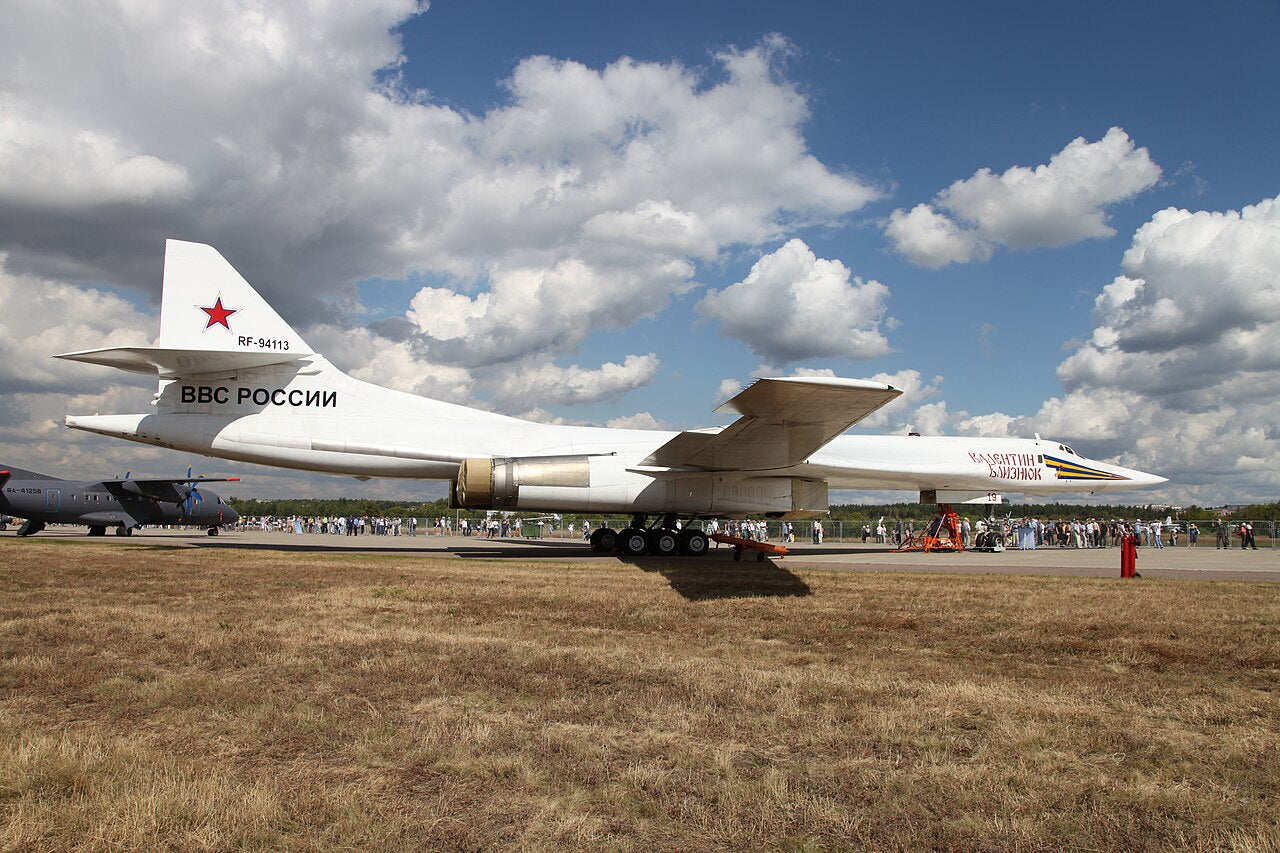
Photograph: Vitaly V. Kuzmin · 2012-08-10 · Photo source · CC BY-SA 4.0 · Unmodified photograph.

At a glance
Original production Tu-160 of the 1980s–1990s. Dimensions are rounded recognition figures; the later Tu-160M is described separately.
- Role
- Strategic bomber and long-range cruise-missile carrierOriginal Tu-160.
- NATO name
- Blackjack
- Crew
- FourBasic production aircraft.
- Length
- About 54 m (177 ft)Rounded recognition measurement.
- Wingspan
- 55.7 m (182 ft 9 in)Reference span. The span changes when the wings sweep; the figure is not the span at every wing position.
- Wing
- Variable sweep, outer panels pivoting on a fixed inner wingThe outer panels pivot relative to the fixed inner wing.
- Engines
- Four Kuznetsov NK-32 afterburning turbofansOriginal engine family. NK-32 series 02 engines belong to later modernised aircraft.
- Armament
- Long-range cruise missilesGeneral carriage capability, rather than a confirmed load on any particular flight.
- Speed class
- SupersonicA design capability, not the aircraft’s speed on every flight.
- First flight
- 18 December 1981Prototype aircraft.
- First unit deliveries
- April 1987An operational long-range aviation unit in the Ukrainian SSR.
In Air Defender
Role guidance · v0.8.16.0
Air Defender has a Tu-160 Blackjack entry in its aircraft catalogue. Its game values are listed separately below. The general label does not identify a precise modernisation standard or establish that every real-world Blackjack capability is available in the simulation.
Compare Aircraft Data with the selected contact’s current height, speed, available flight plan and movement. A type report does not establish its weapons load or intent. Use the identification checks and investigate a possible launch from the available evidence; a bomber turning away does not by itself prove that a missile was released.
Game catalogue values · v0.8.16.0
In-game specifications
These figures come from the game’s general aircraft reference. A matching civilian register entry can supply different fields in Aircraft Data. How to read the two layouts →
- Role
- Strategic Bomber
- Category
- Military Bomber
- Service ceiling
- 50,000 ftA reference upper height. Read Flight Info for the contact’s present height.
- Maximum speed
- 1,330 knotsA reference maximum, not the speed the aircraft is flying now.
- Cruise speed
- 530 knotsA typical speed for the main part of a flight, not a guaranteed commanded speed.
- Stall speed
- 170 knotsA reference for specified conditions. Stalling means the wing loses lift, not that an engine stops.
- Typical crew
- 4
- Powerplant
- Four turbofan engines with afterburners (Kuznetsov NK-32) Compare engine types →
- Manufacturer
- Tupolev (Russia)
Use the right procedure
In depth
Development
Tupolev began the project in the early 1970s, with the basic aircraft-and-systems concept established by the middle of the decade. It was designed as an intercontinental strategic missile carrier rather than a short-range tactical strike aircraft. Kuznetsov began work on its NK-32 engine in 1977.
The prototype flew on 18 December 1981 with B. Veremey as test pilot. Testing of the first production aircraft began in October 1984. The engine programme reached a separate milestone in 1985, when a Tu-160 first flew with series-built NK-32 engines. An operational long-range aviation unit in the Ukrainian republic of the Soviet Union began receiving aircraft in April 1987.
Airframe and recognition
The Tu-160 has a long, pointed nose, a slender fuselage, variable-sweep outer wings and a tall swept fin. The tailplane is mounted part-way up the fin. Four engines are arranged in paired installations beneath the inner wing, with the exhausts extending behind its trailing edge.
The pivoting outer panels change the aircraft’s plan view substantially. With the wings spread, the span is greater than the aircraft’s length; sweeping them back produces a narrower outline. The rounded 54-metre length and 55.7-metre reference span describe the scale of the aircraft without implying one fixed span for all wing settings.
The Tu-22M Backfire also has variable-sweep wings. The Tu-95 Bear has propellers, giving it a different appearance in a clear photograph. Those visual features are absent from the ordinary radar symbol: a track’s height and speed are different evidence from an aircraft photograph.
The Kuznetsov NK-32
The NK-32 is an afterburning turbofan with a three-shaft arrangement. Its compressor and turbine groups turn on separate shafts. An annular combustion chamber burns fuel in the main engine, while a common afterburner sits downstream of the turbines. The engine also has a large variable exhaust nozzle.
A turbofan produces thrust from both its fan airflow and its core exhaust. Afterburning adds fuel downstream of the turbine to increase thrust; it is a different operating condition from flight without afterburner. Read the engine guide for the distinction between a turbojet, turbofan and turboprop.
The first series-built NK-32 was completed in 1984, and a Tu-160 flew with series engines in 1985. The NK-32 series 02 supplied for the later Tu-160M is a subsequent development. The later engine and equipment fit differs from the original 1998 configuration.
Armament and mission
The Tu-160’s strategic mission centres on carrying long-range cruise missiles. An air-launched cruise missile is released by an aircraft and then flies under its own propulsion and guidance. That permits the carrier and the weapon to take different routes: the bomber does not have to remain alongside the missile or fly directly over the target.
A type’s armament capability is not an inventory aboard a particular flight. It also does not identify which weapon, if any, has been released. Keep the aircraft’s reported type, its observed movement and evidence of a separate weapon distinct.
The aircraft in the 1998 setting
By 1998 the Tu-160 had been in unit service for around eleven years. It was a Soviet-designed aircraft operating in the post-Soviet period. The new-build Tu-160M modernisation came later.
Supersonic capability does not mean supersonic flight throughout a mission. A performance figure describes a specified capability, while the current track speed describes this contact now. Likewise, the aircraft’s strategic role does not by itself establish the route, fuel state, weapons load or intent of one flight.
Variants
Tu-160 prototype
The development aircraft first flown on 18 December 1981. Prototype milestones are distinct from the start of production-aircraft testing and operational deliveries.
Original production Tu-160
The aircraft tested from 1984 and delivered to an operational unit from April 1987, with four NK-32 engines and a crew of four. This is the 1980s–1990s production standard.
New-build Tu-160M
A modernised aircraft produced under a later programme, using NK-32 series 02 engines. The first newly built aircraft flew on 12 January 2022. Its equipment belongs to a period well after the 1998 setting.
After 1998
2015–2022 · new-build modernisation
A decision in 2015 launched the programme to resume production in modernised form. Kuznetsov began series deliveries of NK-32 series 02 engines in 2020. On 12 January 2022, the first newly built Tu-160M flew from the Kazan aviation plant.
The 2022 milestone describes a newly built Tu-160M. Modernising an existing airframe is a separate activity. These later developments are distinct from the original aircraft and Air Defender’s 1998 setting.
References and further reading
Period recognition, crew, dimensions and general armament
Development and strategic role
NK-32 design and engine history
- Engines 1944–2000 · Kuznetsov NK-32 entry, p. 199 (reference copy)
- United Engine Corporation · Kuznetsov history: NK-32 production and Tu-160 flight milestones