

Aircraft overview
The Tupolev Tu-22M Backfire is a twin-engine supersonic bomber with variable-sweep wings. It combines high speed with a substantial missile or bomb load. Maritime strike is a major part of its history: a Backfire can attack ships using weapons released well before the bomber reaches the target.
The Tu-22M3 has a crew of four and two NK-25 afterburning turbofan engines. Its first flight took place on 20 June 1977, followed by series production from 1978. The earlier Tu-22M family had already entered Soviet naval service in 1974.
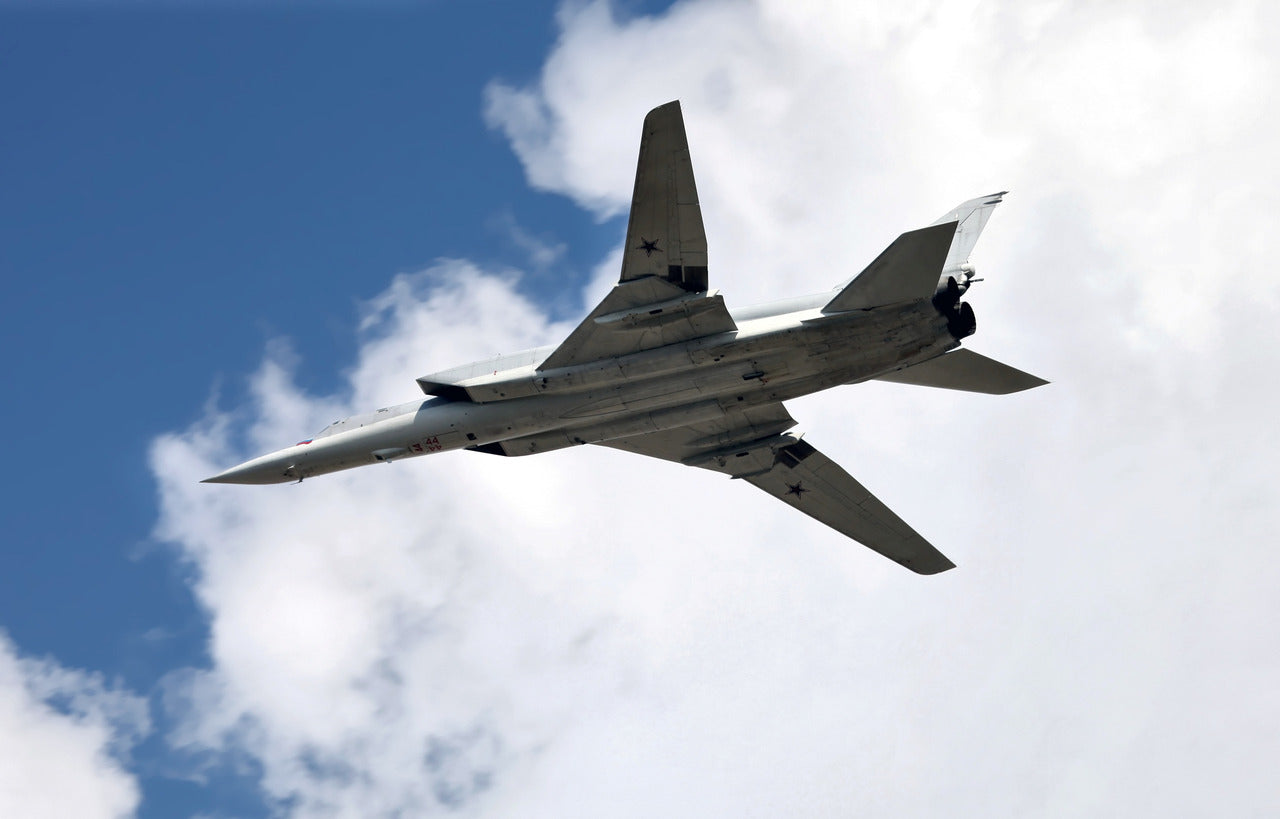
Later photograph (2012): Vitaly V. Kuzmin · 12 August 2012 · Photo source · CC BY-SA 4.0

At a glance
Tu-22M3 · historical reference
- Role
- Supersonic missile-carrier bomber
- Crew
- 4
- Engines
- Two NK-25 afterburning turbofans
- Length
- 42.46 m
- Wingspan
- 34.28 m / 23.3 mSpan changes with wing sweep; the shorter figure describes the swept configuration.
- Normal take-off mass
- 124,000 kgNormal take-off figure; this is not a maximum take-off limit.
- Maximum speed
- 2,000 km/hReference maximum; altitude and load are unspecified. It is not a normal cruising speed.
- Cruising speed
- 900 km/h
- Reference ceiling
- 13,300 m
- Range
- 6,500 kmFlight range with load and profile unspecified. It is not an out-and-back combat radius.
- Armament
- 1–3 Kh-22M missiles, or up to 24,000 kg of bombs; 23 mm GSh-23 cannonAlternative carriage capacities, not the load of every aircraft or sortie.
- First flight
- 20 June 1977Tu-22M3, rather than the earlier Tu-22M family.
In Air Defender
Role guidance · v0.8.16.0
Air Defender includes a Tu-22M Backfire catalogue entry with its game values shown separately below. The family label does not identify a precise real-world variant or prove that every Backfire capability is modelled. It is presented as a supersonic bomber for long-range strike and maritime attack.
Use Aircraft Data alongside the contact’s current height, speed, route and available flight plan. A type report does not establish its weapons load or intent. Follow the identification checks and examine a possible missile launch as a separate event.
Game catalogue values · v0.8.16.0
In-game specifications
These figures come from the game’s general aircraft reference. A matching civilian register entry can supply different fields in Aircraft Data. How to read the two layouts →
- Role
- Strategic Bomber
- Category
- Military Bomber
- Service ceiling
- 43,600 ftA reference upper height. Read Flight Info for the contact’s present height.
- Maximum speed
- 1,030 knotsA reference maximum, not the speed the aircraft is flying now.
- Cruise speed
- 520 knotsA typical speed for the main part of a flight, not a guaranteed commanded speed.
- Stall speed
- 150 knotsA reference for specified conditions. Stalling means the wing loses lift, not that an engine stops.
- Typical range
- 3,600 NMA reference flying distance, not fuel remaining or radar detection range.
- Typical crew
- 4
- Powerplant
- Twin turbofan engines with afterburners (Kuznetsov NK-25) Compare engine types →
- Manufacturer
- Tupolev (Russia)
Use the right procedure
In depth
Development and service entry
The Tu-22M family entered Soviet Naval Aviation in 1974. It provided a faster strike platform able to carry anti-ship missiles, bombs or mines, and also served with the air armies of the Supreme High Command. By July 1991, naval aircraft operated with all four Soviet fleets.
The Tu-22M0 first flew on 30 August 1969. The Tu-22M3 prototype followed on 20 June 1977 and entered series production in 1978. Final acceptance of the M3 took place in March 1989; that milestone is distinct from its first flight and the start of production.
Backfire is the NATO reporting name. The two-syllable name beginning with B identifies it within the NATO jet-bomber naming convention.
Airframe and wing controls
A fixed inner wing carries pivoting outer panels. Their sweep changes from 20 to 65 degrees. The aircraft has a low-mounted wing, a semi-monocoque fuselage and retractable tricycle landing gear. Aluminium alloys form much of the structure, with high-strength and heat-resistant steels, titanium and magnesium alloys used as well.
The wing has leading-edge slats and three-section, double-slotted flaps. It has no conventional ailerons: spoilers move differently on the two sides to control roll, or together to act as an air brake. The horizontal tail is all-moving. These features belong to the aircraft’s flight-control design; they are not extra controls for an Air Defender player.
Engines, crew and protection
Two NK-25 afterburning turbofans power the Tu-22M3. A crew of four operates the aircraft. Its defensive equipment includes electronic warfare systems and a 23 mm GSh-23 cannon.
Afterburning adds fuel to the engine exhaust to increase thrust. It supports high-performance flight but is a different operating condition from economical cruise. The aircraft’s 900 km/h reference cruising speed and 2,000 km/h reference maximum therefore describe different parts of its performance envelope, not a single speed to expect on every flight.
Missiles, bombs and maritime strike
The Tu-22M3 can carry one to three Kh-22M guided missiles, or a bomb load of up to 24,000 kg. Those are carriage capacities: a particular flight may carry a different load, and the maximum bomb load should not be combined with the maximum missile count.
In 1991, naval Backfires were described carrying one or two AS-4 Kitchen anti-ship missiles and launching from as far as 200 nautical miles, about 370 km, from the target. The aircraft could also carry mines and bombs for minelaying or bombing strikes.
Stand-off distance is the separation between the launch aircraft and its target when a weapon is released. It is separate from the aircraft’s flight range. A long stand-off weapon makes the bomber’s route and launch opportunity relevant before it approaches the target itself.
Understanding the performance figures
The Tu-22M3 reference figures include a 13,300 m ceiling and 6,500 km flight range. Neither is a guarantee for every load, route or flight profile. Range is not the same as combat radius, which must allow an aircraft to reach its operating area and return.
The normal take-off mass is 124,000 kg. Normal and maximum take-off masses are different quantities; the 124,000 kg normal take-off figure is not a structural limit. The variable wing also changes the aircraft’s span: 34.28 m and 23.3 m describe its spread and swept dimensions.
Variants
Tu-22M0
An early member of the family, first flown on 30 August 1969.
Tu-22M2
An earlier Tu-22M version, preceding the M3, with its own specifications.
Tu-22M3
The variant described in the quick specifications: two NK-25 engines, four crew and missile or bomb carriage. First flown in 1977, in series production from 1978 and finally accepted in 1989.
Tu-22M3M
A later modernisation with new digital onboard electronics, described separately below. It is not the 1998 reference configuration.
After 1998
28 December 2018 · Tu-22M3M first flight
The first modernised Tu-22M3M flew from Kazan on 28 December 2018. The 37-minute flight checked new systems and equipment, including a modern digital avionics suite. This later M3 development has different equipment from the 1998 aircraft. Air Defender’s broad Tu-22M family entry does not specify the M3M’s modernisation.
References and further reading
Development, structure and flight controls
Tu-22M3 technical specifications
Naval role and stand-off armament in 1991
Period Western aircraft recognition
Afterburner principle and later modernisation
- NASA Glenn · Afterburning jet thrust
- Rostec · First flight of the modernised Tu-22M3M, 28 December 2018
Game catalogue
- Air Defender · Released aircraft reference catalogue, v0.8.2.0