

Aircraft overview
The Tupolev Tu-95 Bear is a Soviet long-range bomber family, recognisable by its swept wings and four engines, each driving two propellers that turn in opposite directions. The family includes early bombers, missile carriers and reconnaissance aircraft. The later Tu-95MS carries cruise missiles rather than relying on flying directly over its target.
The Tu-95MS combines the Bear’s turboprop layout with an airframe developed from the maritime Tu-142 and a crew of seven. The Tu-142 is a separate maritime patrol and anti-submarine branch of the family, covered in its own profile.
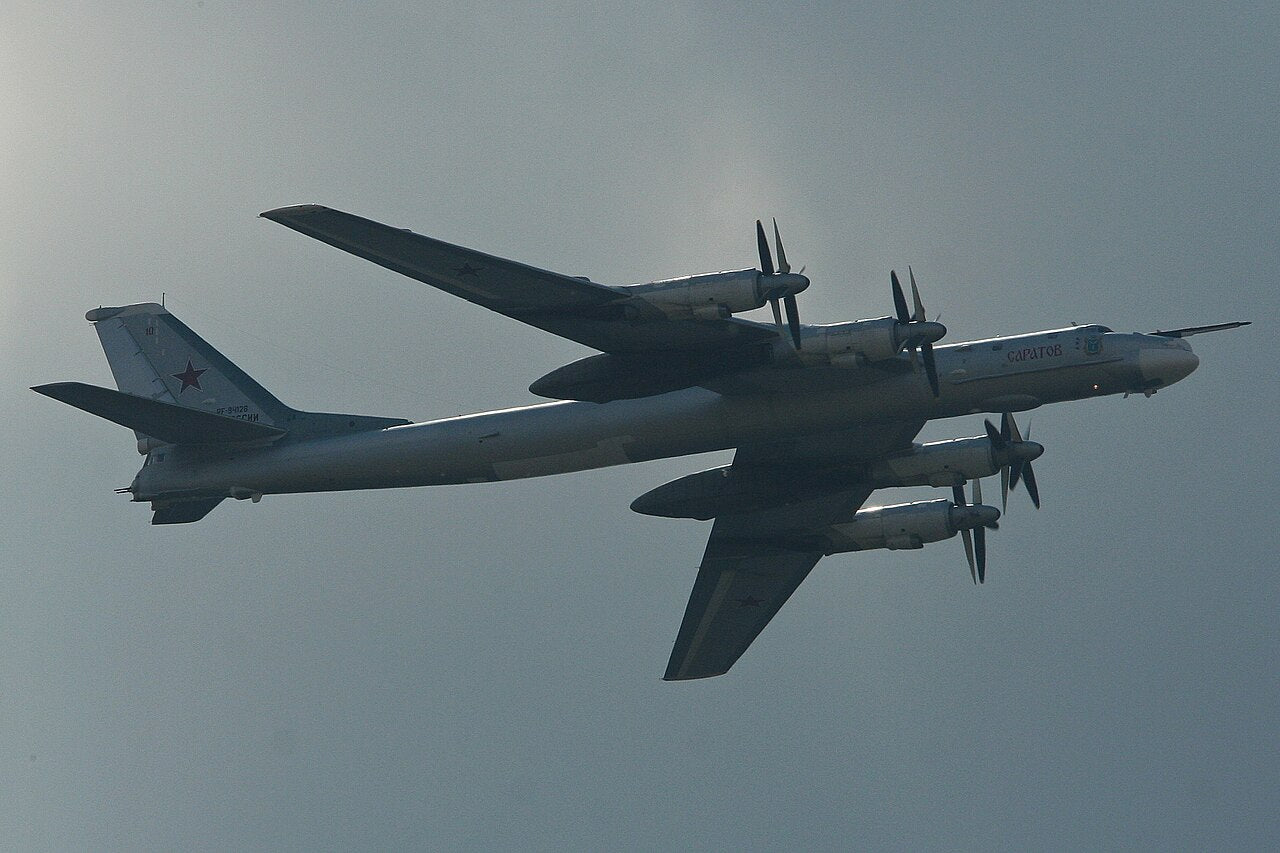
Photograph: Alan Wilson · 2012-08-12 · Photo source: Tupolev Tu-95MS Bear-H RF-94128 10 red (8639002248) · CC BY-SA 2.0 · Unmodified photograph.

At a glance
Tu-95MS · 1994 specification
- Role
- Long-range cruise-missile carrierTu-95MS; different Bear variants perform other missions.
- Crew
- 7Tu-95MS.
- Engines
- Four Kuznetsov NK-12MP turbopropsEach engine drives a pair of four-blade, contra-rotating propellers.
- Wingspan
- 50.04 mTu-95MS.
- Length
- 49.13 mTu-95MS; inclusion of the refuelling probe in this length is unspecified.
- Height
- 13.2 mTu-95MS.
- Wing area
- 289.9 m²Tu-95MS.
- Maximum take-off mass
- 185 tonnesTu-95MS.
- Missile carriage
- 6 internal Kh-55 cruise missiles; 16 total in the original MS16 arrangementThe MS16 adds 10 underwing missiles. These are real-aircraft configurations, separate from game data.
- First flight
- 12 November 1952 · Tu-95 prototype; September 1979 · Tu-95MSThe original family and later MS have different development milestones.
In Air Defender
Role guidance · v0.8.16.0
Air Defender v0.8.16.0 includes a Tu-95 Bear reference entry. Use Aircraft Data to read the type information available for a contact, then compare it with the flight’s current height, speed and route in Flight Info. The catalogue’s figures are shown separately below.
A Bear type report is a starting point for investigation. It does not establish the contact’s identity, weapons or intentions. Follow the identification procedure before assigning an identity. A possible missile launch needs its own evidence on the radar picture.
Game catalogue values · v0.8.16.0
In-game specifications
These figures come from the game’s general aircraft reference. A matching civilian register entry can supply different fields in Aircraft Data. How to read the two layouts →
- Role
- Strategic Bomber / Maritime Patrol
- Category
- Military Bomber
- Service ceiling
- 41,000 ftA reference upper height. Read Flight Info for the contact’s present height.
- Maximum speed
- 460 knotsA reference maximum, not the speed the aircraft is flying now.
- Cruise speed
- 405 knotsA typical speed for the main part of a flight, not a guaranteed commanded speed.
- Stall speed
- 140 knotsA reference for specified conditions. Stalling means the wing loses lift, not that an engine stops.
- Typical crew
- 7
- Powerplant
- Four turboprop engines (Kuznetsov NK-12) Compare engine types →
- Manufacturer
- Tupolev (Russia)
Use the right procedure
In depth
Development
Tupolev developed the Tu-95 in the early 1950s to meet the Soviet requirement for a long-range strategic bomber. The design used turboprops to combine long range with a swept-wing airframe. The first prototype flew on 12 November 1952 with 2TV-2F turboprops. A second prototype, using TV-12 engines, flew on 16 February 1955.
The early aircraft carried free-fall bombs. Development then moved towards missiles that could be released at a distance from the target. The Tu-95K missile programme included a modified MiG-19 test vehicle, designated SM-20, used to develop the Kh-20 weapon system. The production Tu-95K-20 carried a Kh-20. The Tu-95KD added a nose probe for refuelling in flight.
The maritime Tu-142 introduced a redesigned wing and a longer forward fuselage. It first flew in 1968. That branch later provided the basis for the Tu-95MS, whose fuselage was shortened for the bomber mission. The MS first flew in September 1979 and entered series production in 1981.
Airframe and propulsion
The basic arrangement is a mid-mounted swept wing, a long fuselage, a single fin and four wing-mounted engine nacelles. On the Tu-95MS the engines are Kuznetsov NK-12MP turboprops. Each drives two coaxial propellers: the front and rear sets turn in opposite directions. There are four blades in each set, making eight blades at each engine position.
The propellers are a defining recognition feature, but the silhouette alone does not identify the mission equipment. The bomber, naval reconnaissance and anti-submarine branches have different fuselages, radomes and equipment installations. The later Tu-95MS incorporates changes to the original 1952 design.
For the Tu-95MS, the 1994 dimensions are a 50.04 m span, 49.13 m length and 13.2 m height. Wing area is 289.9 m² and maximum take-off mass is 185 tonnes. These describe the named MS variant; the longer Tu-142 has its own dimensions.
Crew and mission systems
The Tu-95MS has a crew of seven. In the first MS configuration, these were the aircraft commander, co-pilot, two navigators, a flight engineer, a communications operator and a gunner. The missile carrier has a large, deep radar radome in the nose and a small fairing at the fin tip for an infrared warning receiver.
The nose refuelling probe allows the aircraft to receive fuel in flight. At the rear, a gun turret provides close defensive armament. Cannon installations differ between configurations, so the presence of a tail turret does not establish one universal gun fit for every Bear.
The naval Tu-95RTs carried reconnaissance and targeting equipment for finding ships and passing information to other forces. The Tu-142 instead carries equipment for maritime patrol and anti-submarine work. The Tu-142MR has a submarine-communications role. These mission systems belong to separate aircraft variants.
Armament and payload
The Tu-95MS was developed as a carrier for the Kh-55, known to NATO as the AS-15 Kent. Six cruise missiles fit on an MKU-6 rotary launcher inside the weapons bay. The launcher presents each missile for release in turn.
The original Tu-95MS16 arrangement adds ten missiles beneath the wings: two near each wing root and three between the engines on each side. Together with the six internal missiles, that gives sixteen. The MS6 arrangement has the six-missile internal load. A capacity figure describes a carriage arrangement, not proof of what a particular aircraft is carrying on a particular flight.
Earlier missile-carrying Bears used different weapons. The Tu-95K-20 carried the large Kh-20, while the Tu-95K-22 was adapted for two Kh-22 missiles. These earlier variants carried different missile loads from the Tu-95MS. Later modernisation also changed the aircraft’s systems.
Operational use to 1998
The Bear family served both the strategic bomber force and naval aviation. In the bomber role, the move from free-fall bombs to stand-off missiles changed the threat: the aircraft could release its weapon before reaching the target area. In naval service, reconnaissance Bears supplied information about ships, while the Tu-142 branch undertook anti-submarine missions.
Soviet naval Bears also operated far beyond their home bases. During the Cold War, Tu-95RTs aircraft used deployments to Cuba, Angola and Vietnam to extend reconnaissance over sea routes and naval activity. Tu-142 aircraft joined deployments to Cuba from 1983. The overseas operations illustrate why similar-looking Bears could be encountered on quite different missions.
Aircraft type, observed behaviour and intelligence must be read together. A long-range bomber’s appearance on a radar display does not itself show its load or confirm that it has launched a weapon.
Variants
Tu-95 and Tu-95M · Bear-A
The early free-fall bomber versions. The Tu-95M introduced more powerful NK-12 engines. These are earlier designs than the later Tu-95MS missile carrier.
Tu-95K-20 and Tu-95KD · Bear-B
The Kh-20 missile-carrier branch. The KD added a nose probe for refuelling in flight.
Tu-95K-22 · Bear-G
Earlier missile carriers rebuilt for the Kh-22, carrying two missiles.
Tu-95RTs · Bear-D
Naval reconnaissance and targeting aircraft used to find ships and supply information for other forces.
Tu-95MS6 and Tu-95MS16 · Bear-H
The later Kh-55 cruise-missile carriers, based on the Tu-142 airframe with a shorter fuselage. MS6 denotes the six-missile internal arrangement; MS16 adds ten underwing missiles.
Tu-142 family · Bear-F and Bear-J
The separate maritime branch. Bear-F covers anti-submarine variants; Bear-J identifies the Tu-142MR submarine-communications relay. Read the Tu-142 profile for that branch.
After 1998
August 2020 · Tu-95MSM flight tests
The Tu-95MSM programme entered flight testing in August 2020. The first modernised aircraft introduced revised engines and propellers, a new radar, navigation and communications equipment, and a new weapon-control system.
These are later developments. They are separate from the Tu-95MS configurations described for the 1998 setting and do not establish equipment or weapons available in Air Defender.
References and further reading
Development, design and variants
- Jane’s All the World’s Aircraft · Tupolev Tu-95 and Tu-142 entry. Edition not identified in the supplied extract.
- United Aircraft Corporation · Tu-95MS history
- Beriev · Albatross No. 01 (60), 29 January 2021, p. 3: Tu-95MS development and modernisation
Tu-95MS dimensions, mass, engines and crew
- Krylya Rodiny, 1994, No. 8 (763), pp. 1–3; table p. 3
- Beriev · Albatross No. 01 (60), 29 January 2021, p. 3: Tu-95MS development and modernisation