

Aircraft overview
The Westland Sea King is a twin-engined helicopter family that served in rescue, anti-submarine, transport and airborne-surveillance roles. The RAF’s HAR3 and HAR3A are dedicated search-and-rescue versions, equipped to find people in difficulty and recover them by winch when landing is impractical.
The HAR3 entered RAF service in 1978 and the HAR3A followed in 1996. They provided rescue cover around Britain and in the Falkland Islands. A four-person crew combines flying, searching, winching and immediate medical care; naval Sea Kings have different equipment and duties.
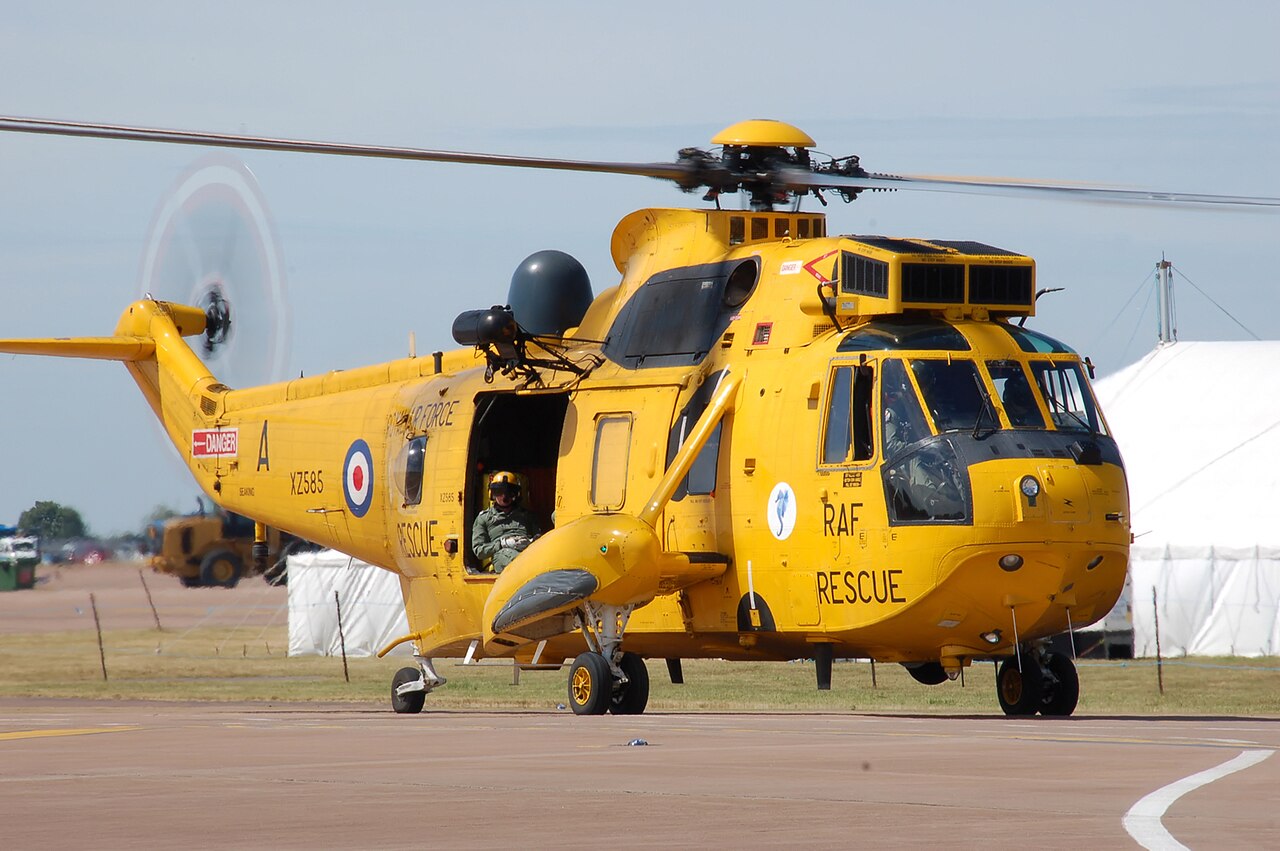
Photograph: Adrian Pingstone · 19 July 2010 · Photo source · Public domain

At a glance
Sea King HAR3/HAR3A · RAF rescue configuration; equipment details below are dated to the early 2000s
- Principal role
- Search and rescueThe RAF HAR3/HAR3A rescue versions.
- Engines
- Two Rolls-Royce Gnome turboshaftsEngine family for the RAF rescue reference.
- Main rotor diameter
- About 18.9 mDiameter of the circle swept by the main rotor.
- Fuselage / overall length
- 14.4 m / 22.15 mOverall length includes the rotors; neither figure is cabin length.
- Normal rescue crew
- FourTwo pilots, a radar/winch operator and a winchman, normally trained as a paramedic.
- Cabin capacity
- 17 passengers, or six stretchers and four passengersAlternative cabin arrangements, subject to the rescue task and loading limits.
- Rescue hoists
- Main hydraulic hoist and emergency electric hoistThe early-2000s RAF rescue equipment fit.
In Air Defender
Role guidance · v0.8.16.0
Air Defender’s v0.8.16.0 catalogue uses the family name Westland Sea King with a combined rescue/anti-submarine role label. Its game figures appear in the catalogue block below; the HAR3/HAR3A specifications here describe the real RAF rescue versions.
The Aircraft Data guide explains the game’s catalogue and selected-flight information. Use the specification guide to compare speeds, heights and range. A historical mission does not establish a playable rescue or submarine-hunting command.
Game catalogue values · v0.8.16.0
In-game specifications
These figures come from the game’s general aircraft reference. A matching civilian register entry can supply different fields in Aircraft Data. How to read the two layouts →
- Role
- Search and Rescue / ASW Helicopter
- Category
- Military Helicopter
- Service ceiling
- 14,000 ftA reference upper height. Read Flight Info for the contact’s present height.
- Maximum speed
- 130 knotsA reference maximum, not the speed the aircraft is flying now.
- Cruise speed
- 110 knotsA typical speed for the main part of a flight, not a guaranteed commanded speed.
- Stall speed
- Not specified as a stall-speed valueA zero in the game catalogue means no usable stall-speed figure is supplied; it does not mean the rotor blades cannot stall. FAA helicopter handbook: rotor-blade stall →
- Typical range
- 660 NMA reference flying distance, not fuel remaining or radar detection range.
- Typical crew
- 4
- Powerplant
- Twin turboshaft engines (Rolls-Royce Gnome) Compare engine types →
- Manufacturer
- Westland (UK)
Use the right procedure
In depth
A helicopter built around the rescue
The rescue crew must locate the casualty, reach the scene, recover people and get them to safety. The Sea King’s cabin provides space for passengers, stretchers and medical equipment. Winching allows the crew to reach a person without landing beside them.
RAF rescue operations covered incidents on land and at sea, assisting civilians as well as service personnel. In addition to UK cover, the HAR3 operated in the Falkland Islands, where long distances and difficult weather made search and navigation equipment particularly important.
Four crew members, four linked jobs
Two pilots operate the aircraft; one is the aircraft captain. The radar operator conducts search tasks and acts as the winch operator at the rescue scene. The winchman goes down to the casualty, provides immediate assistance and prepares the recovery.
The winchman is normally trained to paramedic standard. Inside the aircraft, medical equipment supports care during the flight. The rescue fit includes electrical connections for equipment such as incubators.
Finding the casualty
The early-2000s HAR3/HAR3A equipment includes search radar, a multi-band homing system, satellite navigation and several radios. Search radar helps the crew examine the area, while radio homing helps them follow suitable transmitted signals.
Crews are trained to use night-vision goggles over unfamiliar terrain. These aid the crew’s view in darkness; they are different from a separate infrared search camera. Equipment changed over the aircraft’s service life, and later camera installations do not describe every earlier rescue aircraft.
Winching and cabin arrangements
A hydraulic main rescue hoist performs the recovery, with an electrically powered emergency hoist available as a separate system. The operator manages the hoist from the helicopter while the winchman works with the casualty below.
The cabin can be arranged for up to 17 passengers, or for six stretchers and four passengers. These are alternative arrangements. The crew also has to allow for medical equipment, fuel and the conditions of the individual rescue.
Rescue, submarine hunting and airborne surveillance
Sea King is a family name, rather than one equipment standard. A rescue helicopter carries the people and equipment needed to recover casualties. An anti-submarine version searches for submarines, while a troop-carrying version transports personnel and equipment.
Airborne-surveillance Sea Kings form another branch of the family. The later ASaC7 carries Searchwater 2000 radar in a distinctive inflatable side-mounted radome. That later surveillance fit differs from the HAR3/HAR3A rescue equipment and postdates the game’s 1998 setting.
Variants
Sea King HAR3
RAF search-and-rescue version that entered service in 1978, used in Britain and the Falkland Islands.
Sea King HAR3A
Later RAF rescue version that entered service in 1996. It shares the HAR3’s rescue role.
Naval anti-submarine and transport versions
Other members of the Sea King family served in submarine hunting and troop transport. Those roles do not describe the HAR3 rescue equipment fit.
Sea King ASaC7
Later Royal Navy airborne-surveillance and control version with Searchwater 2000 radar. Its later equipment is not a 1998 HAR3 capability.
After 1998
Early 2000s · rescue equipment
The search, night-flying and medical equipment described above belongs to the early-2000s HAR3/HAR3A configuration. The HAR3 entered service in 1978 and the HAR3A in 1996; these equipment details apply to their later configuration.
2015–2016 · rescue handover and RAF withdrawal
The UK military helicopter rescue units closed during 2015 as rescue cover transferred to a civilian contract. The RAF HAR3/HAR3A’s formal out-of-service year was 2016. The end of UK rescue-base operations and the withdrawal of the aircraft mark are distinct milestones.
2018 · final Royal Navy surveillance operations
The ASaC7 flew its last operational mission in 2018. The remaining UK military Sea Kings left Culdrose for retirement on 26 September that year, after the RAF rescue versions had left service.
References and further reading
HAR3/HAR3A airframe, crew, rescue equipment and introduction
- Royal Air Force · Aircraft & Weapons, ©08/03, pp. 64–65: Sea King HAR3/HAR3A search and rescue
- RAF Museum · Westland Sea King HAR3
UK rescue transition and RAF withdrawal
- Ministry of Defence · Military Search and Rescue Annual Statistics 2015, published 4 February 2016: closure of UK military SAR units
- Ministry of Defence · FOI 2019/07848, 7 August 2019, annex: Sea King HAR Mk3/3a out of service in 2016